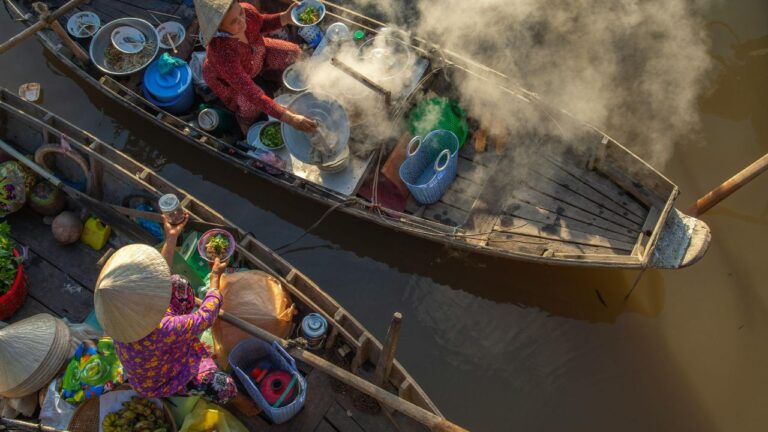
ベトナム料理はフォーやバインミーだけでなく、地域、時間帯、店の専門で選択肢が大きく変わります。20品を全部追うより、北部・中部・南部から一品ずつ、麺・ご飯・軽食を組み合わせると違いが分かりやすくなります。
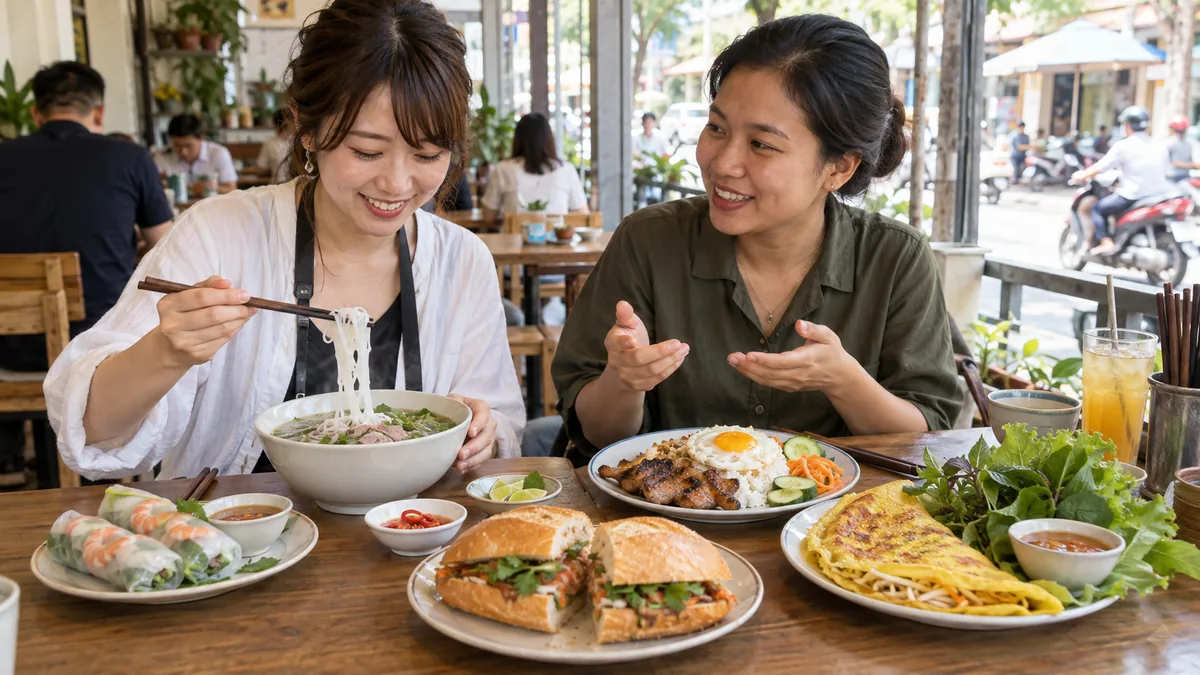
この記事では定番料理を整理しながら、香草、魚醤、甲殻類、ピーナッツ、卵、乳など見落としやすい材料と、日本へ食品を持ち帰るときの検疫条件も補います。苦手食材は「抜ける」と決めつけず、出汁やソースに入っていないか店へ確認してください。
先に結論:初回は3つの軸で選ぶ
- Region:ハノイの穏やかな味、中部の香辛料、南部の甘みを比べる
- Texture:米麺、砕き米、ライスペーパー、もち米から一つずつ試す
- 苦手材料:香草だけでなく、魚醤、エビ、ピーナッツ、卵も確認する
- Bringing it home:肉製品と生果物は買う前に日本の公式検疫条件を見る
Three characteristics of Vietnamese cuisine
Many people vaguely regard Vietnamese cuisine as "somehow healthy," but behind that lie three clear culinary characteristics. Understand these and you'll be able to guess the flavor even of a menu item you're seeing for the first time on the ground.
The diverse noodles and flour dishes born of rice culture
Vietnam is the world's third-largest rice exporter, and its defining trait is an overwhelming number of dishes that use rice. Pho (flat rice noodles), bun (thin rice noodles), hu tieu (southern rice noodles), mi (wheat noodles), banh canh (thick noodles with tapioca) — that's more than 10 kinds of noodles alone. Add rice paper made from rice (banh trang), rice-flour crepes (banh xeo), glutinous rice dishes (xoi) and more, and the variety of flour and rice dishes surpasses even Japan's.
Nuoc mam (fish sauce) is the foundation of the flavor
The source of umami in Vietnamese cuisine is nuoc mam (fish sauce). Milder and sweeter than Thai nam pla, it's used in everything from pho broth to dipping sauces and as a secret ingredient in stir-fries. Phu Quoc Island nuoc mam is known as a particularly high-grade product and is popular as a souvenir too. For detailed brands and uses, seethe nuoc mam guideexplains it too.
Home cooking balanced across the five tastes and five colors
Vietnamese cuisine prizes incorporating the five tastes — sweet, sour, salty, bitter and spicy — and the five colors — red, green, yellow, white and black — into a single meal. The mound of raw vegetables served with pho and the colorful toppings on com tam (rice with mixed toppings) are the result of a conscious effort to balance visual beauty with nutrition. The herbs are covered inthe Vietnamese vegetable guide, which helps you identify the true nature of the leaves that come out locally.
20 essential Vietnamese dishes you can't miss
We introduce, in ranking form, 20 dishes that first-time visitors to Vietnam will definitely want to try on the ground, across three categories: noodle dishes, rice/light meals, and sweets and drinks. We've added a rating of how well each suits the Japanese palate (★1–★5).
7 noodle dishes: standards you'll want to cover beyond just pho
| Dish | Region | Characteristics | Beginner-friendliness |
|---|---|---|---|
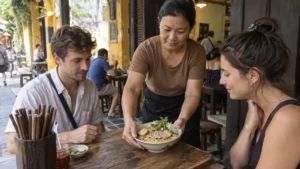
| Pho, the noodle dish that represents Vietnam. Flat noodles made from rice flour are paired with a broth stocked from chicken or beef. | Originated in the north / nationwide | Flat rice noodles in a clear beef-bone or chicken-based broth | ★★★★★ |
| Bun cha (Bún Chả) | Hanoi | Charcoal-grilled pork and rice noodles eaten with a dipping broth | ★★★★★ |
| Bun bo Hue (Bún Bò Huế) | Central Hue | A rich, spicy noodle soup with beef and lemongrass | ★★★★ |
| Hu tieu (Hủ Tiếu) | South | Thin rice noodles in a clear pork-bone-based broth | ★★★★★ |
| Mi Quang (Mì Quảng) | Central Da Nang | Turmeric noodles with a small amount of broth and toppings | ★★★★ |
| Cao lau (Cao Lầu) | Central Hoi An | Udon-like thick noodles with roast pork and crispy fried noodle toppings | ★★★★★ |
| Banh canh (Bánh Canh) | Nationwide | Chewy thick noodles made with tapioca | ★★★★ |
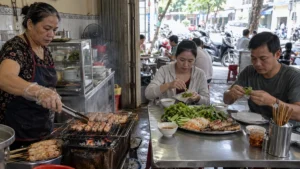
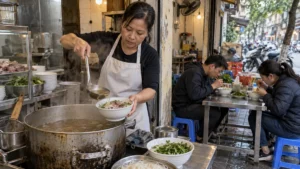
Noodle dishes are the star of Vietnamese cuisine, and the flavor changes greatly by region. Hanoi's pho is thin-cut and light, while Ho Chi Minh's is thick-noodled with a sweeter broth — the same dish can feel like a different thing between north and south.8 great pho spots in Hanoiis also worth referring to.
Noodle dishes are the mainstay from breakfast through lunch, and since many stalls start packing up in the evening, a visit from the morning to early afternoon is the surer bet. When ordering, you can add ingredients (egg = trung / beef balls = bo vien) just by pointing.
7 rice dishes and light meals: the stars of the stalls and eateries
| Dish | Category | Characteristics | Beginner-friendliness |
|---|---|---|---|
| Banh mi (Bánh Mì) | Sandwich | A crisp baguette with meat, vegetables and pate | ★★★★★ |
| Com tam (Cơm Tấm) | Rice | Broken rice with grilled pork and a fried egg | ★★★★★ |
| Xoi (Xôi) | Glutinous rice | Steamed glutinous rice with fillings (both sweet and savory) | ★★★★ |
| Banh xeo (Bánh Xèo) | Crepe | A rice-flour crepe with pork, shrimp and bean sprouts | ★★★★★ |
| Fresh spring rolls (Gỏi Cuốn) | Appetizer | Raw shrimp and vegetables wrapped in rice paper | ★★★★★ |
| Fried spring rolls (Chả Giò/Nem Rán) | Appetizer | Glass noodles and pork wrapped in rice paper and deep-fried | ★★★★★ |
| Cha ca La Vong (Chả Cá Lã Vọng) | Fish dish | Turmeric-flavored white fish stir-fried with dill | ★★★★ |
Fresh spring rolls and fried spring rolls tend to be lumped together as "spring rolls," but in Vietnam they're treated as different things. Fresh spring rolls are an appetizer, while fried spring rolls often come out at more of a main-course level. For detailed history and filling variations, seethe fresh spring rolls explainerandguide to fried spring rollsfor details.
Many places serve rice dishes all day, so com tam works as a go-to for both breakfast and dinner. Banh mi has the freshest fillings at morning stalls, while some shops sell out by late afternoon.
Six sweets and drinks: dessert and café time
| Dish | Category | Characteristics | Beginner-friendliness |
|---|---|---|---|
| Chè | Sweets | A coconut-milk-based dessert similar to sweet soup | ★★★★ |
| Bánh Flan | Sweets | Rich caramel custard served with coffee and ice | ★★★★★ |
| Hoa Quả Dầm | Fruit | A fruit mix tossed with yogurt and condensed milk | ★★★★★ |
| Kem Dừa | Ice cream | Ice cream and nuts served in a coconut shell | ★★★★★ |
| Ca Phe Sua Da (Cà Phê Sữa Đá) | Drinks | Vietnamese iced coffee with condensed milk | ★★★★★ |
| Egg Coffee (Cà Phê Trứng) | Drinks | A Hanoi specialty topped with whipped egg yolk and condensed milk | ★★★★★ |
Sweets and drinks appear during the afternoon tea hour from around 3 p.m. or as an after-dinner dessert. A bowl of chè runs 15,000–30,000 VND (90–180 yen) at a street stall, and for egg coffee, Giang Cafe in Hanoi's Old Quarter (the original spot) is famous. Cà phê sữa đá costs 25,000–40,000 VND (about 150–240 yen) per cup at a local café, rising to 50,000–80,000 VND (300–480 yen) at tourist-area cafés. If you want to bring some home to Japan, see ourVietnamese coffee souvenir guideto compare brands.
Regional differences: North, Central, and South taste completely different
Vietnam is a long, narrow country stretching 1,650 km from north to south, and its climate and food culture vary widely by region. Even the same "phở" can feel like a different dish in the north versus the south. Understanding these regional differences makes it much easier to choose where to eat in the cities you visit. For more, see ourguide to regional Vietnamese cuisineas well.
North (Hanoi): light, salt-based, with Chinese influence
Northern cuisine is light and built on salt and soy sauce, with herbs used sparingly. Chinese influence runs strong, and the focus is on dishes that highlight a delicate broth, such as bún chả, bún bò Nam Bộ, and chả cá Lã Vọng. For street food eaten in Hanoi's Old Quarter, see ourguide to Hanoi street foodand12 spots for a food crawlfor reference.
Central (Hue, Da Nang, Hoi An): spicy and bold, rooted in royal cuisine
Central cuisine is built on the royal cuisine of the former Hue dynasty (the Nguyễn dynasty), marked by complex spicing and bold heat. Dishes unique to Da Nang, Hoi An, and Hue gather here, including bún bò Huế, mì Quảng, and cao lầu. To eat well while staying at a central resort, the standard move is to make the rounds of local eateries in the morning.
South (Ho Chi Minh City, Mekong Delta): sweet, with coconut and French influence
Southern cuisine reflects the hot climate with its characteristically sweet seasoning. It makes heavy use of coconut milk, and the French colonial influence gave rise to crossover dishes like banh mi, chè, and coffee.Ho Chi Minh City dining guideandlocal food at Ho Chi Minh City marketsto check out the best spots.
A resident's view: ingredients Japanese travelers tend to struggle with, and how to handle them
Vietnamese food is often said to suit Japanese palates, but a few ingredients can feel "rough at first." Knowing about them in advance will keep you from stumbling on the ground.
Cilantro (coriander): say "Không rau thơm" when ordering
In Vietnam, dishes are often loaded with cilantro, so if you don't care for it, you can have it left out by saying "Không rau thơm" (khong zau thom = without herbs) when you order. It works even at street stalls, so it's a handy phrase to remember.
Mắm tôm (fermented shrimp paste): brace yourself before trying bún đậu mắm tôm
Mắm tôm is a purple fermented shrimp paste known for its intense aroma. It always comes alongside bún đậu mắm tôm (an assortment of tofu and rice noodles), but the smell can be too strong for first-timers. Mixing in lemon and sugar makes it easier to eat, though if it's not for you, the safe bet is to ask for plain nước mắm instead.
Durian and jackfruit: intensely sweet fruits
The south is famous as a fruit paradise, but durian smells so strong that hotels commonly ban it from the premises, and jackfruit has a distinctive flavor of its own. If you want to try them, the safe approach is to take one bite at a time through a fruit mix (hoa quả dầm).
Unusual and exotic dishes: an authentic experience for the curious
Enough people search "Vietnam food weird stuff" that it's clear Vietnam has plenty of dishes that strike Japanese travelers as unusual. We cover everything from things eaten normally by locals to tourist-oriented experience menus.
Balut (Hột Vịt Lộn): a partially developed duck egg
A dish of boiled duck eggs aged 16–20 days, it's a classic snack costing 10,000–15,000 VND (60–90 yen) per egg at street stalls. It's eaten with lemon salt and rau răm (a Vietnamese herb). High in nutrients, it's long been favored by Vietnamese men as a stamina food.
Thịt Chó (dog meat)
A dog-meat dish eaten in parts of the north. There are specialty restaurants on the outskirts of Hanoi, but consumption has dropped sharply since 2020, especially among younger people, and tourists have no reason to go out of their way to try it. A growing number of people are abstaining on animal-welfare grounds as well.
Snake wine (Rượu Rắn) and fried geckos
Liquor steeped with a whole snake is known as a medicinal spirit and turns up at souvenir shops in the Mekong Delta. Fried geckos are a southern delicacy made by deep-frying small lizards, served only at specialty restaurants. Since bringing them into Japan is difficult on conservation grounds, it's best to limit yourself to photos, or to do your research before deciding whether to eat them.
Traditional dishes for Tet (Lunar New Year)
Some traditional dishes can only be eaten during Tet (Lunar New Year), Vietnam's biggest holiday. If you're traveling in January or February, these are a group of dishes worth knowing in advance.
Bánh Chưng / Bánh Tét
A traditional food of glutinous rice, pork, and mung beans wrapped in leaves and steamed for two full days. The northern bánh chưng is square, while the southern bánh tét is cylindrical, differing in shape by region. During Tet you'll see it everywhere, from homes and markets to convenience stores. It keeps well, and slicing and pan-frying it brings out a different kind of delicious.
Mứt: candied fruits and vegetables
A candied treat served to guests with tea during Tet. Made by simmering coconut, ginger, lotus seeds, jackfruit, and more in syrup, it can be bought as a New Year's souvenir. From late January to early February, many varieties line Hàng Đường street in Hanoi's Old Quarter.
Tips for eating locally: street stalls, water, and food-poisoning precautions
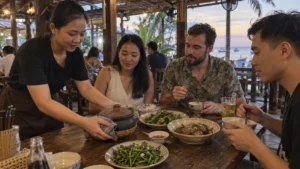
Food crawls are a highlight of any trip to Vietnam, but if you're not careful about choosing stalls and about water, food poisoning can ruin your itinerary. Here are three rules that residents follow.
屋台選びは「加熱・保管・清潔さ」
A stall with a line of locals is likely to have fast ingredient turnover and fresh food. Conversely, avoid empty stalls in tourist areas, since their prep may be old. If you want a drink with ice, the safe choice is a shop that runs bottled water through its ice maker.
Don't drink tap water, and watch out for ice and fruit too
Vietnam's tap water isn't suitable for drinking. So much so that many residents even use mineral water to brush their teeth. For details, see ourguide to tap water safety in Vietnamfor details. Since the ice in fruit smoothies and the water used to wash raw vegetables is often tap water too, those with a sensitive stomach should choose a clean-looking café over a street stall.
Dining etiquette: how to rest your chopsticks and use napkins
Vietnam has customs that differ from Japan, such as the manners for serving shared dishes and the local habit of tossing paper napkins on the floor. For details, see ourcomplete guide to Vietnamese dining etiquettewhere we've put it all together.
How to bring Vietnamese food back to Japan
For those who want to enjoy the flavors they tasted locally back home in Japan, or hand them out as souvenirs, we sort out which foods can be brought back and which can't.
Foods that make easy souvenirs to bring home
- Instant phở and phở kits (lightweight, shelf-stable)
- Vietnamese coffee (ground, beans, or instant)
- Cashews andDried fruit(often individually wrapped)
- Lotus tea and other tea leaves
- Sealed bottles of nước mắm (choose a small plastic bottle)
- Chocolate (craft makers like MAROU)
Foods banned or requiring caution as carry-on or checked baggage
肉・肉製品は、個人消費の少量や加熱加工品でも、輸出国政府の検査証明書がなければ原則として日本へ持ち込めません。ベトナム産の生果物は、マンゴーやドラゴンフルーツなど持ち込めない品目があり、ドリアンなど証明書と入国時検査が必要な品目もあります。100ml超の液体は機内持込不可で、受託手荷物に入れる必要があります。航空会社別の手荷物規定や梱包術はcomplete guide to flights from Japan to Vietnamandsuitcase packing guidefor a detailed explanation.
Tips for recreating Vietnamese dishes at home
The key to recreating authentic flavors in Japan is choosing the right substitutes for seasonings and herbs. We recommend starting with dishes that are easy to recreate.
For beginners: fresh spring rolls and phở
Fresh spring rolls just need rice paper, shrimp, leaf lettuce, cilantro, and rice noodles. You can also substitute the nước mắm-based dipping sauce with fish sauce, sugar, lemon juice, and water. With an instant phở kit, you can recreate an authentic flavor in 10 minutes. For the detailed process, see ourfresh spring roll recipefor details.
For intermediate cooks: bánh xèo and bún chả
For bánh xèo, you make a crepe batter from rice flour, coconut milk, and turmeric, then fill it with bean sprouts, pork, and shrimp before frying. Bún chả pairs charcoal-grilled pork with a dipping sauce, and at home you can recreate it on a grill.
For the serious cook: learn at a local cooking class
If you want to learn authentic cooking techniques and how to use the ingredients, we recommend joining a cooking class held in Hanoi, Ho Chi Minh City, or Hoi An.Vietnamese cooking class guideto compare popular options.
Summary: cover everything from the 20 classics to regional differences and Tet dishes
Vietnamese food is a vast world you can enjoy in depth, starting with the 20 classics and moving on to regional differences, Tet dishes, and delicacies. Because the flavor profiles differ across north, central, and south, an itinerary that visits several cities makes the same dish worth tasting side by side. As long as you keep the street-stall and water precautions in mind, eating your way through the country can be a highlight of the trip. When bringing souvenirs back to Japan, checking the carry-on and checked-baggage rules and plant quarantine in advance will give you peace of mind.
If you want to cover everything from booking your Vietnam trip to sightseeing on the ground, see ourcomplete flight guide・10 recommended cities・cost-of-living guideas well.
Frequently asked questions
What is the most famous food in Vietnam?
The most famous is phở (rice noodle soup), followed by banh mi (sandwiches), fresh spring rolls (gỏi cuốn), fried spring rolls (chả giò / nem rán), and bún chả. First-timers can't go wrong starting with these five.
Is Vietnamese food spicy?
It depends on the dish. Northern cuisine is light and lightly salted with little heat, central cuisine (especially Hue) is hot with plenty of chili, and southern cuisine is sweet. If you don't handle heat well, we recommend starting with northern dishes, and in most cases you can adjust the spice level by adding more.
Which Vietnamese foods are banned or restricted for bringing into Japan?
大きく3つに分かれます。【動物検疫=原則禁止】生鮮肉類および加工品(豚・牛・鶏のジャーキー・ソーセージ含む)。【植物検疫】マンゴー・ドラゴンフルーツなど持ち込めない生果物と、ドリアンなど検査証明書・入国時検査が必要な品目があります。品目別に植物防疫所のベトナム向け一覧を確認してください。【機内持込不可=受託手荷物のみ可】100ml超の液体(ヌクマム・コンデンスミルク・ココナッツオイル等)。茶葉は植物検疫なしで持ち込めると案内されていますが、コーヒー豆、ナッツ、菓子は加工状態と原材料で条件が変わるため、購入前に公式情報を確認してください。
Does Vietnamese food suit Japanese tastes?
Many dishes are based on rice and fish sauce, giving them a flavor that suits Japanese palates well. Phở, banh mi, fresh spring rolls, com tam, and chả cá Lã Vọng rate a five-star ★★★★★ for beginner-friendliness, and most dishes can be eaten without any sense of unfamiliarity even on your first try. Some ingredients like cilantro and mắm tôm have a strong aroma, but you can avoid them by saying "no herbs (Không rau thơm)" when you order.
How much does Vietnamese food cost?
As a rough guide, a bowl of phở at a street stall is 40,000–70,000 VND (about 240–420 yen), banh mi is 20,000–50,000 VND (about 120–300 yen), and a set meal at a local restaurant is 50,000–100,000 VND (about 300–600 yen). Restaurants in tourist areas run two to three times higher.
What happens with meals if you travel during the Vietnamese Lunar New Year (Tet)?
During Tet, locals return to their hometowns, so many local eateries and street stalls close. Restaurants and hotels catering to tourists stay open, but with options greatly reduced, advance reservations are essential. On the upside, this is the only time you can enjoy Tet-only dishes like bánh chưng and mứt.
まとめ:料理名より、地域と材料で選ぶ
初日はフォーやバインミーなど構成が分かりやすい料理から始め、次に地域料理へ進むと味の違いを楽しめます。アレルギーがある場合は、見える具だけでなく出汁、たれ、トッピングまで確認してください。
食品を日本へ持ち帰るときは、空港で売っているかではなく、動物検疫所・植物防疫所の品目別条件で判断します。特に肉製品と生果物は、購入前に持込可否を確認するのが確実です。