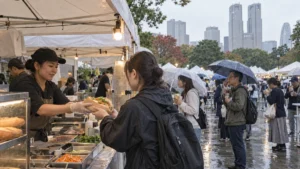
A line formed for coffee at a shopping mall in Garland, Texas. The people waiting weren't only Vietnamese-American residents. On August 9, 2026, Trung Nguyên, Vietnam's largest coffee company, opened a new store under its franchise brand "Trung Nguyên E-Coffee," and Vietnamese business outlet CafeF reported a busy storefront from day one. A small queue at a café on the other side of the Pacific is a clear snapshot of how Vietnamese coffee is being received abroad right now. Anyone who has come to know Vietnamese coffee through travel or living in the country will find this development worth watching.
A line formed outside the Garland, Texas storefront from opening day
The new store's address is 3419 West Walnut Street, Suite 106, Garland, Texas. Garland, near Dallas, is known as a city with a large Vietnamese-American population and many Vietnamese-owned businesses. According to CafeF's reporting, people lined up outside the store on opening day, drawn by curiosity to try Vietnamese coffee. Store listing services show the location first soft-opened in early July, with August 9 marking its full grand opening.
Trung Nguyên explains the choice of Garland as a location by pointing to its established Vietnamese-American community. For local Vietnamese residents, it's the taste of home; for everyone else, it's a first cup. The store is designed to reach both groups at once. Using an immigrant community as a foothold before expanding to the broader local customer base echoes the path Japanese ramen and Thai food took to becoming established abroad.
The "Coffee King": Trung Nguyên's goal of 3,000 stores worldwide
Trung Nguyên was founded in 1996 by Đặng Lê Nguyên Vũ in Buon Ma Thuot, the highland city in Vietnam's Central Highlands. Known in Vietnam as the "Coffee King," he now oversees a group that includes the flagship café chain Trung Nguyên Legend, the low-cost franchise Trung Nguyên E-Coffee, and the instant coffee brand G7. The brand operates in more than 60 countries and territories.
The scale of the expansion shows up in the numbers. According to the company's own announcements, the E-Coffee franchise network topped 800 stores worldwide by mid-2025, with 1,000 contracts signed, and was adding roughly 30 stores a month. It entered the U.S. market in California in February 2025 and, including the Carrollton, Texas location that opened in June 2025, had grown to 6 U.S. stores by mid-year. In March 2026, it opened a large flagship space called "World Coffee" in Houston. The stated targets are 100 stores in the U.S., 1,000 in China, and 3,000 worldwide. The line in Garland is one moment within that long-term plan.
| Item | Details | As of / source |
|---|---|---|
| New store location | Garland, Texas, U.S. (3419 W Walnut St, Suite 106) | CafeF(2026/8/10) |
| Grand opening | August 9, 2026 (soft opening in early July) | CafeF / store listing |
| Countries/territories of operation | Over 60 | CafeF |
| Franchise network | Over 800 stores worldwide, 1,000 contracts signed (adding about 30 stores a month) | Company announcement (mid-2025) |
| Store target | 100 stores in the U.S. / 1,000 in China / 3,000 worldwide | Company announcement |
Why start with America's Vietnamese neighborhoods?
Garland and its surrounding area are one of the so-called "Little Saigon"-type Vietnamese-American enclaves. The U.S. has large Vietnamese communities centered on California and Texas, where demand for the taste of home already exists. Starting there means there's no need to explain the flavor from scratch, and word of mouth spreads more easily. It's no coincidence that Trung Nguyên's U.S. expansion is concentrated in California and Texas—it's a deliberate move aligned with that population distribution.
This strategy has two stages. The first is building on the support of the diaspora community. The second is getting non-Vietnamese local customers who show up there to experience "a strong, sweet Vietnamese-style cup" and to recognize it as a category apart from Starbucks or local third-wave coffee shops. For the low-cost E-Coffee format, which has survived fierce price competition inside Vietnam, the higher price points of the U.S. market are also attractive from a margin standpoint. The real test isn't the opening-day line itself, but how many of those customers come back for a second and third cup.
What's really in the "strong cup" Americans lined up for
Vietnamese coffee's distinct presence abroad comes down to the bean and the brewing method. Vietnam is the world's second-largest coffee exporter, and its main crop is robusta, known for its strong bitterness and body. It's brewed with a darker roast, dripped drop by drop through a metal filter called a phin, and drunk with condensed milk added. This combination of richness and sweetness stands in contrast to the acidity-focused specialty coffee scene, and it leaves a strong impression on first-timers. That's the taste the people lining up in Garland were experiencing. If you want to know more about the types of Vietnamese coffee and how it's brewed,our guide to enjoying authentic Vietnamese coffeeexplains the differences between the types.
Trung Nguyên's strength lies in turning this flavor into something people can take home. The flagship Trung Nguyên Legend serves a cup brewed with a phin, while G7 sticks turn that same taste into something for the home or a gift. Because the café experience and the instant product line connect directly, the taste travelers drink on a trip can be recreated after they get home, which builds attachment to the brand. Overseas stores work as a device for multiplying that entry point around the world.
Three ways to enjoy authentic Trung Nguyên in Japan
The Texas story may sound far away, but it's close to home for people living in Japan too. There are broadly three entry points to trying the real thing.
- Visit a flagship store locally: If you get the chance to travel to Vietnam, have a cup of phin coffee at a Trung Nguyên Legend location. For the history and menu highlights, seeour complete guide to Trung Nguyên Legend.
- Bring some home as a souvenir: Pick up a box of G7 at a local supermarket or the airport. According to our earlier coverage, a 20-stick box of G7 3-in-1 costs around 260 yen—affordable, lightweight, and easy to hand out.
- Order it through Japanese online retailers: Even without traveling, G7 and other Trung Nguyên instant coffees are available through online stores in Japan. For help choosing a brand, seeour recommendations for Vietnamese coffee available through Japanese online retailersas a starting point.
As a price guide, the yen conversions in this article use rates as of August 2026: roughly 1 US dollar to 148 yen and 10,000 dong to about 60 yen. A cup of phin coffee at a local Vietnamese café runs to tens of thousands of dong, and even a large box of G7 from a Japanese online retailer can be found for a few hundred yen—the real thing is closer than you might think.
What's left once the line is gone
One store in Garland isn't major news on its own; it's a snapshot of Vietnamese coffee moving from immigrant food culture toward a spot on the world's café menu. Whether Trung Nguyên's stated goal of 3,000 stores worldwide becomes reality doesn't depend on the opening-day line—it depends on how many customers come back for a second or third cup. The next time you visit Vietnam, or stand in front of the shelf at your neighborhood Asian grocery store, remember the drip of a phin filter and a stick of G7. The same taste people lined up for in Texas can end up in your everyday cup.
Sources
- CafeF, “Cảnh tượng tại quán cà phê ở Mỹ của ông Đặng Lê Nguyên Vũ” (August 10, 2026)
https://cafef.vn/canh-tuong-tai-quan-ca-phe-o-my-cua-ong-dang-le-nguyen-vu-188260810100849941.chn - Trung Nguyên Legend official, “Trung Nguyên E-Coffee Continues Strong Expansion in the U.S.”
https://trungnguyenlegend.com/trung-nguyen-e-coffee-continues-strong-expansion-in-the-us/?lang=en