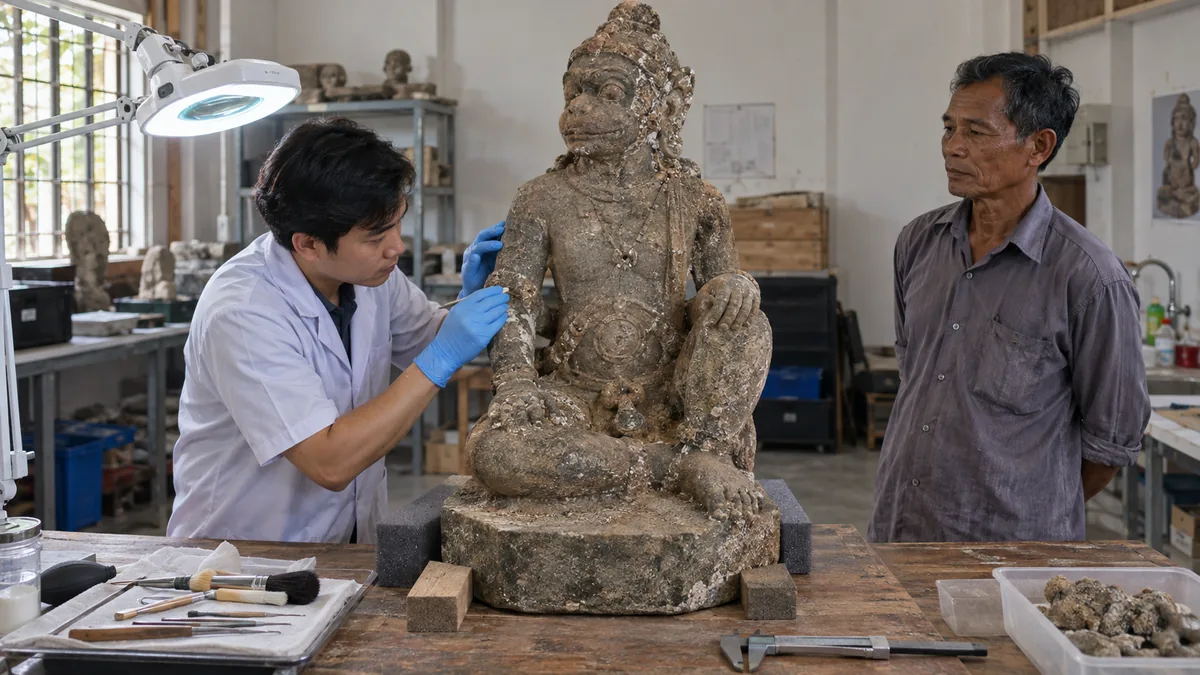
A man in the sea off Quang Ngai Province in central Vietnam pulled up a stone statue buried in the sand. It is a seated figure of Hanuman, the monkey deity of Hinduism, standing 84 centimetres tall and weighing approximately 150 kilograms. Among those who came to see it, one person offered 2 billion dong (approximately 12 million yen) to buy it, but the man refused and handed it over to the provincial museum in 2023. On 27 September 2026, the Quang Ngai Department of Culture, Sports and Tourism announced that the Chairman of the Provincial People's Committee had decided to issue the man a certificate of merit. What makes this story interesting for Japanese travellers to Vietnam is not the size of the sum. It is the fact that this is a country where a Hindu deity carved in the 11th or 12th century can still emerge from the seabed between fishing trips. And the statue that emerges ends up in a museum town that visitors can actually go to.
The yen conversions in this article are calculated at 1 dong = approximately 0.0061 yen as of 28 September 2026 (10,000 dong = approximately 61 yen), and all figures are approximate. In Vietnamese currency units, tỷ equals 1 billion and triệu equals 1 million.
A stone statue pulled from the sea was offered 2 billion dong
According to a report by Thanh Nien on 27 September 2026, the Quang Ngai Department of Culture, Sports and Tourism announced that the Chairman of the Provincial People's Committee had issued a decision to present a certificate of merit to Duong Dinh Luc for discovering and handing over the Hanuman statue, an antique. The paper describes Luc as 66 years old and a resident of Van Tuong Commune, Quang Ngai Province. VnExpress gives the same person's age as 65, and the figure differs depending on the outlet.
Prior to this, the Ministry of Culture, Sports and Tourism had decided to award Luc a cash reward. The amount is 92,870,000 dong (approximately 570,000 yen); according to VnExpress, the decision was signed on 16 September by Vice Minister Hoang Dao Cuong. Thanh Nien rounds this to "nearly 93 million dong" and reports that the provincial Department of Culture, Sports and Tourism has been asked to make the payment within 2026. In other words, the current moment sees two separate developments overlapping: a certificate of merit from the province, and a cash reward from the central government spanning provincial boundaries.
The story of someone offering to buy the statue takes on a different meaning when placed alongside the reward figure. Against the offered price of 2 billion dong, the state reward is 92,870,000 dong — roughly 4.6% of the offer, or put another way, the offer was 21.5 times the reward. That said, the reward is not calculated by applying a flat rate to the object's value; the methodology is examined later. The reason reported for Luc's refusal to sell is not the money but the fact that he considered the statue to be something sacred.
What happened between the 2021 discovery and the 2026 commendation
The story spans more than five years. In early 2021, when Luc went fishing at a place called Vung Buong in the Dung Quat sea, he noticed several broken ceramic shards lying on the bottom. Curious, he dived to a point 3 to 4 metres deep and about 50 metres from shore, where he found part of a stone statue protruding from a layer of sand. He raised it in March of that year, working with relatives and hiring a crane truck to transport it to his home. The statue weighed approximately 150 kilograms, and the operation is said to have been laborious.
| Period | Event |
|---|---|
| Early 2021 | Discovers ceramic shards while fishing at Vung Buong off Dung Quat. Spots part of a stone statue at a depth of 3–4 m, approximately 50 m from shore |
| March 2021 | Raises the statue with relatives; hires a crane truck to transport it home |
| What came next | Visitors come to see it; one person offers 2 billion dong to purchase it. Luc refuses to sell |
| 2023 | Following approaches from the authorities, hands the statue over to the Quang Ngai General Museum for preservation |
| August 2025 | Vice Chairman of the Provincial People's Committee Nguyen Ngoc Sam signs a decision establishing state ownership. The museum takes charge of reception and storage |
| September 16, 2026 | Ministry of Culture, Sports and Tourism decides to award a cash reward of 92,870,000 dong (VnExpress) |
| 27 September 2026 | Provincial Department of Culture, Sports and Tourism announces the Provincial People's Committee Chairman's decision to issue a certificate of merit |
Two years passed from the raising to the handover, another two years from the handover to the establishment of ownership, and a further year to the reward and commendation. The timeline shows directly how long it takes for something found on the seabed to become part of a museum collection.
Why was a Hindu monkey deity on the seabed off central Vietnam?
Hanuman is a Hindu deity depicted in the form of a monkey. In the epic Ramayana, he serves the hero Rama and plays a major role in the search for the abducted consort Sita. He has long been an object of veneration across South and Southeast Asia, but present-day central Vietnam is a region where Buddhism and indigenous beliefs run deep, and some people may find it surprising to hear that a Hindu deity's statue has emerged from the sea there.
What resolves that surprise isChampa. This was a kingdom that flourished across central and southern Vietnam, embraced Hinduism and later came under Islamic influence as well. Scholars differ on how to define its period of existence; some frameworks place it from around 192 CE to its annexation in 1832. The database of the Vietnam National Administration of Tourism records the period of Cham culture in Quang Ngai as the 2nd through 14th centuries. Either way, the central region was part of the Hindu world for far longer than the name "Vietnam" might suggest.
Regarding the statue itself, the Quang Ngai General Museum established an appraisal committee to evaluate it. The material is fine-grained sandstone; of the total height of 84 centimetres, 14 centimetres form an octagonal stone base and 70 centimetres make up the body. The figure is in a seated posture. VnExpress reports the appraisal findings as identifying a round head, protruding eyes, a high nose bridge and a wide mouth, along with circular motifs around the abdomen and tassel-like ornaments, placing it in the late style of Cham sculpture with influence from Khmer art.
On the question of how it entered the sea, Thanh Nien cites researchers as raising the possibility that it originated from the ruins of the Chanh Lo Tower, a Cham site in Quang Ngai. One point worth noting here is the description of the excavation year. Both Thanh Nien and Tuoi Tre give 1927 as the year hundreds of Cham sculptures were excavated from Chanh Lo Tower. However, a feature article published by the same Thanh Nien in 2023 states that French architect and archaeologist Henri Parmentier excavated the site in 1904, that the Vietnam Institute of Archaeology conducted a follow-up survey in 1998, and that the number of artefacts recovered was close to 100. Neither the year nor the count matches. Artefacts from Chanh Lo Tower are displayed in a Quang Ngai room at the Museum of Cham Sculpture in Da Nang, with some also held at the Quang Ngai General Museum.
A separate clue has emerged regarding when it entered the sea. Dang Chi reports that, as analysis results announced by the provincial Department of Culture, Sports and Tourism on 23 September 2026, radiocarbon dating of bivalves and oysters attached to the statue estimated that it fell into the sea sometime between the late 19th and early 20th century. Even if it was carved in the 11th or 12th century, it was not on the seabed the entire time. The sequence is that something which had stood somewhere on land entered the sea roughly a hundred years ago. The broken ceramic shards scattered around the recovery site are also consistent with this reading.
How many years of local income does 2 billion dong represent?
The figure of 2 billion dong sounds, to Japanese ears, like the price of a house. Placed against Vietnamese statistics, it carries somewhat more weight. In the 2025 Living Standards Survey conducted by Vietnam's statistical authority covering approximately 47,000 households nationwide, monthly income per capita was 6 million dong (approximately 37,000 yen), up 10.9% from the previous year. Urban areas were close to 7.4 million dong and rural areas close to 5.2 million dong.
| Comparison | Amount (dong) | Approximate yen conversion | Relationship to 2 billion dong |
|---|---|---|---|
| Offered purchase price | 2 billion | Approx. 12 million yen | ― |
| State cash reward | 92,870,000 | Approx. 570,000 yen | Approx. 4.6% of the offered price |
| Value implied by the reward calculation basis (VnExpress) | Approx. 2,337,000,000 | Approx. ¥14,260,000 | Approx. 1.17× the offered amount |
| National per-capita monthly income (2025) | 6,000,000 | Approx. ¥37,000 | Approx. 28 years' worth |
| Rural per-capita monthly income (2025) | Nearly 5,200,000 | Approx. ¥32,000 | Approx. 32 years' worth |
A quick check of the figures: tỷ means one billion, so 2 tỷ is 2,000,000,000 dong; triệu means one million, so 92.87 triệu is 92,870,000 dong. Dividing 2,000,000,000 dong by a monthly 6,000,000 dong gives roughly 333 months, or about 28 years. Divided by the rural figure, it comes to about 32 years. That said, the 6,000,000 dong figure is per-capita household income, not the wage of a single earner. Children and non-working members are included in the denominator, and the figure encompasses income from farming, trade, and benefits. Van Thuong commune is a coastal settlement adjacent to the Dung Quat industrial zone, but income data at the commune level does not exist, nor does the figure reflect Luc's personal circumstances. Even so, it conveys that 2,000,000,000 dong is not an amount that ordinarily passes through an individual's hands. The decision to turn it down on the grounds that the statue was something spiritual is what this story is about.
There is also a logic behind the seemingly odd figure of 92,870,000 dong. According to VnExpress and Dan Tri, the reward for someone who discovers and voluntarily surrenders an object is calculated under Article 94 of Decree 77/2025/NĐ-CP not by applying a flat rate to the asset's value, but by applying progressively lower rates to successive tiers: 30% on the first 10,000,000 dong, 15% on the next 90,000,000 dong, 7% on the portion from 100,000,000 to 1,000,000,000 dong, 1% on the portion from 1,000,000,000 to 10,000,000,000 dong, and 0.5% on anything above 10,000,000,000 dong — all before income tax. VnExpress applied this formula in reverse to 92,870,000 dong and calculated that the value of the statue used as the basis for the reward would be approximately 2,337,000,000 dong (approx. ¥14,260,000). As a result, the figure the authorities placed at the base of their calculation is higher than the 2,000,000,000 dong that Luc turned down.
The sources for these figures should be noted clearly. The income data come from Vietnam's 2025 Living Standards Survey conducted by the statistical authorities, and all monetary amounts are values as reported in the press. The 2,337,000,000 dong figure is not an officially published appraisal; it is a number back-calculated by VnExpress from the reward amount. The 2,000,000,000 dong figure is reported as an offered price stated by an individual.
Appraisal dates the statue to the 11th–12th century; a researcher puts it at 800 years old
Reports vary on the age of the statue. VnExpress and Tuoi Tre cited appraisal findings placing it in the 11th–12th century. Thanh Nien, on the other hand, reported a cultural researcher in Quang Ngai as saying the statue holds historical value spanning approximately 800 years and is connected to the flow of regional history within the Champa–Dai Viet cultural sphere. Counting back 800 years from 2026 gives the 13th century, which does not align with the 11th–12th century. However, if the statue dates to the late 12th century, that is roughly 830 years ago, so "approximately 800 years" could be read as a rounded figure. Rather than two conflicting theories, the difference is better understood as a matter of precision. The Quang Ngai People's Committee's decision establishing ownership, issued in August 2025, also records the age as approximately 800 years. Visitors reading information panels on site should be aware that dates assigned to Cham sculpture are often given as a range.
Two further points highlighted by researchers are the statue's condition and size. The statue found in Quang Ngai is large and has survived intact, and is said to hold special value as material for comparative study of Cham sculpture. The same researcher is also quoted as describing it as a relic of Cham culture that bears the characteristics of Cham stone carving while depicting subject matter connected to a religion influenced by India.
The authorities' response can also be read as one kind of reaction. The provincial People's Committee issued a decision establishing ownership by all the people and entrusted receipt and storage to the Quang Ngai Provincial General Museum. Luc himself, for his part, offered only the word "spiritual" to explain why he did not sell. In a photo he provided to VnExpress, the statue is shown placed on a rock in a pond at his home — kept and venerated as something sacred. On Ly Son Island, also in Quang Ngai Province, there isa 22-metre whale skeleton that fishermen have long veneratedThe practice of venerating things that come up from the sea does exist along this coast, but neither Luc nor the press reports suggest that his decision stemmed from that tradition.
Where travelers can see Cham sculpture
For those who read this story and want to see Cham sculpture in person, the options that fit into an itinerary are limited. Only confirmed information is listed here.
| Location | Location | Opening hours & admission |
|---|---|---|
| Museum of Cham Sculpture | 2 Thang 9 Street, Da Nang | Official website lists daily hours 7:00–17:00; admission 60,000 dong (approx. ¥370) per person |
| My Son Sanctuary (UNESCO World Heritage Site) | Formerly Quang Nam Province; from July 2025, Da Nang City | Official website price list: foreigners 150,000 dong (approx. ¥920), Vietnamese 100,000 dong (approx. ¥610). Includes admission and service charge |
| Quang Ngai Provincial General Museum | 99 Le Trung Dinh Street, Quang Ngai City | Established 1989; collection of over 15,000 items. Call ahead to confirm opening hours: 0255 382 3849 |
| Po Nagar Towers | Nha Trang, Khanh Hoa Province | Official admission prices and hours could not be confirmed; check on-site notices |
| Hoa Lai Towers | Ba Thap hamlet, Thuan Bac commune, Khanh Hoa Province (formerly Ninh Thuan Province) | Along National Highway 1. Special National Monument. Confirm admission and hours on site |
The Hanuman statue itself has been received and is being kept by the Quang Ngai Provincial General Museum, but the press coverage did not confirm whether it is currently on permanent display. Anyone making a trip specifically to see the statue should call the museum in advance to check.
For those who want to see a broad collection of Cham sculpture in one place, the Museum of Cham Sculpture in Da Nang is the natural starting point. Artifacts from Chanh Lo Tower are displayed in a room dedicated to Quang Ngai, so visitors can see sculpture from the same lineage as the statue in this story. Da Nang itself isa city that made Lonely Planet's 2027 edition top-50 listand My Son Sanctuary is within day-trip range from there. Following the administrative reorganization of July 2025, the former Quang Nam Province was merged into Da Nang City, so the listed location of My Son has changed from "Quang Nam Province" to "Da Nang City" — a detail that can cause confusion when searching for accommodation or tours.
High-speed railway route overlaps with Cham tower protected zone
The story of this statue is not an isolated incident. The question of how far to protect Cham heritage sites is now directly confronting infrastructure planning in Vietnam in 2026.
The situation around Hoa Lai Towers is one example. The towers are a group of three structures believed to have been built in the 8th–9th century, during the early Panduranga period, and stand along National Highway 1. According to the Department of Cultural Heritage, Protection Zone I covers 14,871.7 square metres and Protection Zone II covers 34,423.2 square metres, totalling approximately 49,300 square metres (about 4.9 hectares). The site was designated a Special National Monument by Prime Ministerial Decision No. 2499 on 22 December 2016. However, it emerged that the planned route of the North–South High-Speed Railway overlaps with part of Protection Zone II, and in June 2026 the Khanh Hoa Provincial People's Committee called on the central government and relevant ministries to reroute the line entirely outside Protection Zone II. The province's proposed solution was not to shift the route eastward but to move it westward, closer to the existing National Highway 1 corridor.
The regulatory framework has also changed. The Law on Cultural Heritage 2024 (No. 45/2024/QH15), which came into force on 1 July 2025, stipulates that cultural heritage found underground or underwater within Vietnam's land territory, islands, internal waters, and maritime zones is owned by all the people. Antiquities under all-people ownership cannot have their ownership transferred through sale, exchange, gift, or similar means. The provincial decision establishing ownership of the statue was issued in August 2025, immediately after the new law took effect. The legal basis for the reward is reported to be Article 94 of Decree 77/2025/NĐ-CP, which sets out the authority and procedures for establishing ownership of state assets. The tiered, declining-rate calculation method derives from that article.
Reading the reward as merely about 4.6% of the offered price does not tell the whole story. Working back through the tiered formula, the value the authorities placed at the base of their calculation is approximately 2,337,000,000 dong — higher than the 2,000,000,000 dong that was turned down. Yet the amount received is 92,870,000 dong. The system is designed so that the higher the recognized value, the lower the proportion paid out; the rate drops to 1% for the portion above 1,000,000,000 dong. The framework holds that objects found on the seabed or underground belong to the state, and those who surrender them receive a reward. Even so, a gap in amounts remains. How to bridge that gap is a challenge Vietnam's museums and authorities will continue to face. Tien Phong also reported that the certificate of commendation came with a cash prize from the provincial commendation fund, so the recognition was not purely symbolic.
Getting to Quang Ngai: no tour packages; travel south by train or road
Quang Ngai is a destination for which almost no tour products aimed at Japanese travelers exist. Getting there means heading south from Da Nang or Hoi An, and Quang Ngai City is a stop on the North–South railway line. The airport closest to the Dung Quat area is Chu Lai Airport, which administratively became part of Da Nang City following the July 2025 reorganization. Van Thuong commune is a coastal area adjacent to the Dung Quat industrial zone and has not been developed as a tourist destination. Rather than making the sea where the statue was found the goal, a more practical approach is to plan around the Quang Ngai Provincial General Museum in Quang Ngai City.
The administrative reorganization also affects how itineraries are structured. Quang Ngai Province merged with Kon Tum Province on 1 July 2025, meaning the new province now stretches from the coast to the Central Highlands in a single administrative unit. Mang Den, on the highlands side, is now within the same province, andtea fields where purple mua flowers bloomreach their peak in September. The ability to connect coastal Cham sculpture with highland scenery within a single province is a side effect of this reorganization. Ly Son Island, off the Quang Ngai coast, also belongs to the same province.
It is also worth having a sense of costs. The Museum of Cham Sculpture charges 60,000 dong (approx. ¥370), and the foreigner admission at My Son Sanctuary is 150,000 dong (approx. ¥920) — light compared with museums and heritage sites in Japan. Travel time, however, is considerable. A day to visit My Son from Da Nang and a separate day to travel down to Quang Ngai should be budgeted independently.
Planning your next Central Vietnam trip: where to begin
What travelers can take away from this story is the fact that Cham artifacts not yet known to the world remain beneath the sea and ground along central Vietnam's coast. A 84-centimetre divine statue lay buried at a depth of 3–4 metres, about 50 metres from shore, and caught the eye of someone who had come to fish. Knowing you are walking through a place with that kind of density changes how the displays in a museum look.
For building an itinerary, working from north to south is the most natural approach. Add a morning at the Museum of Cham Sculpture to a Da Nang stay. The official website lists opening from 7:00, so arriving early means fewer crowds. Seek out the Quang Ngai room to find artifacts from Chanh Lo Tower, the site named in connection with this statue. My Son Sanctuary warrants a full day of its own. Since its listed location has changed to Da Nang City, try searching under the old Quang Nam Province name as well when looking for tours. If extending the trip to Quang Ngai, call the Provincial General Museum in advance to ask about the display status of the Hanuman statue — the number is 0255 382 3849 — to avoid making the journey and finding it unavailable.
It is also worth remembering that Luc's decision came in two stages. He turned down 2,000,000,000 dong not because the object was a cultural artifact, but because he felt the statue had a spiritual presence. He parted with it two years later, after being approached by the authorities. This was not a story where regulations led the way. The sense that something risen from the sea should be treated as sacred came first, and the procedures for reward and commendation were layered on top of that. Standing before a Cham stone statue in a Central Vietnam museum and recalling that sequence may change, just slightly, how the stone behind the glass appears.
Sources
- Thanh Niên・Người vớt tượng thần khỉ Hanuman giao nộp bảo tàng được tặng bằng khen
- VnExpress・Người giao nộp tượng thần khỉ Champa được thưởng gần 93 triệu đồng
- Tuổi Trẻ・Thưởng gần 93 triệu cho người vớt, giao nộp tượng thần khỉ Hanuman ở Quảng Ngãi
- Museum of Cham Sculpture (Da Nang) — official website
- My Son World Cultural Heritage Site — official website & admission fees
- Vietnam National Administration of Tourism database — Quang Ngai Provincial General Museum
- Vietnam Department of Cultural Heritage — Hoa Lai Towers
- Thể thao & Văn hóa・Kiến nghị điều chỉnh hướng tuyến để bảo vệ di tích quốc gia đặc biệt tháp Hòa Lai
- Đại biểu Nhân dân・Thu nhập bình quân của người Việt đạt 6 triệu đồng/tháng
- Luật Di sản văn hóa 2024 số 45/2024/QH15 (full text)
- Thanh Nien — Tháp Chánh Lộ và những câu hỏi còn bỏ ngỏ (Parmentier excavation, 1904)
- Dân trí・Lão nông nộp cổ vật được thưởng, tượng rơi xuống biển khoảng 100 năm trước
- Tiền Phong・Người giao nộp tượng thần khỉ ở Quảng Ngãi vừa được thưởng tiền, vừa nhận bằng khen