Ho Chi Minh City Decision 73/2026/QĐ-UBND takes effect on 1 October 2026. The substance is that shops selling paid internet access are permitted to operate daily from 8:00 to 22:00—but this does not mean the hours themselves are changing on 1 October. The former Ho Chi Minh City had already established the same 8:00–22:00 window under Decision 46/2015/QĐ-UBND from 2015. What is changing is the scope of application: following the administrative reorganization of July 2025, which brought areas of the former Binh Duong Province and the former Ba Ria–Vung Tau Province into the city, the entire city is now consolidated under a single regulation. The businesses covered are internet agencies and public internet access points that do not provide electronic gaming services. Places such as hotels, restaurants, airports, bus terminals, and cafés that offer Wi-Fi free of charge without gaming facilities may follow their own operating hours—a distinction that was established at the same time. For both residents and business travelers, the practical effect is that the option of renting a computer on the street late at night is unavailable anywhere in the city. And this is a separate matter from the regulations that apply to gaming shops, and separate again from the treatment of venues offering free Wi-Fi.
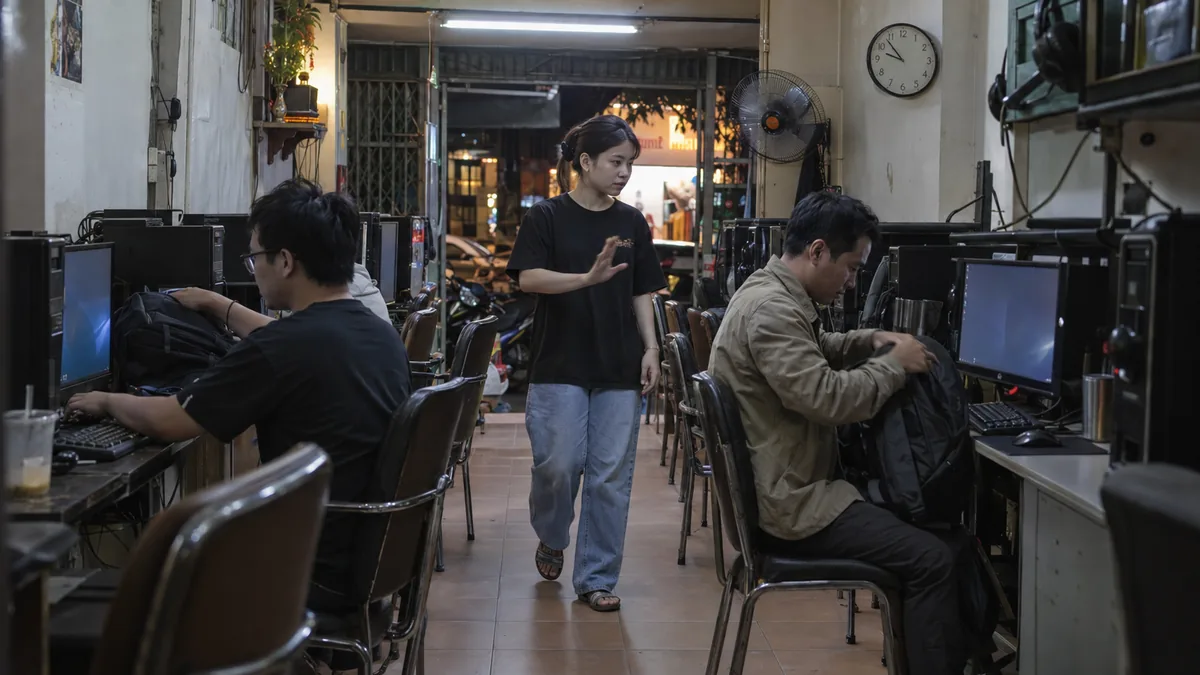
Which shops in Ho Chi Minh City cannot open after 22:00 from 1 October onward
The text of Decision 73/2026/QĐ-UBND is brief. "Internet agencies (đại lý Internet)" and "public internet access points (điểm truy nhập Internet công cộng)" within the city that do not provide electronic gaming services are permitted to operate daily from 8:00 to 22:00. Businesses subject to the decision must post their opening and closing hours at the premises. Implementation is led by the Department of Science and Technology (Sở Khoa học và Công nghệ) in coordination with relevant departments. The effective date is 1 October. This matches what the Ho Chi Minh City Press Center presented in its press summary dated 28 September. The reason it was issued now is explained in the draft rationale published by the city's Department of Science and Technology. When administrative units are merged, the regulations of the merged units retain effect only within their original areas. Ho Chi Minh City was left with Decision 46/2015 from the former Ho Chi Minh City, Decision 02/2019 from the former Binh Duong Province, and Decisions 25/2014 and 25/2015 from the former Ba Ria–Vung Tau Province all coexisting. All of them set the same 8:00–22:00 window, and Decision 73/2026 consolidates these four instruments into a single regulation covering the entire city.
In Vietnamese legal terminology, what Japanese speakers might call a "net café" falls into three distinct categories. An internet agency is an establishment that has a dealer agreement with an ISP and provides paid internet access. A public internet access point is an access point located in a public place such as a hotel, restaurant, airport, port, bus terminal, or café; under Article 5, Paragraph 3 of Decree 147/2024/NĐ-CP, no agency registration is required if no fee is charged, but if a fee is charged, the establishment is treated as an agency. A shop that lets customers play online games falls into a third category—"public electronic gaming service provider (điểm cung cấp dịch vụ trò chơi điện tử công cộng)"—and is outside the scope of the current decision. Being outside the scope does not mean it is unregulated; it means nationwide regulations already apply to that category.
Gaming shops and internet agencies are governed by different underlying legislation
Shops known colloquially in Vietnamese cities as "tiệm net" or "quán net" are often gaming venues. However, these are informal names and do not determine legal classification. Article 68, Paragraph 8 of Decree 147/2024/NĐ-CP, as reported by the state-run Nhan Dan newspaper among others, prohibits public electronic gaming service providers from operating between 22:00 and 8:00 the following morning; that decree itself took effect on 25 December 2024. Late-night operation of gaming shops is closed off by a nationwide decree. The line itself is not new either: Article 105, Paragraph 3 of Decree 15/2020 from 2020 already included a provision imposing a fine of 5–10 million dong on gaming venues operating outside the 8:00–22:00 window.
For shops that sell connectivity only, without gaming, the matter is delegated to local authorities rather than set nationally. This is because Article 5, Paragraph 4 of Decree 147/2024/NĐ-CP states that "provincial and municipal People's Committees shall prescribe measures" for the operating hours of this category. Ho Chi Minh City's Decision 73/2026 is an exercise of that delegation, resetting the hours for the entire city under a single instrument. Decisions issued under the same delegation have appeared in other provinces as well. Lam Dong Province restricted hours to 8:00–22:00 under Decision 69/2026/QĐ-UBND, promulgated on 11 September; the effective date is given as 20 September in the legal database and press reports, while the document metadata in the provincial gazette shows 22 September, leaving the date split. Ninh Binh Province, under Decision 31/2026/QĐ-UBND promulgated on 10 March, has prohibited operation between 22:00 and 7:00 the following morning from 25 March onward. The opening hour differs by province, but the common thread is closing at 22:00. Ho Chi Minh City has not imposed an unusually strict crackdown; it is part of a broader trend of provinces converging on the same line.
The fines increased in July 2026. Decree 174/2026/NĐ-CP on administrative sanctions took effect on 1 July, setting a fine of 10–15 million dong under Article 100, Paragraph 3 for gaming venues operating outside the 8:00–22:00 window, and a fine of 5–10 million dong under Article 36, Paragraph 3 for internet agencies or public internet access points that fail to observe their prescribed operating hours. At approximately 165 dong per yen (as of 28 September 2026), these amounts correspond to roughly ¥60,000–¥90,000 and ¥30,000–¥60,000 respectively. Article 100, Paragraph 4 also provides for suspension as an additional penalty, but the applicable sub-paragraphs are a, b, e, and g; sub-paragraph đ, which covers operating-hours violations, is not among them. A shop does not face closure simply for breaching the hours. Note also that the amounts in Decree 174/2026 apply to organizations; for individual proprietors committing the same violation, the fine is halved.
A single table to check categories, exceptions, and fine amounts
The conclusion differs depending on which category the place you are visiting falls into. Organizing what has been publicly disclosed gives the following.
| Type of establishment | Permitted operating hours from 1 October onward | Legal basis and fine |
|---|---|---|
| Internet agencies / paid public internet access points (no gaming) | Daily 8:00–22:00 | Decision 73/2026/QĐ-UBND. Hours violations carry a fine of VND 5 million–10 million under Article 36, Clause 3 of Decree 174/2026/NĐ-CP |
| Public internet access venues offering games (tiệm net) | 8:00–22:00 (operating between 22:00 and 8:00 the following morning is not permitted) | Article 68, Clause 8 of Decree 147/2024/NĐ-CP. Hours violations carry a fine of VND 10 million–15 million under Article 100, Clause 3 of Decree 174/2026/NĐ-CP |
| Hotels, restaurants, cafés, airports, ports and bus terminals that provide Wi-Fi without placing games on premises and without charging for the connection itself | The operating hours of the establishment in question | Article 3, Clause 2 of Decision 73/2026/QĐ-UBND. Follows the establishment's own opening and closing hours |
| Home fixed-line connections and personal mobile data connections | No restrictions | Not covered by this decision |
The posting requirement also has a practical effect. Covered venues will be required to display their opening and closing times at the entrance, so from October onward it will be easier to tell at a glance whether a venue closes at 22:00.
Automatic logout at exactly 22:00: how owners and customers responded
Looking at what happened at gaming venues in July makes it easier to picture what things will look like from October onward. Thanh Nien reported on a venue on Nguyen Gia Tri Street in Binh Thanh Ward where, at 21:58, a staff member went around announcing "closing in 2 minutes," and at 22:00 the billing system automatically logged out and screens went dark all at once. Owner Do Van Hien, 37, told the paper he enforces the rule strictly because Article 100, Clause 3 of Decree 174 allows for fines of VND 10 million–15 million, and explained that he had built in an automatic logout at exactly 22:00 so that customers would not ask for extra time.
The same paper's reporting also captured the impact on revenue. Ha Thi Nguyet Ngan, 28, who runs a venue in Linh Trung Ward, said she previously operated around the clock and that "22:00 used to be the busiest time. From 22:00 to 1:00 was always peak hours, and on weekends every seat was taken with people waiting." She says she switched to 8:00–22:00 from July 1. Nighttime hourly revenue has largely disappeared, and food and drink sales have fallen in tandem. In response, she has been organizing daytime tournaments on weekends and offering discounts in the morning and afternoon to draw customers in earlier. Vu Trung Hieu, 31, who owns a venue on Thanh Thai Street, acknowledged that the nighttime hours had accounted for a large share of his business, but told the paper that no longer requiring staff to work through the night was a positive change.
Customer reactions are not all in one direction either. Le Gia Huy, 22, interviewed by the same paper, said his regular venue now closes at 22:00 so his options have narrowed, but also noted that he used to play until 2:00 or 3:00 a.m. and feel it the next day, whereas now he is able to get to bed earlier. Psychology master's degree holder Nguyen Thi My Nhung commented to the paper that having a fixed cutoff at 22:00 gives some people an opportunity to restructure their daily routines. That said, this reporting concerns gaming venues. The category of businesses coming under the same hours citywide from October 1 includes many shops serving demand for printing, scanning and document preparation, and their revenue model is different. They will not necessarily follow the same sequence of events.
Where can people who need internet access late at night connect?
The practical answer leans toward stopping the search for a shop and getting your own connection instead. Vietnam is already a mobile-first country: telecommunications statistics published by the Ministry of Science and Technology in August 2026 show that as of July 2026, mobile broadband subscriptions stood at 131.7 million and fixed broadband subscriptions at 24.79 million. Subscription counts are not the same as individual users, but it is clear that renting a computer at a street-side shop was never the dominant mode of access.
For short-term business travelers and tourists, mobile data is the most practical option. Viettel, Vinaphone and Mobifone all offer plans, and a new eSIM plan launched by Viettel in September—10 GB per day for 30 days at VND 125,000 (approximately ¥760)—was reported by HTV and several other outlets. The plan can be activated via QR code through an app; the details are covered ina guide to purchasing a Viettel eSIM through the app. With tethering, you can work from your hotel room late at night as well.
Residents with heavy workloads are best served by getting a home fixed-line connection. VNPT, Viettel and FPT Telecom all provide service nationwide. Plans change frequently, so check the current rates on each provider's official website before signing up. More important than the price is the process: a contract requires proof of identity and documentation relating to your place of residence, so this is not something you can arrange during a stay of a few days. Rental properties sometimes include a connection, so confirming this before you move in will help you avoid paying for two.
Venues that do not place games on premises and do not charge for the connection itself are not subject to the 8:00–22:00 restriction and operate according to their own business hours. 24-hour cafés, hotel lobbies and business centers, and waiting areas at airports and bus terminals fall into this category. However, because stepping into a model that charges for the connection itself brings a venue closer to the agency category, if you plan to use a paid co-working space late at night, it is safest to ask the venue in advance whether 24-hour access is available and how they handle nighttime operations. The city's decision draws the line by type of venue; it does not distinguish by the nationality or residency status of the user.
Where is demand for renting computers at shops going?
For venues in the former Ho Chi Minh City area, October 1 is not a turning point—the hours have always been 8:00–22:00. The change affects areas in the former Binh Duong Province and former Ba Ria–Vung Tau Province, and since the same schedule was already in place there between 2014 and 2019, the practical impact is limited. Even so, demand for renting computers at street-side shops is shrinking overall. Many of the businesses coming under the same citywide rules from October 1 are shops that serve demand for printing, scanning, document preparation and assistance with online applications. The more government procedures move online, the more this kind of work tends to consolidate into daytime hours. Changes to VNeID for foreign residents are covered ina separate article on the VNeID updates that now extend to foreign residents; as more procedures assume the use of such apps, there will be more situations where your own device handles what a rented computer once did.
The outlet for late-night demand is mobile data and fixed-line connections, not street-side shops. With Vietnam's mobile broadband subscriptions reaching 131.7 million, the motivation to search for a shop late at night was already thin. Airlines are also moving toward offering free in-flight connectivity, andVietjet's plan to install Starlink on 120 aircraftis one example of a growing assumption that you will be connected even while traveling. The shift from "renting at a shop" to "carrying your own connection" is being driven simultaneously from both the regulatory side and the product side.
What will actually change is the enforcement and posting side of things. Displaying opening and closing hours will become mandatory, and the Department of Science and Technology will lead inspections together with local authorities, meaning that from October onward, whether a venue's signage matches its actual operating hours will be subject to verification. Even if you see a venue open late at night, it can be hard to tell from the outside whether it is a café that does not charge for its connection or a covered agency. For users, the quickest approach is to check the venue's posted notice.
Steps to securing internet access on your first day after arrival
Here is a sequence to help business travelers arriving in Ho Chi Minh City on a late-night flight avoid getting stuck.
- Before leaving Japan, decide whether to set up an eSIM in advance or buy one locally. Travel eSIMs purchased in Japan involve less setup hassle, but over a 30-day period, local carrier plans tend to offer better value per gigabyte. For longer stays, local is the better choice; for a few days, the difference is small either way.
- Before departure, confirm that your device supports eSIM and that any SIM lock has been removed. If this is not in order, you will be stuck at the airport.
- Airport Wi-Fi is not subject to the hours restriction as long as no charge is made for the connection, so even on a late-night arrival you are not constrained by operating-hours rules. You can plan to complete your activation process in the arrivals hall.
- Choose accommodation where late-night connectivity is reliable. Hotel Wi-Fi is outside the hours restriction, but what the decision governs is the hours during which a venue may operate—it does not guarantee that equipment will be functioning. Confirm when booking that Wi-Fi is available around the clock.
- If you are staying long-term, consider a fixed-line connection. A contract requires proof of identity and residential documentation, so settle on a property first and then check current plans on each provider's official website.
- If you plan to work outside late at night, identify a 24-hour café or hotel business center in advance. For paid co-working spaces, ask the venue directly about nighttime operations.
Things to confirm before October 1
For people living in the former Ho Chi Minh City area, there is almost nothing to do—the schedule is the same as before. Those in the former Binh Duong Province and former Ba Ria–Vung Tau Province areas should note that from October 1, venues will be required to post their opening and closing times, so checking the signage at your regular shop will tell you whether it is covered. Beyond that, having two backup options for late-night work will keep you from getting stuck. Venues that do not place games on premises and do not charge for the connection are outside the hours restriction, so keeping a hotel lobby and a 24-hour café in mind will largely eliminate the risk of screens going dark at 22:00. If your late-night connectivity currently depends on a shop, move it to either an eSIM or a fixed-line connection.
Decision 73/2026 itself does not include any stated rationale relating to youth protection. What the city's Department of Science and Technology cites is the need to implement the delegation under Decree 147 and to consolidate regulations following the merger. Separately, Ho Chi Minh City issued instructions through the Department of Culture and Sports at the end of July directing districts to strengthen online game management, including technical measures limiting players under 18 to 60 minutes per day per game and requirements to prevent games rated 18+ from being reclassified as 12+. That is a distinct set of measures directed at gaming venues. Lawyer Vo Minh Thu, quoted in Thanh Nien, explained that the aim of Decree 174 is to ensure a wholesome entertainment environment and curb all-night use. In any case, internet access itself is not being cut off. What is changing is simply that the line defining which venues close at 22:00 will now be the same across the entire city.
Sources
- LuatVietnam・TP HCM: Đại lý Internet chỉ được mở cửa từ 08 giờ đến 22 giờ mỗi ngày từ 01/10/2026
- Tuổi Trẻ・Tin tức sáng 28-9: TP.HCM cấm đại lý Internet hoạt động sau 22h
- Ho Chi Minh City Press Center · Tổng hợp thông tin báo chí liên quan đến TP.HCM ngày 28/9/2026
- Thanh Niên・Quán internet ‘xuống đèn’ sau 22 giờ đêm
- Dân trí・TPHCM siết quản lý trò chơi điện tử, cấm tiệm Internet mở cửa xuyên đêm
- Nhân Dân・Nghị định mới: Quán điện tử công cộng không được hoạt động từ 22 giờ đến 8 giờ hôm sau
- Hệ thống pháp luật・Nghị định 174/2026/NĐ-CP Điều 36
- Hệ thống pháp luật・Nghị định 174/2026/NĐ-CP Điều 100
- Hệ thống pháp luật・Nghị định 147/2024/NĐ-CP Điều 5
- Ministry of Science and Technology of Vietnam · Số liệu tăng trưởng lĩnh vực Viễn thông – tháng 8/2026
- HTV・Viettel ra mắt gói cước eSIM 5G, 10GB/ngày chỉ 125.000 đồng
- Báo Bảo vệ pháp luật・Lâm Đồng: Từ ngày 20/9, đại lý Internet chỉ được hoạt động từ 8h đến 22h
- UBND xã Yên Khánh (Ninh Bình)・Quyết định 31/2026/QĐ-UBND về thời gian hoạt động của đại lý Internet
- Ho Chi Minh City Official Gazette · Quy định về thời gian hoạt động của đại lý Internet (Decision 46/2015/QĐ-UBND)
- Ho Chi Minh City Department of Science and Technology · Draft and statement of reasons for Decision 73/2026
- Hệ thống pháp luật・Nghị định 15/2020/NĐ-CP Điều 105 khoản 3