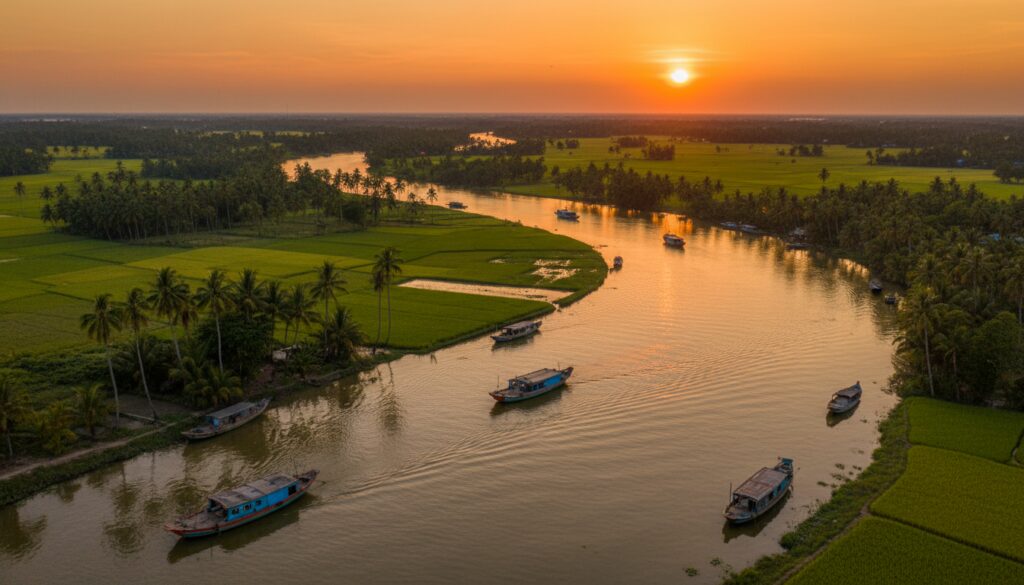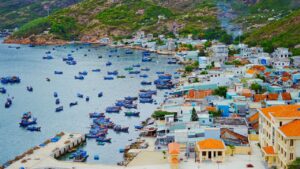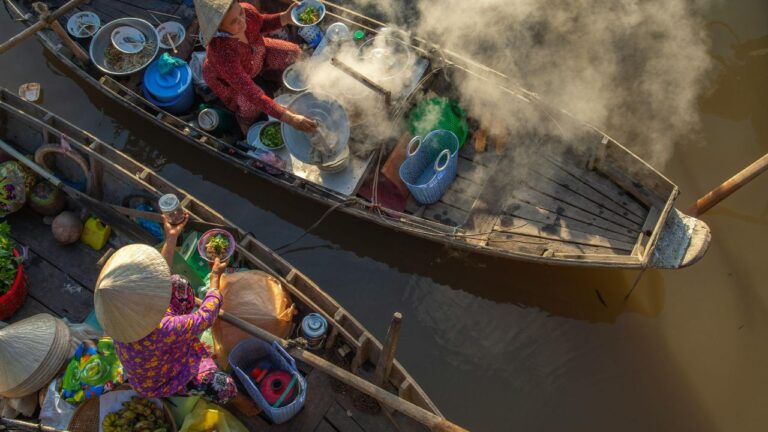
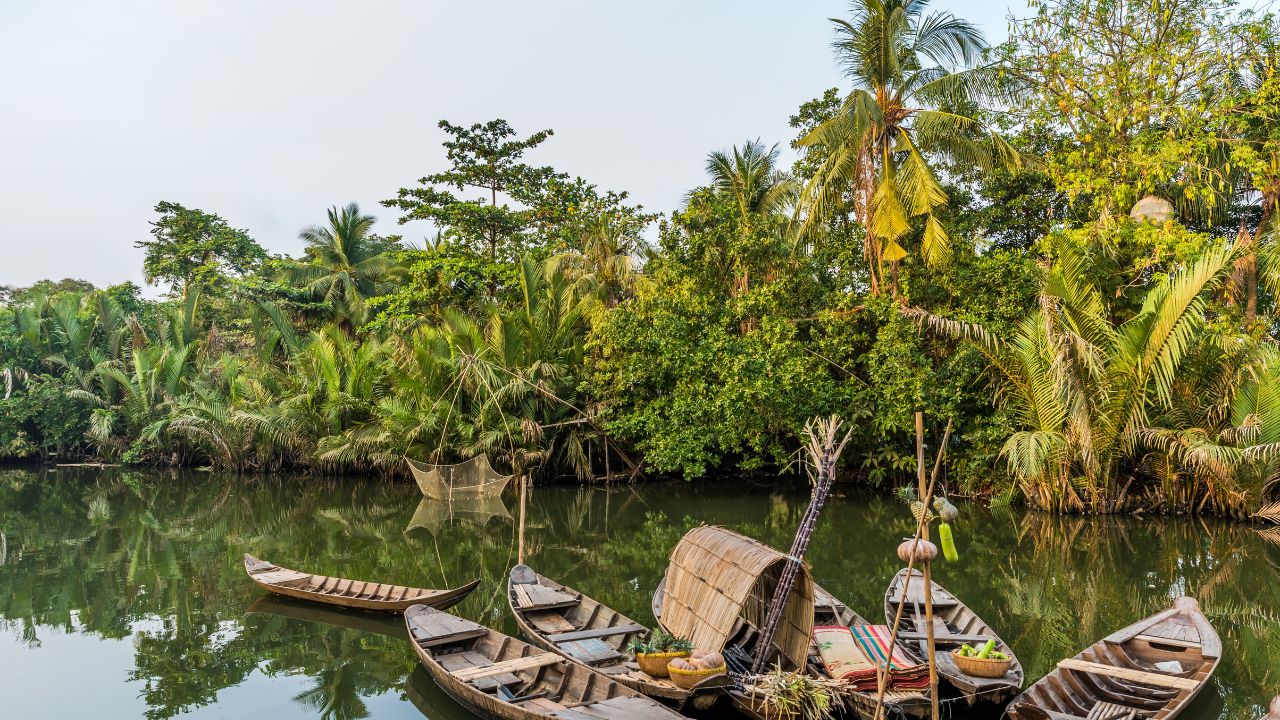
The Mekong Delta is a vast water-town region in southern Vietnam where the Mekong River splits into many branches and pours into the sea. Floating markets, orchards, and palm-forest canal cruises are the main acts, visited on a day trip to a multi-day tour from Ho Chi Minh City. It’s a region where you can experience “life on the river.” This page rounds up the big picture of the region, how to get around, classic spots, model courses, food, souvenirs, and the latest topics, and guides you to individual articles on cafés, news, and souvenirs.
| Location | A delta spanning 9 provinces in the south |
|---|---|
| Characteristics | Vietnam’s granary |
| Best season | December–April |
| Suggested days | 2–3 days |
| Language | Vietnamese (English also understood in tourist areas) |
| Currency | Vietnamese dong (VND) |
| Time difference from Japan | -2 hours |
What kind of place is the Mekong Delta?
The Mekong Delta is a vast waterway region spread across the lower reaches of the Mekong River in southern Vietnam. Spanning nine provinces, this delta serves as the country's "rice bowl," supplying Vietnam's rice, fruit, and seafood. Signature destinations include Can Tho (floating markets), Ben Tre (the "coconut capital"), My Tho (a classic day trip from Ho Chi Minh City), and Chau Doc (near the Cambodian border). Each area offers canal cruises, orchard visits, and traditional craft experiences, giving you a wide range of things to try. The Mekong Delta is a vast delta across the lower Mekong River, a waterway region spanning five provinces and cities (Can Tho City, Vinh Long, Dong Thap, An Giang, and Ca Mau Provinces, following the administrative reorganization of July 2025). Known as "Vietnam's rice bowl" for its rice, fruit, and seafood production, it accounts for about 50% of the country's rice output. Sightseeing routes vary widely by purpose: My Tho and Ben Tre for a day trip, the Can Tho floating markets for an overnight stay, or a more advanced route reaching Chau Doc and Ca Mau Cape over two to three days. Each area offers canal cruises, orchards, and traditional craft experiences, letting you savor the diverse landscapes of southern Vietnam.
Getting to the Mekong Delta and getting around
2–5 hours by car from Ho Chi Minh City (varies by destination). Varied, from day tours to 3-night, 4-day cruises. There’s also Can Tho International Airport, accessible by domestic flight.
The delta is divided into multiple towns such as My Tho, Ben Tre, and Can Tho. Getting around is basically by boat, and tours that push into narrow canals in small boats are the standard. Since Can Tho’s floating market is at its best in the early morning, we recommend staying the night before and setting out first thing in the morning.
Classic sightseeing spots in the Mekong Delta
We've summed up the representative spots in a quick-reference table. Use it as a guide when planning your route.
| Spot | Notes |
|---|---|
| Cai Rang floating market (Can Tho) | The delta’s largest; early morning 5–7 a.m. |
| Ben Tre’s coconut canals | Into small palm-forest canals by hand-rowed boat |
| My Tho’s fruit orchards and midstream islands | A day trip from HCMC; all-you-can-eat fruit |
| Chau Doc and Sam Mountain | The Cambodian border; a sacred mountain and temples |
| Long Xuyen / floating houses and fish-farming rafts | A floating settlement on the Mekong main stream |
Cai Rang floating market (Can Tho)
The largest floating market representative of the Mekong Delta, and the highlight of delta sightseeing. From before dawn, boats gather and buy and sell fruit and ingredients from boat to boat. Sellers indicate their goods by holding them at the tip of a pole. Since the peak of activity is early morning, 5–7 a.m., the rule is to set a boat out from Can Tho’s Ninh Kieu Wharf before sunrise. Having breakfast at an onboard stall is also popular.
Ben Tre’s coconut canals
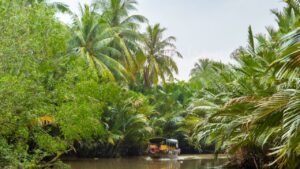
The standard in the “coconut kingdom” of Ben Tre is a cruise proceeding by hand-rowed small boat through narrow canals covered with nipa palms. The royal route is to stop along the way at a coconut-candy workshop, palm-sugar making, and a beekeeping garden, and savor tropical fruit at an orchard. It’s a delta-like experience you can enjoy even on a day trip from Ho Chi Minh City.
My Tho’s fruit orchards and midstream islands
My Tho is the closest delta gateway to Ho Chi Minh City. On the midstream islands floating in the Mekong River (Unicorn Island, Thoi Son Island, and others), you can enjoy all-you-can-eat tropical fruit, appreciate southern traditional music (don ca tai tu), and tour the canals by hand-rowed boat. Half-day to one-day tours are abundant, and it suits a delta introduction.
Chau Doc and Sam Mountain
The sacred Sam Mountain (Nui Sam) rising in Chau Doc near the Cambodian border. From the summit you can look out over the Mekong plain and even to the Cambodian side, and at its foot is Ba Chua Xu Temple, one of southern Vietnam’s foremost places of worship. In the dry season, it’s also easy to combine tours of the nearby Tra Su palm forest and floating villages (water settlements, fish-farming rafts).
Long Xuyen / floating houses and fish-farming rafts
On the Mekong main stream around Long Xuyen in An Giang Province, a distinctive landscape spreads out where floating houses on the river surface and fish-farming rafts raising fish beneath the houses run in succession. You can see up close a life that’s complete on the river, and tours touring the settlement by boat are the standard. You can touch the simple daily life of a delta unspoiled by tourism.
Sample courses for the Mekong Delta
Day trip: From Ho Chi Minh City toward My Tho / Ben Tre. Tour the canals by boat and visit palm-sugar and coconut-candy workshops and orchards.
One night, two days: Extend to Can Tho, and the next morning head to the Cai Rang floating market. The lively early-morning river market is the delta’s foremost highlight.
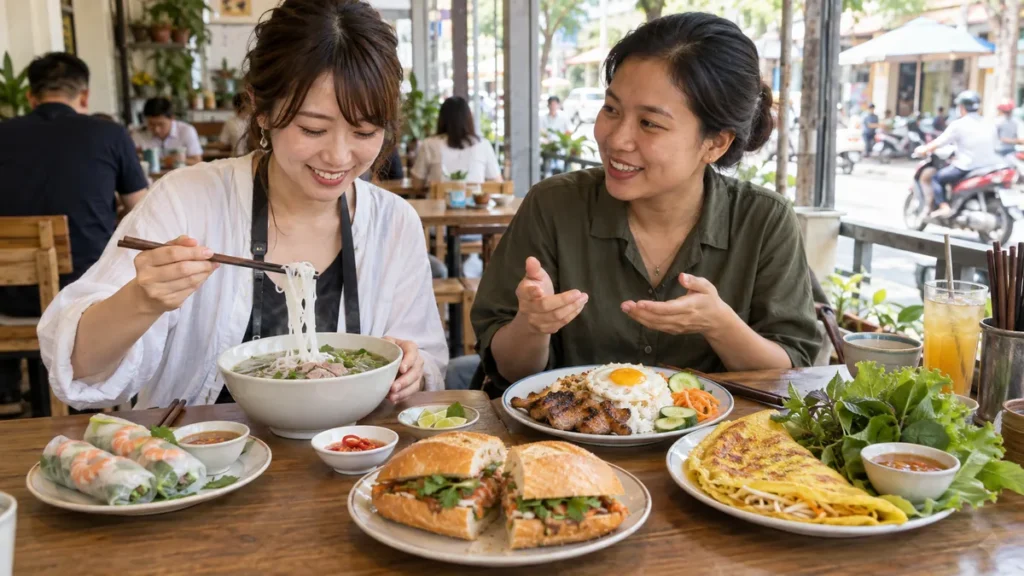
Food and specialties of the Mekong Delta
In the Mekong Delta, river fish, fermented foods, and tropical fruit are the main acts, with specialties differing by region. Here’s a table of representative dishes and local products.
| Dish | Characteristics |
|---|---|
| Hu tieu My Tho (My Tho noodles) | A rice-noodle dish originating in My Tho. Springy rice noodles are combined with pork, shrimp, and offal in a clear soup made from pork bones and dried shrimp. You can choose with-soup or no-soup, a bowl representative of the delta. |
| Bun ca Chau Doc (fish soup noodles) | A noodle dish in a fish-based broth that is a specialty of Chau Doc. Slices of catfish and snakehead fish, along with plenty of herbs, are added to a soup tinted golden with turmeric. You can sense the Khmer and Cham cultural influence unique to this border region. |
| Cá lóc nướng trui (straw-grilled snakehead fish) | A regional Delta dish in which snakehead fish is skewered on bamboo and grilled quickly over straw. You strip off the fragrant charred skin, then wrap the flesh with vegetables in rice paper to eat. It is a bold plate that symbolizes the river-fish culture. |
| Coconut candy and tropical fruits | Ben Tre's coconut candy (keo dua) and palm sugar, along with tropical fruits such as durian, mangosteen, and rambutan, are flavors that represent the Delta and make good souvenirs. |
Souvenirs to buy in the Mekong Delta
We've summed up distinctly Vietnamese souvenirs by item (item names link to individual pages).
| Item | Genre | Notes |
|---|---|---|
| Coconut oil | Food | The Mekong is a major coconut-producing region. You can find these at souvenir shops in the Delta. |
| Cashew nuts | Food | Available at markets, supermarkets, and the airport |
| Nuoc mam (fish sauce) | Food | Available at markets, supermarkets, and the airport |
| Vietnamese coffee beans | Food | Available at markets, supermarkets, and the airport |
| Basket bags | Goods | Available at markets, supermarkets, and the airport |
Latest topics from the Mekong Delta
Recent news related to the Mekong Delta is covered in detail in separate articles.
- A couple in their 60s in Can Tho runs a free eatery for poor workers
- A new luxury vessel "Victoria Mekong II" on the Mekong River — a new choice for an elegant delta cruise
- The Mekong's fruit paradise "Dong Thap Fruit Festival" debuts and draws 500,000 visitors, timed with June's peak fruit-picking season
Best season, budget, and trip preparation
The best season is the dry season, December to April, when it is easy to travel and ideal for visiting floating markets. The rainy season (May to November) is the flood period and water levels rise, but it is also the peak harvest season for orchard fruit.
Budget 600 to 1,500 yen per day. A day trip from Ho Chi Minh City runs 5,000 to 8,000 yen, and a two-day, one-night tour (including the Can Tho floating market) runs 10,000 to 18,000 yen. The pinnacle of Mekong cruising is a three-to-five-day river cruise (traveling upriver by barge to the Cambodian border), with luxury plans starting from 200,000 yen per person. In the rainy season (May to November) water levels are high and orchards can flood, while the dry season (December to April) is better suited to land-based sightseeing. Malaria risk is low, but bring insect repellent as a precaution against dengue fever.
Points to note
The sun and humidity are intense, so don't forget a hat, sunscreen, and plenty of water. Small boats rock, so keep your luggage to a minimum and put valuables in a waterproof bag. Floating markets are at their liveliest in the early morning, so a slow start makes them easy to miss.
Mekong Delta hotels and where to stay
The Mekong Delta splits between central Can Tho, handy for the floating markets, and riverside and islet resorts. Where you stay changes the feel of the trip.Mekong Delta hotel guideFrom a convenient base to a resort stay, we cover the best places to stay by area, with a quick-reference table and individual notes alongside their actual Google Maps ratings.
The Mekong Delta on the map