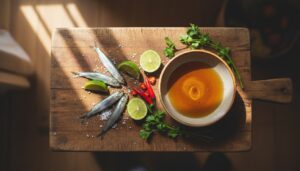
Nuoc mam, the fish sauce essential to Vietnamese cuisine, made by salting and fermenting seafood. With the umami born from the traditional methods of Phu Quoc Island and Phan Thiet, you can make the dipping sauce for pho and fresh spring rolls at home too. Compared with Japanese fish sauces (shottsuru, ishiru), its fishy aroma is gentler and easier to use, and it can also be applied as a secret ingredient in Japanese cooking. Choose a small bottle and it's easy to carry home—a souvenir that delights anyone who loves to cook.
What is nuoc mam?
A fish sauce aged with only anchovies and salt
Nuoc mam (Nước mắm) is a fish sauce made by aging small fish such as anchovies (cá cơm) with salt in wooden barrels for about 12 months. Phu Quoc Island's, in particular, is protected by geographical indication (GI) and known for its clear amber color and rich umami. The first liquid that drips from the tap at the bottom of the barrel is called “nhị,” the highest grade, with the highest nitrogen content. The version diluted from it or blended with later pressings is “pha đấu (blend).” For how to use it and choose it,the complete nuoc mam guideexplains it in detail too.
Why it's chosen as a souvenir
- You can recreate at home the “nuoc cham” dipping sauce for pho and fresh spring rolls
- A small bottle is easy to carry home and delights anyone who loves to cook
- It has the depth of being able to enjoy flavor differences by origin and grade
- Unopened, it keeps for a long time, making it good as a stock souvenir too
Types and how to choose
For nuoc mam, the “origin” and the “độ đạm (nitrogen grade)” determine the strength of flavor and the price. If you'll use it as a raw dipping sauce, choose a high grade of 40–43°N; for stir-fries and braised dishes, the standard 25–30°N—choosing by use avoids waste. The “nhị” first pressing bottled as is is the highest grade, with richer umami than blended (pha đấu) products.
Flavor changes by origin
| From Phu Quoc Island | Protected by appellation of origin. Clear amber color and rich umami |
|---|---|
| From Phan Thiet | A traditional producing area in the south-central region. A well-balanced flavor |
| From Cat Hai (north) | Near Hai Phong. A northern style with firm saltiness |
Points for choosing
- The “độ đạm (nitrogen grade)” value—Phu Quoc GI ranges from 20–43°N. A high grade of 40–43°N suits raw dipping sauces, while the standard 25–30°N suits stir-fries and braised dishes—use them for different purposes
- Ingredient labeling—Those with only anchovies and salt are closest to the traditional method
- Volume—For carrying home, a leak-resistant small bottle (200–300 ml) is reassuring
If you want to dig deeper into choosing and using it, the dedicated guide helps; if you want to survey Vietnamese souvenirs overall, the food guide is useful.

Major brands and labels
Phu Quoc Island's is protected by geographical indication, and those with origin labeling are a quality benchmark. As a gift for someone who loves to cook, choosing an island-workshop brand or a high-grade line delights them.
| Hưng Thành (Phu Quoc) | A Phu Quoc staple. Easy to obtain and good for gifting |
|---|---|
| Thanh Quốc (Phu Quoc) | A popular island-workshop brand. Aged, rich umami |
| Red Boat | A premium line with a high nitrogen grade, well regarded overseas too |
Recommended uses and ways to enjoy
The first thing to try making is “nuoc cham,” the dipping sauce served with fresh and fried spring rolls. A guide ratio is “1 nuoc mam : 1 sugar : 1 lime juice : 4–5 water,” with chopped chili and garlic added, adjusting water and lime to taste. It can also be applied to pho and salads (gỏi).
- Combine with sugar, lime, chili, and garlic to make the “nuoc cham” sauce
- Adding a small amount as a secret ingredient in stir-fries and braised dishes boosts the umami
- After opening, store in a cool dark place or refrigerated and use up promptly
Having seasonings on hand that pair with nuoc cham lets you recreate the local taste more authentically.

Where to buy and price ranges
If you're visiting Phu Quoc, the local workshops are best for both freshness and price, but you can also get reliable quality at upscale supermarkets and airports in the cities. As a gift for someone who loves to cook, choosing at a shop where you can confirm origin labeling and grade is reassuring.
- Phu Quoc local workshops—Best for both freshness and price
- Upscale supermarkets (ANNAM Gourmet, etc.) and Ben Thanh Market—Handy for comparing brands
- Airport duty-free shops and Lotte Mart—For restocking and reliable staples
Price range
| Small bottle (200–300 ml) | 200–600 yen |
|---|---|
| Standard bottle (500 ml) | 400–1,000 yen |
| High grade / gift box | 1,000–3,000 yen |
Tips for making it a souvenir
- To guard against leaks and odor transfer, double-wrap the bottle in a zipper bag
- Mind the liquid limits for carry-on and put it in checked luggage
- To prevent breakage, wrap it in clothing and place it in the center of your suitcase
- The smell is strong, so pack food and clothing separately
Frequently asked questions
- Can you bring nuoc mam home by plane?
-
Because it's a liquid, carry-on is restricted. It's safest to put it in checked luggage and double-wrap it in a zipper bag to prevent leaks. Wrap the bottle in clothing to prevent breakage. Choosing a product in a plastic bottle removes the worry of breakage, letting you carry it home with more peace of mind.
- Is a higher “độ đạm” value better?
-
It's the nitrogen grade; the higher it is, the higher the fish ratio and the richer the flavor. A high grade suits raw dipping sauces, but for cooked dishes the standard grade finishes plenty delicious.
- How do you store it after opening?
-
Avoid direct sunlight and store in a cool dark place or refrigerated. The flavor fades easily, so after opening we recommend using it up within a few months as a guide.
- Should I buy a mass-produced product (like Nam Ngư) or a traditional-method one?
-
If you want affordability for everyday use, a mass-produced product is plenty. But if you want them to enjoy flavor differences as a souvenir, choosing a Phu Quoc traditional-method one with only anchovies and salt as ingredients delights them.