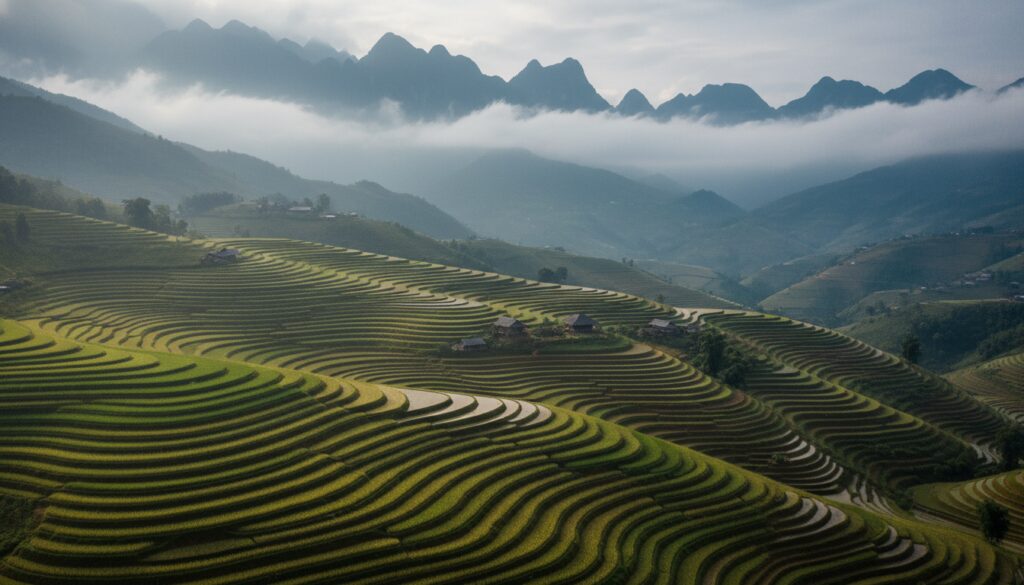
Sa Pa is a mountain resort at about 1,600 m in elevation in Lao Cai province, northwest Vietnam. From a town opened as a summer retreat in the French colonial era, Hmong and Dao settlements, terraced rice fields strung out in tiers, and Vietnam's highest peak Mount Fansipan spread out. It's a "mountain trip" where trekking the valleys, rather than a town walk, is the star. This page pulls together everything from the area's overall picture, how to get around, standard spots, model courses, food, souvenirs, and the latest topics, and guides you to individual articles on cafés, news, and souvenirs.
| Location | Northwest, Lao Cai province |
|---|---|
| Elevation | About 1,600 m |
| Best season | March–May, September–November |
| Suggested days | 2 days |
| Language | Vietnamese (English also understood in tourist areas) |
| Currency | Vietnamese dong (VND) |
| Time difference from Japan | -2 hours |
What kind of place is Sa Pa
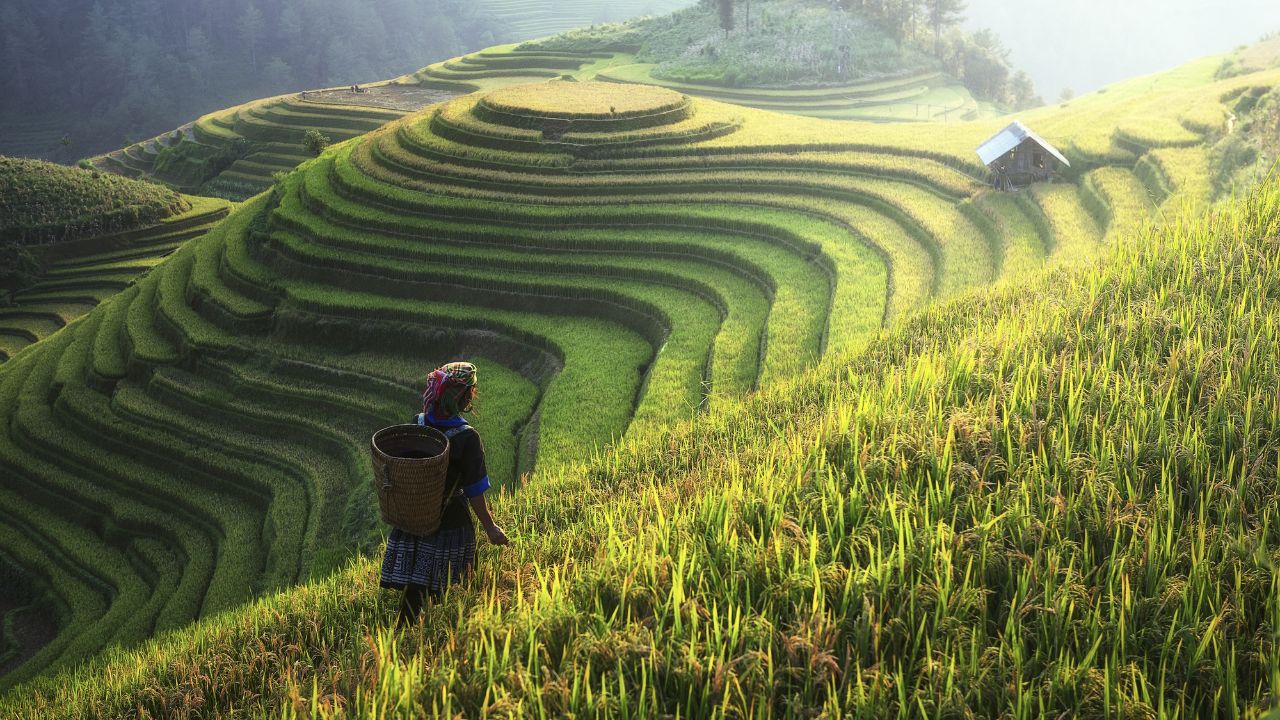
Sa Pa is a mountain town in northwest Lao Cai province, a summer retreat located at about 1,600 m elevation. A mountain resort developed in the French colonial era, its appeal is the superb views of terraced fields and ethnic-minority culture. Villages where many peoples — Hmong, Dao, Giay, Tay, and more — live in traditional dress dot the area. It's also the trailhead for Vietnam's highest peak Mount Fansipan (3,143 m), and you can go straight to the summit by cable car. Sa Pa is a mountain town developed as a summer retreat in the late 19th century of the French colonial era, and old French-architecture villas still remain in the town center. Across steep mountain terrain spreading from 1,600 m to 3,143 m (Mount Fansipan), terraced fields, ethnic-minority settlements, and waterfalls are dotted. Settlements of the Hmong (Black Hmong, Red Hmong), Dao, Giay, Tay, and others, retaining ethnic dress and their own languages, are opened as tourism resources, and homestay experiences staying in traditional houses are popular too. Autumn (September–November) is the peak for the golden-shining terraced fields, and spring (March–May) for the blooming mountain cherry blossoms and green young leaves.
Getting to Sa Pa and getting around
Getting to Sapausually starts from Hanoi. Overnight trains used to be the main option, but since the Noi Bai–Lao Cai Expressway opened,a direct limousine van now takes 5.5–6.5 hours, making the trip much shorter. It's a fiercely competitive route, with over 220 departures a day run by more than 20 companies.
Three Ways to Go — Choose by Speed, Price, or Comfort
| Means | Duration | Fare guide | Characteristics |
|---|---|---|---|
| Limousine Van(9–16 seats) | 5.5–6.5 hours | 320,000–660,000 dong | The most common choice now. Often picks you up at your hotel in the Old Quarter |
| Sleeper bus (overnight) | 6 to 7 hours | 230,000–370,000 dong | Cheap, but the downside is arriving early at 4:30–5:00, before check-in time |
| Cabin-style sleeper bus | 6 to 7 hours | 450,000–750,000 dong | Private-room-like and comfortable, including two-person "Cabin Tình Yêu" options |
| Train(Hanoi → Lao Cai) | 7 hours 45 minutes to 8 hours, plus 1 hour by bus | Seats from 185,000 dong, sleeper berths 280,000–500,000 dong | Has the most travel atmosphere, but requires a transfer |
Going by Train — You Get Off at Lao Cai
The traindoesn't run all the way to Sapa. From Hanoi,Lao Cai Stationit covers 294km in about 7 hours 45 minutes, and from there you take a bus35km, about an hour,climbing up to reach Sapa town.
The main overnight trains areSP1 (departs 21:35, arrives 5:25 the next day)、SP3 (departs 22:00, arrives 5:55)、SP7 (departs 22:40, arrives 6:40). Premium sleeper carriages run by private companies (Sapaly, Chapa Express, King Express, etc.) cost 450,000–750,000 dong and offer much more comfortable interiors.
One thing to note: Hanoi Station (120 Lê Duẩn) faces Le Duan Street at the front, buttrains heading to Lao Cai depart from the rear, on the Trần Quý Cáp Street side. This is easy to miss on a first visit, so arrive early and check with station staff.
| Lao Cai Station → Sapa (public bus) | 30,000–40,000 dong / 1–1.5 hours. 5:50–18:45 |
|---|---|
| Same route (shared minivan) | 40,000–100,000 dong / 45–80 minutes. Sometimes drops you at your accommodation |
| Same route (taxi / ride-hailing) | 450,000–550,000 dong / about 1 hour |
Trains tend to arrive between 5:30 and 6:30, so the station forecourt gets crowded with touts hawking shared rides. For terraced field views,sit on the left side facing forward. The road has continuous hairpin turns, so if you're prone to motion sickness, it's reassuring to bring medication.
Getting Around Town and to the Villages
Sapa's town center — the stone church, Sapa Lake, and Sapa Market — iswithin walking distance of each other. That said, there are many slopes, so wear comfortable shoes.
| Taxi | Starting fare 12,000–20,000 dong, then 15,000–18,000 dong per km |
|---|---|
| Town → Cat Cat Village | Taxi 80,000–120,000 dong |
| Town → Fansipan cable car station | Taxi 100,000–130,000 dong (about 3km, roughly 10 minutes by car) |
| Town → Ta Van / Lao Chai Village | Taxi 250,000–300,000 dong |
| Full-day charter | 1.2–1.5 million dong |
🔴 What to Know Before Renting a Motorbike
Motorbike rentals in Sapa can be found for 80,000–200,000 dong a day, butwe strongly recommend that Japanese travelers not drive one themselves。
The reason is licensing. Vietnam is asignatory to the Vienna Convention, and Geneva Convention international driving permits issued by countries such as Japan, the US, Canada, and Australiaare not valid there. In other words, even if you hold an international license obtained in Japan, in Vietnamyou'll be treated as driving without a license. If you're involved in an accident, your overseas travel insurance may not pay out.
If you really want to get around on your own, check whether you hold a Vietnamese driving license. If not, it's safer to use taxis, motorbike taxis, or a charter.
One more thing: when renting,don't agree to hand over your original passport even if asked to. Choose a shop that will accept a copy or a cash deposit instead, and if you do leave something, always get a written receipt.
Sa Pa's standard sightseeing spots
We've summed up the representative spots in a quick-reference table. Use it as a guide when planning your route.
| Spot | Notes |
|---|---|
| Mount Fansipan | 3,143 m elevation, cable car + steps |
| Cat Cat village | A Hmong settlement within walking distance of the center |
| Lao Chai and Ta Van terraced fields | The standard Muong Hoa Valley trek |
| Bac Ha market | Held only on Sundays, an ethnic-minority weekly market |
| Silver Waterfall (Thac Bac) | About 30 minutes by car from Sa Pa, a big drop |
| Muong Hoa Valley | A superb-view road of a valley where terraced fields are strung out |
Mount Fansipan
Vietnam's highest peak, called the "Roof of Indochina," at 3,143 m elevation. A cable car about 6.3 km in total length crossing the Muong Hoa Valley takes you at once to near the summit station, taking about 15 minutes. To the summit, after disembarking, you reach it by about 600 steps or by a separate-fee funicular (monorail). If you're after a sea of clouds, the early morning has a higher probability, and there are many days when fog blocks the view in the afternoon. Since it's high in elevation and chilly even in summer, bringing a jacket is reassuring.
Cat Cat village
A Black Hmong village you can also reach on foot descending the sloping road from central Sa Pa, with terraced fields, waterwheels, and a waterfall flowing through the village as highlights. You can see indigo-dyeing and hemp-weaving workshops and village life up close, and the very scenery of the whole village spreading along the slope makes a picture. Since it's downhill going and a climb back returning, if you're unsure of your stamina there's also the option of using a bike taxi on the way back. The early morning hours have few tourists, making it easy to take photos of light streaming into the terraced fields.
Lao Chai and Ta Van terraced fields
The most popular trekking route in Sa Pa, walking the terraced fields spreading across the Muong Hoa Valley. From central Sa Pa to the southwest, it continues about 7 km to Lao Chai village and about 10 km to Ta Van village, letting you enjoy the scenery of Black Hmong and Giay villages and terraced fields over a full day. The whole route is roughly 10 to 12 km, with mud and steep slopes, so non-slip shoes are essential. May to June, when water fills the fields, and September, when the rice is dyed golden, are the best seasons when the terraced fields' expressions become richest.
Bac Ha market
This weekly market is one of the Northwest's leading ethnic minority markets, drawing Flower Hmong along with Tay, Giay, and Nung people, among others. It's held only on Sunday mornings and packs up by around midday, so arriving early in the morning is essential. It's about 110–135km from Sapa, roughly a 4-hour drive each way, making a day trip difficult unless you join a local tour that departs at dawn. The main draw is the market's lively atmosphere, with colorful ethnic costumes and livestock trading.
Silver Waterfall (Thac Bac)
A large waterfall with a drop of over 200 m, along Route 4D heading to the O Quy Ho Pass. At about 12 to 15 km from central Sa Pa, about 30 minutes by car, it's easy to access and easy to drop by on the way. Climbing the steps to right by the falls lets you experience the spray and force up close, and on clear days the water flow shines silver. Located at around 1,800 m elevation with low temperatures, watch for cold feet and slipping after rain and in winter.
Muong Hoa Valley
A valley spreading southeast from central Sa Pa, Sa Pa's symbolic scenery where terraced fields blanketing the slopes and ethnic-minority villages are strung out. From viewpoints you can command a view of the Muong Hoa River flowing along the valley floor and the tiered fields, and you can look down on this valley from above from the Fansipan cable car too. You can enjoy the scenery just cruising the route by bike or car, and combining it with trekking lets you push into the valley's bosom. The early morning when morning fog fills the valley, and the harvest season when the rice colors, are especially beautiful.
Sa Pa model course
Saparequires 11–13 hours round trip from Hanoi, and that's the biggest constraint. Without accounting for it, your trip can end up being just travel. Here are realistic itineraries by length of stay.
2 Days, 1 Night — The Trick Is Not to Overreach
| Day 1 | 7:00 Depart Hanoi (pickup in the Old Quarter) → Arrive Sapa around 13:00 → Lunch → Head to Fansipan (takes 3–4 hours) → Evening stroll around town |
|---|---|
| Day 2 | Morning: Cat Cat Village (round trip on foot plus time there, 3–4 hours) → Depart Sapa 14:00–15:00 → Arrive Hanoi around 21:00 |
If you only have 2 days and 1 night, pick either Fansipan or trekking — just one. You can't fit both. Taking an overnight bus to arrive early is another option, but then you have to figure out what to do before check-in time.
3 Days, 2 Nights — The Best Fit
| The night before | 22:00 Sleeper train from Hanoi Station (SP3) |
|---|---|
| Day 1 | 5:55 Arrive Lao Cai → About 1 hour by bus → Arrive Sapa around 7:00. Drop off luggage and have breakfast → Fansipan in the morning to afternoon → Town and market in the evening. Stay in town |
| Day 2 | All-day trekking (Y Linh Ho → Lao Chai → Ta Van). Stay at a homestay in Ta Van village |
| Day 3 | Morning: terraced field views at sunrise → Return to Sapa for lunch → Take a limousine van departing 14:00–15:00, arriving in Hanoi around 21:00 |
This itinerary has three advantages.Taking the overnight option for the outbound leg maximizes your time on the ground,it saves you the cost of one night's accommodation, andyou get to stay both in town and in a village.
Fansipan: Prices and Timing
For most visitors to Sapa, the main goal is Indochina's highest peak,Fansipan (3,143m). A cable car takes you straight up.
| Item | Details |
|---|---|
| Round-trip cable car | Adults 800,000 dong (weekdays) / 850,000 dong (Saturday mornings and holidays). Children (100–140cm) 550,000 dong; under 100cm free |
| Ride time | About 15 minutes one way. Total length 6,292.5m, elevation gain 1,410m |
| Steps to the summit | About 600 steps from the upper cable car station. You can skip them by taking the funicular (up 150,000 dong / down 120,000 dong) |
| Muong Hoa funicular | Round trip about 150,000–200,000 dong (varies by operator) |
| Stay guide | 3–4 hours (including the funicular and time at the summit) |
| Hours | Roughly 7:30–17:00. Hours vary by day of the week, so check in advance |
Compared to town, the summit5-7°C coolerso bring something to layer on even in summer. Depending on the weather, you may find yourself in cloud with nothing visible at all.
If it's a Sunday, there's also the Bac Ha Market
If your trip includes a Sunday,Bac Ha Marketis worth working into your plans. It's a market where mountain ethnic groups, including the Flower Hmong, gather, selling textiles and food, plusa horse marketas well. However,it only opens on Sundaysso if you want to go, you'll need to build your itinerary around that day.
Sa Pa food and specialties
We've put the local flavors you'll want to savor in Sa Pa into a table.
| Dish | Characteristics |
|---|---|
| Black chicken (ga den) | A mountain-region native chicken with bones and meat tinged black, characterized by firm meat quality and rich savoriness. Often served grilled, in hotpot, or stewed, its nourishing, deep flavor suits the mountain chill. It can be savored as a standard local ingredient at Sa Pa eateries and restaurants. |
| Bamboo-tube rice (com lam) | A mountain-region staple of glutinous rice packed into a bamboo tube and slowly grilled over charcoal. The glutinous rice, faintly infused with the scent of bamboo, finishes toasty outside and chewy inside. Eating it with salt, sesame, or meat dishes is the standard. |
| Thang co | A traditional hotpot handed down among the Hmong, simmering horse meat and offal with spices in a large pot for a long time. A local dish served at markets and festivals, its distinctive aroma and deep richness are cherished by locals. An item unique to the northwest that you can encounter around the Bac Ha and Sa Pa markets. |
| Salmon hotpot and sashimi | A dish using salmon (trout) farmed in cool mountain water, served as hotpot or sashimi as a Sa Pa specialty. With firm flesh and good fat, making it into a hotpot with herbs and sauce warms the body. It's highly popular as local gourmet food unique to a high-elevation land. |
| Grilled stall food | At the stalls lining the area around Sa Pa's plaza at night, you can grill skewered meat, vegetables, eggs, and more over charcoal to eat. Nibbling warm grilled food on a chilly night is the standard way to spend time, letting you casually enjoy local flavors. |
Souvenirs to buy in Sa Pa
Souvenirs from Sapa are centered onhandicrafts made by mountain ethnic groupsandand products harvested in the highlands. Many of them can't be found in other Vietnamese cities, so it's fun to pick out things you can only buy here.
| Item | What it is | Price guide |
|---|---|---|
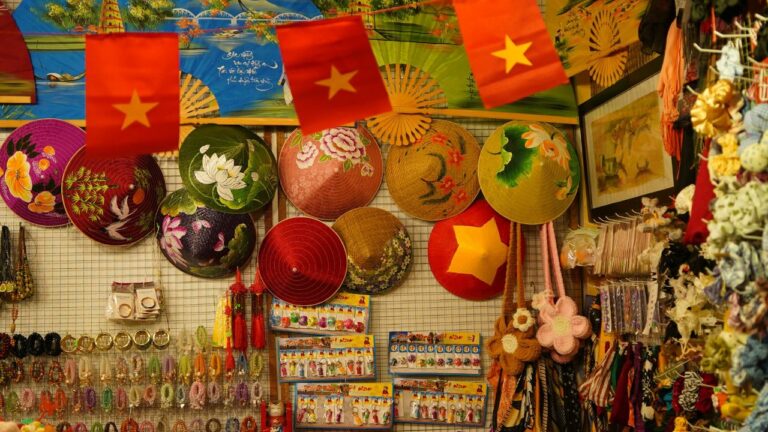
| Hmong embroidery and textiles | Indigo-dyed cloth, embroidered bags, scarves, wallets. Natural dyes and hand embroidery | Bags 50,000-150,000 dong, scarves 100,000-300,000 dong |
| Red Dao herbal bath packs | Dried medicinal herbs for bathing. A traditional remedy long used for postpartum recovery | To be confirmed |
| Shan Tuyet snow tea (Shan Tuyết) | Wild tea picked from old highland tea trees. Sapa's signature tea | To be confirmed |
| Mountain honey and herbs | Honey from highland flowers, spices such as cardamom | To be confirmed |
| Dried fruit | Plums, pears, apples. Fruits unique to the highlands | To be confirmed |
| Local liquor | Cinnamon wine, corn wine, plum wine | To be confirmed |
| Silverwork | Silver accessories made by the Hmong | To be confirmed |
Where to buy
| Sapa Market | The 2nd floor has clothing, textiles, traditional medicine, and souvenirs. The widest selection in town |
|---|---|
| Cau May Street | Lined with boutiques and coffee roasters |
| Ta Phin Village | Home to Red Dao embroidery workshops and herb-growing areas. You can buy directly from the makers |
| Cat Cat village | Craft stalls. Close to town |
| Bac Ha Market | Sundays onlyHeld then. Known for Flower Hmong textiles and its horse market |
For shopping,Mornings are less crowded and easier for browsing. At markets and villages,cards aren't accepted, so bring cash. Bargain gently — that's the basic rule.
If you want to try an experience, go for the herbal bath
handed down by the Red Dao,the herbal bath (tắm lá thuốc)is an experience unique to Sapa. At the communal bathhouse in Ta Phin Village,one session costs 80,000-100,000 dongor so. Spas in town also offer it for 150,000-300,000 dong (often including a massage or herbal tea). It's a perfect way to finish off legs tired from trekking.
Sa Pa's latest topics
Recent topics related to Sapa are covered in detail in their own separate articles.
Best season, budget, and trip preparation
Sapa sits on a plateau at an elevation of around 1,600m. Vietnam has an image of being a hot country, butSapa's average annual temperature is 15.4°C. Even at the height of summer the high is only around 23°C, and in winter it drops close to freezing.get your clothing wrong and you'll really feel the cold, so please read this section carefully.
Monthly climate
| Month | High / Low | Rainfall | Characteristics |
|---|---|---|---|
| January–February | 13〜14℃/6〜8℃ | 65〜80mm | The coldest month. Foggy, with frost at times |
| March | 18℃/11℃ | 105mm | Spring-like weather. Wildflowers bloom |
| April-May | 21〜22℃/14〜16℃ | 235〜345mm | The season when the terraced fields are flooded |
| June–August | 23℃/17〜18℃ | 380〜465mm | Peak of the rainy season. July sees the most rain |
| September | 22℃/16℃ | 315mm | The golden rice ears begin |
| October | 19℃/14℃ | 195mm | Good visibility. Golden terraced fields and clear skies |
| November | 16℃/10℃ | 90mm | Sea-of-clouds season. Cool and dry |
| December | 13℃/7℃ | 65mm | Cold and dry. Frost in the mornings |
*Temperatures for Sapa that show up in search results can run higher than reality, because they sometimes mix in figures from Vietnam's lowlands or use data from a distant weather station. The table above is based on average figures for an elevation of 1,500m.
What month to visit depends on what you want to see
| Mirror-like flooded terraces | Late April-early June (peak in May). Flooded fields reflect the sky. Sapa grows only one rice crop a year, so if you miss this window you won't see it. |
|---|---|
| Golden rice ears | Mid-September-mid-October (peak in late September). After harvest, from November to April, the fields turn bare and brown |
| Sea of clouds | Early mornings in Novemberare best. Also visible October-December |
| Overall best time | March-May and September-November. Little rain and good visibility |
It does NOT snow every year
Some people see photos of "snow in Sapa" and decide to visit in winter, butsnowfall in the town itself has happened only 4 times since 1990(2011, 2013, 2014, and 2016). In January 2016 the temperature hit -4.2°C with 8-12cm of snow on the ground, but that was the coldest weather in 60 years.
In recent years, warming has actually reduced snowfall and frost. It falls fairly often at the summit of Fansipan, butwe don't recommend going to town expecting snow. What's reliable in winter isn't snow but thick fog (an average of 137 foggy days a year, with dense fog from December to February).
Dress guidelines
- Summer (May-September): Waterproof jacket, quick-dry fabrics, non-slip shoes. Rubber boots are the practical choice for trekking. Leeches appear in July
- Winter (December to February): Thermal base layer + fleece + windproof outer layer. Also a knit hat, gloves, and a scarf. Nights drop close to freezing
- Spring/autumn: The gap between midday and morning/evening exceeds 10°C, so dress in layers
- For fabric, rather than cotton,wool or synthetic fibers are better. They lose far less body heat when wet.
Budget guide
| Classification | Per day | Rough cost breakdown |
|---|---|---|
| Budget | 280,000-640,000 dong (US$11-25) | Dorm bed + street food + walking treks |
| Mid-range | 1,150,000-2,420,000 dong (US$45-95) | Mid-range hotel + restaurants + cable car |
| Luxury | From 4,650,000 dong (from US$182) | High-end hotel + private car + guide |
| Hostel / dormitory | 100,000-200,000 dong |
|---|---|
| Village homestay | 150,000-350,000 dong per person (100,000-150,000 for a simple stay) |
| Mid-range hotels | 600,000-1,000,000 dong |
| High-end hotel | From 2,500,000 dong |
| Pho / bun bo | 25,000-40,000 dong |
| Banh mi | 20,000 dong |
| Guided trek (2 days, 1 night) | 800,000-1,200,000 dong |
Some accommodations charge extra for heating in winter. Room rates also rise on weekends and during peak periods (Tet, April 30-May 1), so book early for those times.
Sapa hotels and where to stay
Choosing where to stay in Sapa comes down tostaying in town or staying in a village— a trade-off between convenience and experience, and there's no single right answer.
The center of Sapa town
Accommodations and restaurants cluster around the stone church, Sapa Market, and Sun Plaza. It's also where buses arrive and depart, sofor a first visit to Sapa, or a short stay, thisis the safer choice.
| Advantages | The widest choice of accommodations, restaurants, and tour operators. Minimal travel needed |
|---|---|
| Downsides | Highly commercialized, with little mountain atmosphere left. Noisy on weekends.You can't see the morning mist over the terraced fields from town |
| Main streets | Cau May Street (the main street), and the area around Sapa Lake and the stone church |
| Dealing with noise | Avoid rooms facing the square or the bar strip, and choose one on the 2nd or 3rd floor or higher |
A village homestay in the Muong Hoa Valley
Another option is to stay in a village in the valley.Waking up right beside the terraced fieldsis an experience you can't get at a hotel in town. Another appeal is that trekking starts right from your front door.
| Village | Distance from town | Ethnic group | Nature |
|---|---|---|---|
| Ta Van (Tả Van) | 10-12km (about 30 min by motorbike) | Hmong, Giay, and Red Dao | The classic homestay choice. The widest choice of homestays. Accessible by car |
| Lao Chai (Lao Chải) | 7km | Hmong | Some of the valley's largest terraced fields. Quieter than Ta Van |
| Cat Cat (Cát Cát) | 2-2.5km (45 min walk) | Hmong | The closest and most touristy. Waterfall and water wheels. The pick if you only have half a day |
| Ta Phin (Tả Phìn) | 17km (northeast) | Red Dao and Hmong | Embroidery andherbal baths— a village known for these. In the opposite direction from the valley |
| Ban Ho (Bản Hồ) | 30km | Tay | The farthest out. Stilt houses. Best for a longer stay |
A common approach is"one night in a hotel in town + one night in a village homestay". This way you get both convenience and experience. That said, staying in a village means arranging transport every time you head into town, so if you only have one night, staying in town is the safer choice.
Sa Pa on the map