The powerful bitterness and body of dark-roasted Robusta—Vietnamese coffee is a souvenir that lets you recreate the local taste at home, from sweet iced coffee with condensed milk to authentic black. You can choose the form—beans, ground, or drip—and it's also appealing for being light, long-keeping, and easy to hand out.
What are Vietnamese coffee beans?
The Robusta variety that supports the world's No. 2 production
Vietnam is the world's second-largest coffee producer after Brazil, and most of its output is Robusta. The Dak Lak province and Buon Ma Thuot area of the central highlands are a major producing region, where the elevation and red-earth soil suit Robusta cultivation. Compared with Arabica, it has more caffeine and stronger bitterness, body, and a roasted-nut toastiness. Meanwhile, the Cau Dat area of Da Lat (Lam Dong province) is known as an Arabica region—Typica, Bourbon, Mocha—producing beans for specialty shops to enjoy tartness and floral aromas.
Why it's chosen as a souvenir
- You can recreate local ways of drinking at home, like “cà phê sữa” combined with condensed milk
- You can choose the form—beans, ground, or drip bags—to match how the recipient brews
- Long-keeping at room temperature and light—suited to handing out to many people too
- There are also talking-point premium items like civet-derived “chồn (cà phê chồn = weasel) coffee”
If you'll extend to the producing areas, grasping how to explore two towns known as coffee homes makes the trip go smoother.


Types and how to choose
For Vietnamese coffee as a souvenir, choosing along two axes—“form (beans, ground, drip)” and “contents (roast level, variety, presence of flavoring)”—avoids mistakes. Decide the combination to match the recipient's brewing and preferences. Note that the rare Arabica variety is also produced in the Cau Dat area near Da Lat in the southern highlands, so for recipients not keen on bitterness, choosing an Arabica blend is also an option.
Using beans, ground, and drip for different purposes
| Ground (pre-ground) | The most common souvenir type, ready to brew right away with a phin |
|---|---|
| Beans (whole) | For coffee lovers who want freshly ground. Needs a grinder |
| Drip bag | Just pour hot water. Ideal for handing out at the office |
| Chồn (cà phê chồn) type | A rare premium bean collected after passing through a civet's body. Often made from Robusta, for gifting |
Points for choosing
- Roast level—For a sweet drink with condensed milk, dark roast; for drinking black, a medium roast is easier to handle
- Robusta 100% or blend—For bitterness, mainly Robusta; for mellowness, an Arabica blend
- Presence of flavoring—Like Trung Nguyên's standard blends, many add butter oil (bơ) or cacao during roasting to scent it. If you prefer the bean's own taste, choose an unscented (pure coffee) type
- Grind—If brewing with a phin, a medium-coarse grind (about coarse sand or fine salt) is the guide. Too fine and it clogs; too coarse and it comes out weak
Major brands and labels
Here are the major brands you'll see at supermarkets and specialty shops. If unsure, start with Trung Nguyen or Highlands—easy to obtain with a stable taste—and you won't go wrong.
| Trung Nguyen Legend | The largest maker, from Buon Ma Thuot. The “Sáng Tạo (Creation)” series is the staple |
|---|---|
| Highlands Coffee | From a café chain. Easy to obtain even at supermarkets with a stable taste |
| K Coffee | Rising in popularity for a clean taste mindful of export quality |
| Mê Trang | From Nha Trang. A toasty roast befitting the central coast |
Recommended ways to drink and enjoy
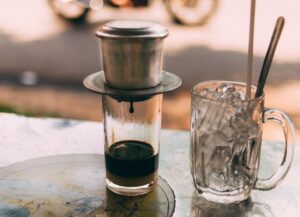
- Brew it strong with a phin and add condensed milk for “cà phê sữa”—the local staple
- Add ice to make it iced (cà phê sữa đá). Easy to drink even in summer
- “Cà phê sữa chua,” combined with yogurt, is popular in Hanoi too
- After opening, transfer to an airtight container, avoid heat and humidity, and drink it up within 1–2 months
The dedicated filter “phin” is what you use to brew cà phê sữa. Get it together with the beans or ground, and you can brew the same way right after returning home.

Where to buy and price ranges
- Supermarkets (Lotte Mart, Big C, Co.op Mart)—Many varieties and affordable prices
- Brand stores (Trung Nguyên, Highlands)—Rich gift packaging
- Specialty shops (Thao Dien area in Ho Chi Minh City, Hanoi's Old Quarter)—Single-farm beans for enthusiasts too
- Airport duty-free shops—Pricier, but insurance against forgetting to buy
Price range
| Ground / beans 250–500g | 300–1,000 yen |
|---|---|
| Drip bags (box) | 300–800 yen |
| Gift package | 1,000–3,000 yen |
| Chồn-type premium line | 2,000–6,000 yen |
Tips for making it a souvenir
- To prevent aroma transfer, pack flavored and unscented types separately
- Telling them how to brew the ground type delights them more (confirm whether they have a phin)
- In a suitcase, sandwich it between clothes to prevent the bag tearing
- It keeps at room temperature, but after returning home, seal it and consume it promptly for the best taste
When you want to know more about types and ways to drink, the comprehensive guide is handy. If you're looking for an easy-to-hand-out coffee-flavored souvenir, this is also a candidate.
Frequently asked questions
- Which is more suited as a souvenir, beans or ground?
-
Ground is the safe bet for a recipient without a grinder. For coffee lovers who prefer freshly ground, beans. For handing out at the office, drip bags are easy to distribute and recommended.
- Why is Vietnamese coffee bitter?
-
Because the main variety is Robusta, which has more caffeine and bitter compounds than Arabica. The sweet way of drinking it with condensed milk pairs well with this strong bitterness and has become the local staple style.
- Should I buy a phin (dedicated filter) too?
-
If you want to recreate the local taste, buying it together is recommended. With a phin, you can brew repeatedly without paper. We explain how to brew in a separate article.
- How long does it keep?
-
Unopened, about six months to a year is typical. After opening, the aroma fades easily, so seal it and drink it up within 1–2 months as a guide to keep the flavor.