Southern Vietnam is a cacao-producing region, and with “Marou”—launched by two Frenchmen—at the forefront, you'll find bean-to-bar makers leveraging the character of each origin. The handcrafted packaging, decorated with geometric patterns and gold leaf, becomes a gift as is, special even before you open it. Mind the heat, and it's a light, easy-to-hand-out grown-up souvenir.
What is Vietnamese chocolate?
Single-origin cacao born of the Mekong's bounty
Southern Vietnam's Ben Tre, Tien Giang, Dong Nai, Lam Dong, Ba Ria, and Dak Lak provinces are cacao-producing regions, valued for fruity, tart flavors. Marou drew global attention with “single-origin” chocolate made separately by harvest area, and lifted the reputation of Vietnamese cacao with origin-specific bars from these six provinces. For details,the complete guide to Vietnamese chocolateexplains it too.
Why it's chosen as a souvenir
- With highly designed packaging, it delights even before opening
- You can taste-compare by origin, and there are Vietnamese flavors like coffee and pepper too
- Many come in individual wraps or mini tablets, easy to portion out for handing around
If you want to carefully compare brand differences, the complete guide is quick; knowing how to explore the cacao town of Ben Tre helps with origin-based buying too.

Types and how to choose
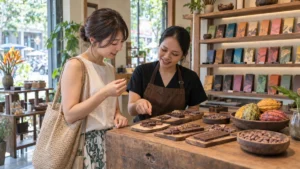
The fun of Vietnamese chocolate is being able to taste-compare “single origins” that differ in tartness and fruitiness by region. First decide on your preferred intensity by cacao content, then play with origins and flavors.
Choose by cacao content and flavor
- Dark (high cacao)—For grown-ups, with tart, bitter notes. For coffee lovers too
- Milk and flavored—Unusual ones like pepper, salt, and pistachio are fun
- Tablet type / mini box—For portioning out or for home use
Major brands and labels
Knowing the three representative brands chosen for souvenirs is enough. For a balance of beautiful packaging and taste, starting with Marou or Pheva delights people.
| Marou | Globally acclaimed for six origin-specific single origins. Flagship store in Ho Chi Minh City |
|---|---|
| Pheva | Handmade from Da Nang (founded 2012). Uses Ben Tre Trinitario cacao |
| Alluvia | From Tien Giang. Distinguished by bean-to-bar from its own farm |
Marou names its bars directly after their growing region, and the cacao content varies by origin too — Tien Giang 70%, Dong Nai 72%, Lam Dong 74%, Ba Ria 76%, Ben Tre 78%. The higher the percentage, the less sweet and the more pronounced the acidity and bitterness, so you can use the percentage as a guide to your preferred intensity. Pheva, meanwhile, leans into playful varieties infused with Vietnamese ingredients like Phu Quoc pepper, Da Lat green tea, and Ben Tre brown rice, making it fun to pick and choose.
Recommended ways to enjoy
The appeal of single origin is being able to sense the differences in tartness and fruitiness by region. Over-chilling closes off the flavor, so bringing it back to room temperature and savoring it little by little is recommended.
- Bring it back to room temperature and taste-compare by origin, little by little
- Paired with Vietnamese coffee or tea, the tartness and aroma stand out
- In summer it melts easily, so chill to firm it up, then return to room temperature for a better mouthfeel
Where to buy and price ranges
If you want the real thing for sure with a wide selection, the flagship store or an upscale supermarket is reassuring. Airport duty-free is pricier, but handy for a last-minute restock before departure.
- Maison Marou flagship (Ho Chi Minh City, Hanoi, Hoi An)—The full line and limited editions are stocked
- Upscale supermarkets (ANNAM Gourmet, The Warehouse)—Compare-and-buy major brands
- Airport duty-free shops—For a restock before departure
If you'll work a flagship-store tour into your itinerary, checking how to explore Ho Chi Minh City too makes shopping go smoothly.
Price range
| Mini tablet | 200–400 yen |
|---|---|
| Chocolate bar (standard size) | 400–900 yen |
| Gift box (a few bars) | 1,500–4,000 yen |
Tips for making it a souvenir
Temperature control is the biggest point for chocolate. So it won't melt in Vietnam's heat or on the way home, work out the timing of your purchase and how you carry it.
- It melts easily in heat, so buy it just before returning and carry it home in a cooler bag
- On the plane, carry-on keeps a more stable temperature than checked luggage
- If it melts and re-solidifies it turns whitish (bloom), but this doesn't greatly affect quality
Knowing food souvenirs that go well together when handed out broadens the range of an assortment.

Frequently asked questions
- Can you bring chocolate home in summer?
-
It melts easily, so buy it as close to departure as possible and curb temperature rise with a cooler bag or carry-on. If it melts and hardens, the surface may turn white, but the taste doesn't change much.
- Where is it surest to buy Marou?
-
You can get it at the Maison Marou flagships in Ho Chi Minh City and Hanoi, upscale supermarkets like ANNAM Gourmet, and duty-free shops at major airports. The flagships stock limited flavors too.
- How long does it keep?
-
It depends on the product, but a guide is about six months to a year from manufacture. Store at room temperature avoiding heat and humidity, and after opening, eat it up promptly.
- Which should I choose for less-sweet chocolate?
-
The higher the cacao content of a dark type (70% or more), the more the sweetness is restrained and the tartness and bitterness stand out. For coffee lovers or those not keen on sweets, Marou's high-cacao single origins are a good fit.