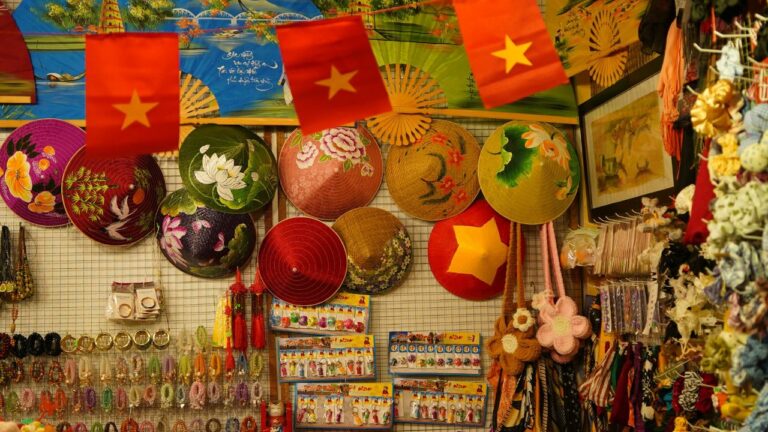
Vietnamese lacquerware, where eggshell and shell fragments glint on a deep-black or vermilion surface. “Son mai (sơn mài),” refined as art during the French colonial period, spans widely from everyday items like chopsticks and small plates to lacquer paintings hung on walls, and you can pick it up at craft shops in Ho Chi Minh City and Hanoi. Choose light, thin pieces and they fit in a suitcase too.
What is Vietnamese lacquer (son mai)?
Characteristics of son mai
Son mai is a uniquely Vietnamese lacquer technique that builds up many layers of lacquer and finishes by grinding them out. Eggshell inlay, mother-of-pearl, and gold leaf are embedded into a natural-lacquer base, and the surface is polished at the end to bring the pattern to the fore. With a deep luster based on black, vermilion, and gold, it divides into two strands: everyday lacquerware and framed lacquer paintings (art).
Why it's chosen as a souvenir
- Light and thin—Because it's lacquered over wood bases or plywood, it's lighter than ceramics and less of a burden in your luggage
- A wide price range—From affordable items like chopsticks and small plates to framed lacquer paintings, you can choose to fit your budget
- Vietnamese character—Eggshell and mother-of-pearl designs are emblems of Vietnamese craft, sparking conversation about your travels
- Both practical and decorative—It works as both tableware for the dining table and art to brighten a wall
Standard souvenirs that convey Vietnamese character go well together too.

Types and how to choose
For son mai, the way you choose differs between “lacquerware to use” and “lacquer paintings to display.” For daily use, easy-to-handle small items; to leave an impression as a gift, highly decorative pieces with inlay or mother-of-pearl.
Types of lacquerware
| Chopsticks and chopstick rests | Gold or vermilion work on a black base. Light and hard to break, easy as a hand-out souvenir |
|---|---|
| Small plates and tea saucers | The white eggshell-inlay pattern shines. A staple bought in bulk for guests |
| Small boxes and box items | Accessory and trinket boxes. Highly decorative with mother-of-pearl and lid paintings |
| Trays | Large black or vermilion pieces. An accent for the table or interior |
| Lacquer paintings (art) | Framed works depicting lotus or Vietnamese scenery. Good as wall-hung keepsakes |
Points for choosing
- Surface smoothness—Well-ground-out pieces are smooth to the touch, with little unevenness or bubbles in the lacquer
- Inlay precision—Check whether the crackle pattern of eggshell and the seams of mother-of-pearl are carefully embedded
- Weight and thickness—Considering ease of carrying home, choosing thin, light pieces makes packing easier
- Natural lacquer or resin coating—Authentic son mai layers Vietnam's distinctive natural lacquer (Annam lacquer). Affordable souvenirs are often finished with cashew resin coating, and you can roughly tell by the deep sheen and price
- Clarifying the use—Decide whether you'll use it as tableware or display it, and choose a form and size to match
Major producing areas and labels
At craft shops in Ho Chi Minh City and Hanoi, workshop-brand pieces are on display. Because inlay fineness and color tone differ by artist and workshop, comparing the actual items at the storefront reveals the differences.
| Tuong Quan | A workshop known for traditional son mai technique. Deals in lacquerware and lacquer paintings |
|---|---|
| Vu Hong Anh | A maker who handles highly decorative lacquer works |
| Huong Lien Lacquerware | A rich selection centered on everyday lacquerware |
Recommended ways to use and display
Lacquerware works on both the dining table and in the room. Being mindful of placement that brings out the luster makes it fit a Japanese home too.
- Use small plates and tea saucers for sweets and tea when guests come, and the white eggshell pattern shines
- Use small boxes for accessories or seals, placing them in the entryway or on a desk
- Stack trays on a wooden table and line up small items on top, and the black base stands out
- Display lacquer paintings framed on a wall away from direct sunlight, and enjoy the luster with indirect lighting
Here are Vietnamese traditional crafts you can likewise enjoy displaying.
Where to buy and price ranges
Specialty shops cluster in the tourist areas of Ho Chi Minh City and Hanoi, and you can also get it at markets and airports. Craft shops emphasize quality and selection; markets, price haggling.
- Craft shops on Dong Khoi Street (Ho Chi Minh City)—The central spot with a consistent quality range of lacquerware and lacquer paintings
- Hanoi's Old Quarter—Shops from small items to lacquer paintings are dotted around, easy to compare and choose
- Ben Thanh Market and Saigon Square—Many affordable small items, with room to haggle
- Airport duty-free shops—Buy in bulk before departure, handy for adding hand-out souvenirs
Refer to how to explore the two big cities where craft shops cluster, too.

Price range
| Chopsticks and chopstick rests | About 300–800 yen |
|---|---|
| Small plate / tea saucer (one) | About 500–1,500 yen |
| Small boxes and box items | About 1,000–3,000 yen |
| Trays | About 2,000–6,000 yen |
| Lacquer painting (framed) | 5,000 yen to tens of thousands of yen |
Tips for making it a souvenir
Lacquerware is light, but it has a weakness to dryness and impact. Japan's winters are dry, so paying a little attention to handling after you bring it home helps it last.
- Wood-based pieces can crack from dryness, so wrap them in cushioning and carry them between clothes
- Inlay and mother-of-pearl surfaces are weak to abrasion, so don't stack pieces—wrap each one separately
- Tableware rarely causes trouble at customs, but if worried, keep the purchase receipt
- For handing out, chopsticks and small plates; for special recipients, small boxes or lacquer paintings—use them by budget
Frequently asked questions
- Can Vietnamese lacquerware be used daily as tableware?
-
Many chopsticks and small plates are designed for everyday use and suit guests too. But strong friction, dishwashers, and microwaves damage the lacquer, so wash by hand and handle gently.
- What's the difference between eggshell inlay and mother-of-pearl?
-
Eggshell inlay crushes and embeds eggshell to create a white crackle pattern. Mother-of-pearl thinly processes shell to produce an iridescent luster, and the way they shine differs.
- Will it break if brought back to Japan?
-
Wood-based lacquerware can crack in Japan's dry winter. Wrapping it in cushioning and storing it away from sudden temperature and humidity changes is reassuring.
- Don't lacquer paintings (art) take up too much space?
-
Small framed pieces can be packed flat and carried in the bottom of a suitcase. If choosing a large piece, ask the shop whether it can be carried rolled, or consult them on packing, for peace of mind.