On July 11, the Vietnamese newspaper Dan Tri featured, with photos, an “old school of distinctive curved architecture” in Da Lat, drawing renewed attention. The subject is the former Lycée Yersin, built during the French colonial period—now Da Lat Junior College (formerly Da Lat Teachers’ Junior College). Da Lat, a highland city at about 1,500 m, bustles with direct flights from Ho Chi Minh City and summer visitors, and with the ___ scheduled for August,The reopening of Lien Khuong Airport, Da Lat's sky gatewayand access recovers further. Here we lay out, from a practical angle, the highlights of this 'impossibly beautiful old school,' whether you can visit, how to get there, and photography etiquette for working it into your itinerary.
What Is the "Arcing School Building" Reported by Dân Trí?
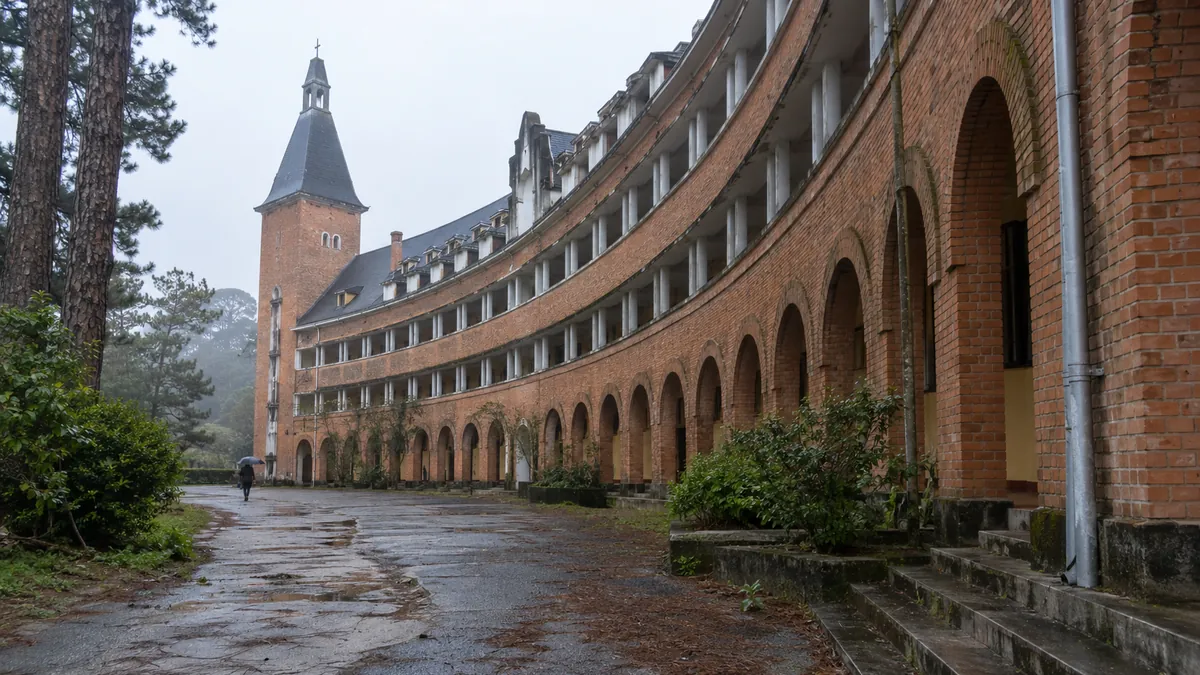
What the article focused on is the schoolhouse block that traces a long arc along the hillside slope. Seen head-on, both ends curve gently toward you, like an open book. The designer is said to have imbued this curve with the meaning "a thirst for learning," and the figure woven from red-brick walls and hillside green has become one of Da Lat's premier photo spots.
The building’s symbol is a 54-meter bell tower standing at the highest point of the grounds. The slender tower is visible from all over the city and is still in active use as a backdrop for graduation and wedding photos. Looking up from nearby, you can clearly see the coursing of the red brick said to have been shipped from Europe and the texture of the bluish dark slate roof.
From Petit Lycée to Yersin, and then to a junior college
The school's history goes back to 1927. Construction began to a design by French architect Moncet, and it opened at first as the 'Petit Lycee Dalat,' attended by French children and those of some wealthy Vietnamese families. In 1935 it was renamed Lycee Yersin after Dr. Alexandre Yersin, the bacteriologist who 'discovered' the town of Da Lat.
The building's design drew on architectural elements from Morges, Switzerland, with which Dr. Yersin had ties, expressed in features like the bell tower, steeply pitched roof, and arched cloister. In 2022 it was merged with nearby educational institutions and is now used as Da Lat Junior College. Even as its name and use have changed, the building itself has stood on the hill for more than 90 years.
Architectural specs by the numbers
Here is a list of the key verified figures. Because the curved schoolhouse’s overall length differs by source between the near and far sides, only the high-confidence items are given here.
| Item | Details |
|---|---|
| Groundbreaking | 1927 |
| Design | French architect Moncet |
| School building | Three floors, 24 classrooms, a curved layout |
| Bell tower height | 54m (standing at the highest point of the grounds) |
| Main building materials | European red brick and French roof tiles |
| National heritage designation | December 28, 2001 (architectural relic) |
The distinction of being chosen among the “1000 masterpieces of 20th-century architecture”
This building is talked about as a tourist site for more than just its looks. What sets it apart from other photo spots is the weight of expert recognition it has accumulated.
- It has been selected by the International Union of Architects (UIA) as one of the world's 1,000 most original buildings representing the 20th century.
- On December 28, 2001, it was officially recognized as a national architectural heritage of Vietnam.
- It’s repeatedly used as a location for Vietnamese films, dramas, and music videos, and locally it’s a staple for commemorative photos during graduation season.
Da Lat keeps spawning new photogenic spots like flower fields and cafés, but whereas most of those are artificially created scenery, this school differs in that nearly a century of time itself is its backdrop.A tour of Da Lat's photo spots, from Ghibli-style cafes to hydrangea fieldsJust adding this one piece of genuine historic architecture to your itinerary greatly widens the variety of your photos.
What a traveler gets from this one spot
From a tourist’s standpoint, the value of adding this school to your itinerary comes down to three points.
First,An architectural stroll to enjoy on foot in the cool highlands. Da Lat has a comfortable climate even in midsummer, and strolling while looking up at the hillside building offers a side of travel unlike a beach resort. It's close, about 2 km from town, and easy not to get lost—just head up the slope toward the bell tower.
Second,A serious cultural asset you can drop by for freethe point. As many photogenic spots move to charge admission, here there's basically no entry fee. Being able to see up close the real thing chosen among the 20th century's great buildings, without straining your trip budget, is a big draw in cost-performance terms too.
Third,A “living school” that requires considerate visitingis that. This is not a tourist facility but a working campus where students still study today. That is exactly why minimal manners—walking quietly, avoiding class hours, and not entering areas without permission—help preserve this scenery for the next traveler.
Getting there and practical visiting information
Here's the basic information worth knowing before you visit. Opening hours and photography rules can change at the school's discretion, so give priority to on-site notices and staff guidance.
| Item | Details |
|---|---|
| Name | Da Lat College (former Lycée Yersin) |
| Address | 109 Yersin Street, Da Lat, Lam Dong Province |
| Distance from the city center | About 2 km from the center (around Xuan Huong Lake) |
| Admission | Basically free (visiting hours are limited, as it's an active educational institution) |
| Flights to Da Lat | Lien Khuong Airport (scheduled to reopen in August 2026) |
| Etiquette | View quietly so as not to disrupt classes; follow the posted rules for photography |
Summary: add a slice of 'real time' to your itinerary
An arcing school building, a 54 m bell tower, red brick brought from Europe. Begun in 1927, this school has stood on Da Lat's hill for more than 90 years under changing names, and is listed among the UIA's "1,000 Notable Buildings of the 20th Century." Next time you visit Da Lat, try slotting this one spot in between the flower fields and cafés.New attractions like Fresh Garden on the flower hillTouring it as a set with ___, you can capture both manufactured photogenics and genuine history in a single day. Just check the airport’s reopening status and the site’s visiting hours before you go, and you’re well prepared.