ベトナムでは抹茶風味のラテや菓子が増えていますが、「ベトナム産抹茶」と書かれた商品がすべて日本式の碾茶を石臼で挽いた抹茶とは限りません。緑茶粉末、砂糖入りラテミックス、着色した製菓材料もあるため、産地名や「ceremonial」の表現だけで品質を判断しないことが大切です。
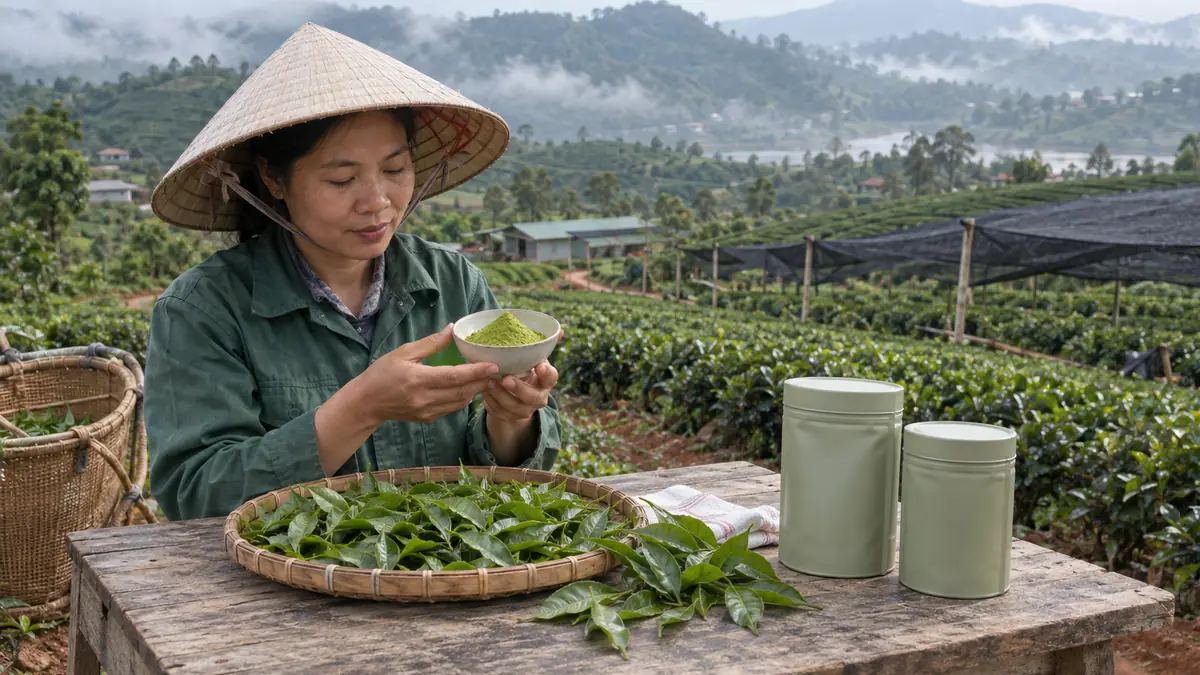
この記事ではバオロックの茶産地とDoi Depなどを紹介しつつ、公式情報で確認できる事実と販売側の訴求を分けます。買う前に原材料、製法、収穫・製造時期、保存方法、砂糖の有無を確認してください。
先に結論:お土産は表示で選ぶ
- 「100% tea」か、砂糖・香料・乳成分入りのミックスか
- 茶葉の産地と製造者が明記されているか
- 抹茶の製法説明があるか、単なる緑茶粉末か
- 遮光・密封包装で、開封後に冷暗所または冷蔵保存できるか
The fast-growing Vietnamese matcha market and its background
ベトナムで抹茶が一気に注目を集めるようになったのは2020年代以降。民間調査会社は抹茶市場の成長を予測していますが、市場規模は「抹茶」に含める商品の定義で大きく変わります。数字は公式統計ではなく、傾向を見る参考値です。ベトナム国内ではTikTok ShopやShopeeでの抹茶ラテ用パウダーの売上が急増し、カフェ・スーパー・コンビニまで広く流通するようになりました。
Three elements are driving the boom. The first is the evolution of café culture. Major chains such as Highlands Coffee and The Coffee House have added matcha drinks to their menus, and more than 10 matcha specialty cafés have opened within Ho Chi Minh City. The second is rising health consciousness. The younger generation has taken note of catechins and theanine, creating a flow of choosing matcha as an alternative to coffee. The third is the Japanese-food boom. Following sushi and ramen, matcha is being chosen as a “distinctly Japanese experience.”
Chances to encounter matcha while café-hopping or choosing souvenirs are rising sharply, making it a presence you can’t ignore as a theme for a Vietnam trip.
Vietnam’s main matcha production area: Bao Loc, Lam Dong Province
Indispensable to any discussion of Vietnamese-grown matcha is Bao Loc in Lam Dong Province. About four hours by car northeast of Ho Chi Minh City, this town sits in highland terrain at around 800 meters elevation and has long been called “Vietnam’s tea capital.” Tea cultivation began in the French colonial era, and some of the country’s largest tea fields still spread out here.
Tea leaves nurtured by 800-meter highlands and mist
バオロックの茶栽培に適した条件は3つ。年平均気温22度前後の冷涼な気候、年間を通じて発生する霧、そして粒子の細かい玄武岩質の土壌です。霧や冷涼な気候は茶栽培の特徴ですが、霧と日本式の被覆栽培は同じではありません。テアニン量や宇治・西尾との類似性は、商品ごとの栽培・分析資料がなければ断定できません。
Adoption of Japanese-style shade cultivation
From the latter half of the 2010s, Japanese-style shade-cultivation (shading) techniques were adopted in earnest in Bao Loc’s tea gardens. Covering the tea leaves with black shade nets for about 20 days raises theanine content and suppresses catechins, the bitter component—this technique is the core of high-grade Japanese matcha. In Bao Loc, several factories operate that, in addition to this method, carry out the process all the way to grinding the leaves with a dedicated stone mill.
VietGAP and organic certification
Tea gardens with an eye on exports to Europe and North America are increasingly obtaining international certifications such as Organic JAS and USDA Organic, on top of VietGAP, Vietnam’s own good agricultural practices. Meeting the demands of advanced markets with strict residual-pesticide standards has led to a quality lift across the whole production area.
Doi Dep—a premium matcha brand from Bao Loc
The name that comes up as the front-runner of Vietnamese matcha is Doi Dep, based in Bao Loc. By combining vast in-house tea gardens with Japanese-style equipment, it has pioneered Vietnam’s domestic premium matcha market, and among matcha lovers it has become an object of surprise: “can Vietnamese-grown matcha really be finished to this level?”
The origin of the brand name: “a pair of sandals”
“Doi Dep” is a Vietnamese phrase meaning “a pair of sandals.” Because sandals only function once they form a pair, the name is held up as a brand concept symbolizing “the inseverable relationship between people, between land and people, and between nature and people.” The philosophy of valuing the ties among tea garden, artisan, and consumer also has something in common with the Japanese culture of hospitality.
Adoption of Japanese-style techniques and inviting experts
Doi Depの公式サイトでは、バオロックの茶、ギフト、リゾート事業は確認できます。一方、日本人専門家の招聘、石臼挽き、テアニン値が日本産に迫るという主張は、今回確認できた公式ページでは裏づけを取れませんでした。購入時は商品の裏面表示と製法説明を優先してください。
Running a Tea Resort
What sets Doi Dep apart from other brands is that it runs a luxury “Tea Resort” integrated with the tea gardens. With villas overlooking the tea fields, a matcha-whisking experience program, and even meals in a tea-kaiseki style, visitors can not just “drink tea” but “stay in tea culture.” It is increasingly introduced as a highlight of Bao Loc tourism and is taking root as a weekend getaway from Ho Chi Minh City and Da Lat.
Product lineup
Doi Dep’s matcha products fall broadly into three grades: a ceremonial grade for the tea ceremony, a premium grade for cafés and lattes, and a cooking grade for sweets and cooking. Besides specialty shops, they have come to be seen at some upscale supermarkets in Ho Chi Minh City and at airport souvenir shops.
Differences between Japanese-grown and Vietnamese-grown matcha
What surprises many Japanese people drinking Vietnamese-grown matcha for the first time is that the flavor is lighter than they imagined. Organizing the differences from Japanese-grown matcha from a resident’s point of view looks like this.
| Item | Japanese-grown matcha (Uji, Nishio) | Vietnamese-grown matcha (Bao Loc) |
|---|---|---|
| Color | Deep, rich green | Bright yellow-green |
| Aroma | Umami-driven, like nori seaweed | Grassy, like fresh greenery |
| Flavor | Rich umami and sweetness | Light and refreshing, with a faint acidity |
| Price range (30g) | 1,500–5,000 yen | 500–1,500 yen |
| Best ways to drink | Koicha and usucha (straight) | Lattes, sweets, and cooking |
Japanese-grown is designed with an emphasis on umami, on the premise of “whisking and drinking.” Vietnamese-grown, by contrast, has restrained umami due to the difference in climate, and shows its true worth in latte and sweet uses paired with milk or sweetness. The right way to see it is not as a substitute for Japanese-grown, but as an option in a different category.
A recommendation to try a taste comparison
If you have a chance to compare the two during your Vietnam trip, we recommend giving it a try. For instance, a “two-cup” approach—whisking and drinking Japanese-grown matcha in the morning and enjoying a Vietnamese-grown latte in the evening—lets you feel each one’s character clearly.
Local cafés where you can experience Vietnamese matcha
The matcha specialty cafés increasing in each city let you try Vietnamese matcha easily, one cup at a time. We have carefully selected recommended shops from a resident’s perspective.
MIYAEN (Da Lat, Bao Loc)
A specialty café that puts Bao Loc–grown Vietnamese matcha center stage. A rare place where you can enjoy locally grown matcha in a Japanese-style space, with the appeal of freshness shipped straight from the source. For details, seethe complete MIYAEN guide.
Atelier Matcha (Ho Chi Minh City)
A matcha brand from Uji, Kyoto, opened its first overseas store in 2025. You can experience the quality of Japanese-grown matcha in Vietnam. Local-only items like the coconut-milk MATCHA latte are also worth checking. For details, seethe complete Atelier Matcha guide.
Nagocha Matcha (central Ho Chi Minh City)
Vietnam’s first Japanese-style matcha specialty chain. It uses ceremonial-grade matcha from across Japan—Kyoto, Uji, Kagoshima, Fukuoka, Shizuoka, and more. For details, head tothe Nagocha Matcha guide.
Yakishime (Can Tho)
A Japanese-style matcha café in Can Tho, the central city of the Mekong Delta, that embodies the Japanese aesthetic of wabi-sabi. For details, seethe complete Yakishime guide.
How to buy Vietnamese matcha as a souvenir
Once you think you’d like to “take home” a flavor you liked at a café or “give it to family or friends,” it pays to know where you can buy it as a souvenir. Being able to get a premium grade at a more reasonable price than Japanese-grown is an appeal unique to Vietnam.
Upscale supermarkets
ホーチミンのAnnam Gourmet Market、ハノイのIntimex、全国チェーンのCo.opMartやWinMartなどで、ベトナム産抹茶のリテールパッケージが買えます。価格は店舗・原料・容量で変わるため、VND表示と正味量を確認します。Doi Depなど主要ブランドの製品も取扱店舗が増えています。
Brand-direct and tea specialty shops
You can buy authentic Vietnamese matcha mainly at Doi Dep’s direct shop inside the Tea Resort, as well as at tea specialty shops such as Trà Việt (a Vietnamese-tea specialty store). The price is a little higher, but the appeal is the reassurance of having the origin and even the production date clearly stated.
Airport duty-free shops
Souvenir shops in the departure areas of Tan Son Nhat International Airport (Ho Chi Minh City) and Noi Bai International Airport (Hanoi) also carry Vietnamese-grown matcha. Keep it in mind as a last chance if you forget to buy any right before flying home.
Online (before and after your trip)
You can also buy matcha from major brands like Doi Dep on platforms such as Shopee Vietnam, TikTok Shop, and Lazada. It is handy if you want to try before your trip or place a reorder after returning home. More shops now support international shipping to Japan as well.
Recommended Vietnamese matcha souvenirs by recipient
The best way to choose changes depending on “who you’re giving it to.” Here are recommendations organized into four patterns from a resident’s point of view.
For a matcha-loving friend
「セレモニアル」は国際的に統一された公的等級ではありません。日本産との比較を楽しんでもらえる「飲み比べギフト」として機能します。Doi Depなど産地・ブランドが明確なものを選ぶと話題が広がります。
For tea lovers and the parents’ generation
A set with Vietnamese green tea or lotus tea is recommended. It lets them experience the whole world of Vietnamese tea.A roundup of Vietnamese tea souvenirsandA feature on lotus teais also worth referring to.
For the health-conscious or as office handouts
Café-use powder or tea-bag types (10–20 bags, 500–800 yen) are convenient. They make a highly practical souvenir that people can enjoy by making lattes at the office.
For yourself or a cooking lover
Cooking grade (100g, 700–1,200 yen) is a good deal since you can use plenty in sweets and dishes. With wide uses—Japanese and Western confections, matcha lattes, matcha salt—it’s easy to work into everyday cooking.
Frequently asked questions
Here is a roundup of questions frequently asked before buying Vietnamese matcha souvenirs.
Q. Can I bring Vietnamese-grown matcha back to Japan?
A. For processed powdered matcha, there are no special restrictions on bringing it into Japan. However, since separate rules apply to bringing in large quantities for commercial use, please enjoy it within the scope of personal souvenirs.
Q. How long does it keep?
A. As a guide, about 1 to 1.5 years from production while unopened. After opening, refrigerating it and finishing it within a month is recommended.
Q. Can I whisk it the same way as Japanese matcha?
A. You can whisk it with the same chasen, but since Vietnamese-grown has a lighter flavor, it is better suited to lattes and sweets. If you do whisk it, the trick is to adjust it on the thin side, with more hot water for a small amount.
Q. Can I visit Doi Dep’s Tea Resort as a tourist?
A. Yes, you can. Bao Loc is about four hours by car from Ho Chi Minh City and about two hours from Da Lat. It accommodates everything from a day trip combining a tea-garden tour and a matcha experience to an overnight stay.
Q. Is there Vietnamese matcha with organic certification?
A. Some premium brands have products certified by Organic JAS or USDA. Check the certification mark on the package when choosing.
A summary of choosing Vietnamese matcha souvenirs
Vietnamese-grown matcha is growing fast as “another Vietnamese-grown indulgence” next to coffee. Led by Doi Dep from Bao Loc, a distinctive matcha culture fusing Japanese-style techniques with the local climate has blossomed all at once over the past few years. Not as a substitute for Japanese-grown matcha but as a new option for lattes, sweets, and cooking, it offers a worthwhile choice for both souvenirs and yourself.
For related local café information and Vietnamese tea souvenirs in general, please also refer to the articles below.
- [Latest] Crowd-pleasing Vietnamese tea souvenirs | A roundup of recommended brands and where to buy
- The complete MIYAEN guide
- The complete Atelier Matcha guide
- The complete Nagocha Matcha guide
- The complete lotus tea guide
まとめ:抹茶という名前より、原材料と製法を見る
バオロックは茶産地として知られ、Doi Depも現地茶ブランドとして公式に確認できます。ただし、緑茶粉末と日本式抹茶、ラテミックスは別の商品です。健康効果や等級名に引かれる前に、原材料、産地、製法、砂糖、包装を比較してください。
ストレートで飲むなら少量を試飲し、ラテや製菓なら用途に合う粉末を選ぶのが現実的です。高温多湿のベトナムでは、購入後の遮光・密封と、帰国後の早めの消費も品質を左右します。