Quy Nhon is a beach city in Binh Dinh Province in south-central Vietnam. Less crowded than resort-heavy Nha Trang, it's a laid-back town where crystal-clear water coexists with the ruins of the Champa Kingdom. The emerald-hued Ky Co Bay and Eo Gio (Egg Beach) draw plenty of visitors. This page covers everything from an overview of the city and how to get around to classic spots, a model itinerary, food, and souvenirs, and links out to separate articles on cafés, news, and souvenirs.
| Location | Binh Dinh Province, south-central region |
|---|---|
| Population | About 450,000 people |
| Best season | February–August |
| Suggested days | 2 days |
| Language | Vietnamese (English also understood in tourist areas) |
| Currency | Vietnamese dong (VND) |
| Time difference from Japan | -2 hours |
What kind of city is Quy Nhon?
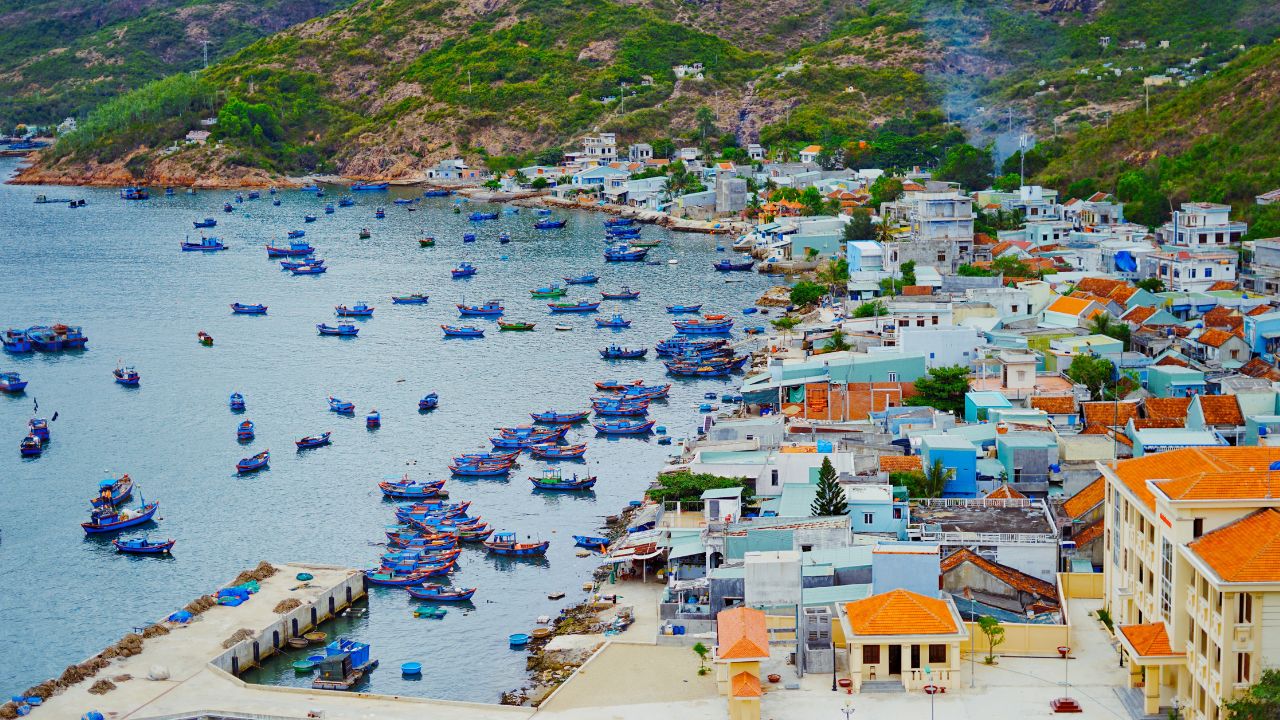
Quy Nhon City is the capital of Binh Dinh Province, a port city of about 450,000 people. As a hidden beach town in south-central Vietnam, it is gradually becoming known among Western backpackers. Less touristy than Nha Trang, its appeal lies in being able to spend time on quiet beaches while feeling local life. It’s also a town with many repeat visitors drawn by the brick towers from the Champa Kingdom era, the stunning views of Eo Gio cape, and fresh seafood. Quy Nhon is an area favored by Western backpackers as an off-the-beaten-path beach town where tourism development has not yet advanced. It’s just a 30-minute drive from downtown to Eo Gio cape and Hoang Hau Beach, and you can enjoy local life on quiet beaches with few tourists. Brick towers from the 11th–12th century Champa Kingdom era (Banh It Towers, Doi Tao Tower) are scattered around the city, letting you touch its distinctive history and culture. Recently, the FLC Group’s large-scale resort development (FLC Sunstar) has also progressed, and it is gradually taking shape as a resort area as well.
Getting to Quy Nhon and getting around
One hour by domestic flight from Ho Chi Minh City (Phu Cat Airport). 45 minutes by taxi from the airport to the city. 1.5 hours from Hanoi. Rail travel is also possible, about 12 hours by overnight sleeper from Ho Chi Minh City.
Accommodations line the central city beach, and evenings are lively with locals. Head to Ky Co and Egg Beach by boat or car. The Champa towers are scattered in and around the city, and touring them by car is efficient.
Classic sightseeing spots in Quy Nhon
We've summed up the representative spots in a quick-reference table. Use it as a guide when planning your route.
| Spot | Notes |
|---|---|
| Quy Nhon Beach | A quiet arc-shaped beach directly linked to the city |
| Eo Gio cape (Wind Gorge) | A cliff about 30 minutes by car from the city |
| Hoang Hau (Queen’s) Beach | A cove carpeted with egg-shaped round stones |
| Banh It Towers | 11th–12th century Champa towers standing on a hill |
| Ong Nui Temple (Linh Phong Temple) | A giant white Buddha seated atop a mountain |
| Ky Co Beach | A crystal-clear cove reached by speedboat |
Quy Nhon Beach
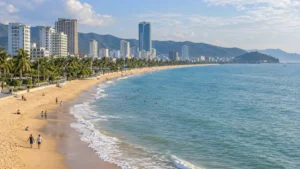
A bow-shaped stretch of sand running about 4 km right in front of the city, with fewer tourists than famous resorts, where everyday seaside scenes unfold as locals stroll and bathe morning and evening. The waves are relatively calm, and the sunrise seen through the palm-lined avenue and beyond Ghenh Bridge is beautiful. Since most accommodations are along the coastal road, you can walk out to the sea without any transfers—an appealing point. The early hours around 6–7 a.m. have few people and soft light, making it good for both strolling and photos.
Eo Gio cape (Wind Gorge)
A cape at the tip of the Nhon Hai peninsula, with a walkway maintained along the curving cliffs, where you can look down from above at the scenery of rough waves crashing against sheer rock faces. Its name means “the pass of the wind,” and because sea winds blow strongly through it, it’s known as a place to enjoy the scenery on foot rather than swim. About 30 minutes by car or motorbike from the city, with a walking loop of the cape taking about 1–1.5 hours. Early morning, before the wind picks up and with less backlighting, is easier for walking, and the coloring of the twilight sky is also a highlight.
Hoang Hau (Queen’s) Beach
A small cove strewn with smooth, egg-shaped round stones polished by the waves, where a distinctive stone-beach—rather than sandy—landscape unfolds. Once considered a retreat associated with Nam Phuong, Vietnam’s last empress, it’s commonly called Queen’s Beach. Close to Eo Gio cape, it’s conveniently located to visit together with peninsula sightseeing. Since the stones get slippery when wet, easy-to-walk shoes are reassuring, and it’s easier to photograph the run of stones at low-tide times when the waves have receded.
Banh It Towers
A late 11th–12th century brick relic of the Champa dynasty built on a small hill, with several towers remaining including the main tower and a gate tower; the main tower stands over 20 meters tall. You can see up close the decorations influenced by Hindu culture, such as reliefs of the sacred bird Garuda and various gods. Because it’s on a hill, you can look out over the surrounding fields and river beyond the towers, and it’s easily accessible about 20–30 minutes by car from the city. Since there’s little shade from the sun, a morning or evening visit to avoid the heat, along with a hat and water, is recommended.
Ong Nui Temple (Linh Phong Temple)
A temple standing halfway up Mount Chop Van in Phu Cat district, about 30 km north of the city, where a white seated Buddha statue—said to be one of the largest in Southeast Asia—towers atop the mountain. It’s about 600 stone steps up to the elevated area with the Buddha, and once you reach the top you can take in a sweeping view of green mountain ranges and the coastline. Access is a little under an hour by car or motorbike from the city, and you’ll want to allow about 2–3 hours for the visit including the steps. Since the stairs are long and there’s little shade, it’s best to visit in the cool morning with easy-to-walk shoes.
Ky Co Beach
A cove beyond the Nhon Hai peninsula, called the “Maldives of Quy Nhon” for its white sand and highly transparent water. Since the land route is rugged, it’s common to cross by speedboat from a pier near Eo Gio, and you can enjoy swimming and snorkeling. Combining it with Eo Gio cape, an efficient way to go is to walk the cape in the morning, then move to the sea around 9–10 a.m. Since the sun is strong and shade is limited, prepare plenty of sun protection and water.
Sample courses for Quy Nhon
Day 1: In the morning, stroll Quy Nhon Beach in the city and have bun cha ca for breakfast at a stall. During the day, head to the Nhon Hai peninsula, walk the Eo Gio cape walkway, then go to the egg-stone shore of Hoang Hau (Queen’s) Beach. If you have the energy and time, cross by boat to Ky Co Beach and enjoy a swim. In the evening, savor banh xeo tom nhay and seafood dishes at a coastal eatery.
Day 2: In the cool morning hours, visit the Champa ruins at the hilltop Banh It Towers. Next, head to Ong Nui Temple about 30 km north of the city, climb the roughly 600 steps, and take in the mountaintop white Buddha and the coastline view. Return to the city, and wrap up by buying banh it la gai and nem cho Huyen as souvenirs.
Food and specialties of Quy Nhon
Here’s a table of local flavors to try in Quy Nhon.
| Dish | Characteristics |
|---|---|
| Bun cha ca Quy Nhon | A rice-noodle soup topped with fish-paste cakes (cha ca), whose Quy Nhon character comes from a clear broth made with fresh sea fish and springy, chewy cakes. It’s a staple eaten as breakfast at stalls and eateries, adjusted to taste with lime, chili, and herbs. |
| Banh xeo tom nhay | A small rice-flour galette made with freshly caught small shrimp used as they are, named “jumping shrimp” because the shrimp are so fresh they leap. The outside is crisp and fragrant; you wrap it with bean sprouts and greens in rice paper or fresh vegetables and eat it with a dipping sauce. |
| Nem cho Huyen | A representative fermented pork of Binh Dinh Province, characterized by a sweet-and-sour flavor wrapped in the scent of guava leaves and a good balance of moderate fat. Besides eating it as is, a local way to enjoy it is to lightly grill it over charcoal and taste it with a sauce containing chili and garlic. |
| Banh it la gai | A triangular local sweet—which also gave the Banh It Towers their name—of glutinous rice and mung-bean paste wrapped in leaves and steamed. The scent of the leaves, the chewy dough, and a faint sweetness harmonize in a simple treat often chosen as a souvenir. |
| Seafood dishes | Fitting for a fishing-port town, there are many restaurants along the coast where you can enjoy seafood such as shrimp, squid, and shellfish—steamed, grilled, or in soup. Since tourism hasn’t advanced too far, you can enjoy fresh catch relatively unpretentiously at local eateries. |
Souvenirs to buy in Quy Nhon
We've summed up distinctly Vietnamese souvenirs by item (item names link to individual pages).
| Item | Genre | Notes |
|---|---|---|
| Nuoc mam (fish sauce) | Food | Available at markets, supermarkets, and the airport |
| Cashew nuts | Food | Available at markets, supermarkets, and the airport |
| Vietnamese coffee beans | Food | Available at markets, supermarkets, and the airport |
| Vietnamese pepper | Food | Available at markets, supermarkets, and the airport |
| Basket bags | Goods | Available at markets, supermarkets, and the airport |
Best season, budget, and trip preparation
The best season is the dry season from February to August. Swimming is best from April to August. Be mindful of the rainy season and typhoons from September to December.
Budget: about 5,000–12,000 yen a day. Quy Nhon's specialty, bun cha ca (fish cake noodle soup), is famously served at "Bun Cha Ca Quy Nhon – Phan Boi Chau," where a bowl costs around 400 yen. Phu Cat Airport is a 1-hour domestic flight from Ho Chi Minh City or Hanoi. Train travel is also an option—an overnight sleeper from Ho Chi Minh City takes about 12 hours (around 3,000 yen). With few tourist sites and sparse crowds, Grab and taxi use is relatively low here, and getting around mainly means walking or taking motorbike taxis.
Points to note
Since it’s a town in the middle of tourism development where English isn’t always understood, a translation app comes in handy. Boat tours may be canceled due to weather, so leave room in your schedule. The sun is strong, so sun protection is essential.
Quy Nhon hotels and where to stay
Quy Nhon splits between the city beach, where town and sea meet, and resorts in the quiet coves on the outskirts. Where you stay changes the feel of the trip.Quy Nhon hotel guideFrom the city beach to the quiet resorts, we cover the best places to stay by area, with a quick-reference table and individual notes alongside their actual Google Maps ratings.
Quy Nhon on the map