In the Q1 statistics released by the Vietnam National Administration of Tourism at the end of April 2026, it came to light that visitors to Vietnam from South Korea reached about 1.33 million (up 17% year on year). Combined with mainland China's over 1.4 million, the two countries alone account for over 40% of the total 6.76 million international visitors. In March alone, they drew about 2.1 million, and double-digit growth of 12.4% continues. It's the result of a denser flight network, big flight increases by Korean Air, Asiana, VietJet, and Vietnam Airlines, and micro-trip demand that positions Da Nang, Nha Trang, and Phu Quoc as "overseas reachable in 3 to 5 hours from Seoul." For Japanese readers, changes are becoming pronounced, such as "there are situations in Da Nang where Korean gets you further" and "the beaches, cafes, and spas that Japanese and Koreans favor are subtly divided."
"40% from two countries, China and South Korea": what happened in Q1
According to statistics reported in late April by Sai Gon Giai Phong (en.sggp.org.vn), about 1.33 million visitors came from South Korea between January and March 2026, up 17% year over year. Combined with mainland China's more than 1.4 million, the two countries alone accounted for over 40% of the 6.76 million total international arrivals. In March alone, international arrivals approached 2.1 million, setting a new monthly record. Far ahead of Japan (4th), Taiwan (3rd), and the United States, the figures confirm South Korea remains one of Vietnam's most important source markets for tourism.
An official of the Korea Tourism Organization explained in an interview with a local Vietnamese paper that in full-year 2025, Vietnam took in over 4.3 million of the roughly 29.6 million people who went abroad from South Korea, consistently ranking among the top three overseas destinations. A flight network from Seoul and Busan links the five cities of Hanoi, Ho Chi Minh City, Da Nang, Nha Trang, and Phu Quoc, and access of just 3 to 5 hours each way fit the trend of "micro-trips (short, frequent travel)" perfectly.Da Nang was chosen No. 2 in the "Top 9 Asian Summer Destinations,"and behind this too is this ultra-bullish demand from the Korean side.
Da Nang goes "mini-Seoul": from Bach Dang to An Thuong
As the South China Morning Post (SCMP) reported in detail in spring 2026, a phenomenon is occurring where Da Nang is called "more an extension of Busan than Vietnam" by Korean visitors. The An Thuong district, running from Bach Dang Street along the coast to My Khe Beach, is lined with Korean barbecue joints with Hangul signs like "Hwaro House" and "Meat Plus Da Nang," and Korean fried chicken chains like BHC and CHIR straight out of Seoul; at night, the streets fill with the Korean of Korean tourists and owners.
SCMP introduced local Vietnamese operators' voices, such as "you can't do business in An Thuong without Korean" and "Koreans living permanently in Da Nang, together with Hanoi and Nha Trang, exceed 20,000." Schools, hospitals, beauty clinics, and jjimjilbang (Korean-style saunas) are all in place, and wealthy Koreans touring real estate as a side trip while sightseeing are also increasing.Even in Da Nang Food Tour 2026's new "eat with the five senses" concept,Korean guides and Korean-language menus are becoming standard.
The Korean visitor market in numbers
| Item | South Korea (Q1 2026) | Japan (for reference) | Notes |
|---|---|---|---|
| Q1 visitor numbers | About 1.33 million | About 250,000 | South Korea is five times Japan |
| Year on year | +17% | About +9% | South Korea sharply higher |
| Main destinations | Da Nang, Nha Trang, Phu Quoc, Hanoi | Hanoi, HCMC, Hoi An | Beach-oriented |
| Spending per person | About 1,000-1,500 dollars/week | About 800-1,200 dollars/week | More shopping |
| Average length of stay | 4-5 days (short and frequent) | 5-7 days | South Korea is short and frequent |
| Main direct flights | Korean Air, Asiana, VietJet, Vietnam Airlines, Jin Air, T’way, and over 30 others | JAL, ANA, VN Airlines, VietJet, and others | South Korea over 300 flights a week |
| Peak months | March to May, October to December, January Lunar New Year | March-April, September-December | Tied to long holidays |
| Typical repeat segment | Families (three generations), newlyweds, golf | Couples, women's groups | Different family makeup |
Korean visitors have a strong micro-trip orientation of "short, frequent, nearby," and it's not unusual for people to visit Vietnam two or three times a year. LCCs from Incheon, Gimpo, and Busan (Jin Air, T’way, Jeju Air) offer direct Da Nang flights for 300 to 500 dollars each way, and there's a thick segment moving on packages of a three-night, four-day resort stay plus golf (Ba Na Hills GC, Montgomerie Links). It's a rhythm in contrast to the Japanese "once a year, one-week stay."
K-pop visitor draws go into full swing: Hanoi Lotte Mall Tay Ho's "Hallyu Fan Tour"
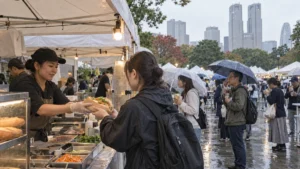
The Korea Tourism Organization (KTO) Vietnam office held the "Korean Culture and Tourism Festival 2026" at Hanoi's Lotte Mall Tay Ho from April 23 to 26, 2026. Under the theme "Hallyu Fan Tour," it brought together packages touring K-pop music video locations, along with Korean food, cosmetics, and K-drama costume experiences.Vietnam's 10 architectural-revival cafesThe fact that many Korean creators are involved in these too is an extension of this cultural exchange.
Reactions from industry figures are lively too. The head of the KTO Vietnam office commented to VietnamPlus, "Just as Vietnamese are drawn to K-pop, Koreans are drawn to Vietnam's 'local yet refined cafes and food.'" SCMP introduced a local hotel manager's voice, "On peak Saturdays there are days when 70% of calls are in Korean, 20% Vietnamese, and 10% English," conveying that the operational language on the ground has effectively gone Hangul. On X too, posts from Japanese travelers can be seen here and there, such as "the proportion of Korean signage in central Nha Trang is high" and "there are time slots when Japanese can't use the pool because a Korean group has booked out the resort."
Impact on Japanese readers: how to make the most of the "Seoul feel despite being Vietnam"
The concentration of Korean visitors is especially pronounced in the three cities of Da Nang, Nha Trang, and Phu Quoc, and Japanese travelers have three options. (1) Deliberately ride the Korean wave: enjoy An Thuong's Korean barbecue, Korean ingredients at Lotte Mart, and 24-hour jjimjilbang (Sunrise Sauna, Saigon Sauna) as a "Vietnam trip that doubles as a Korea trip." (2) Divide the territory: choose French bistros in Da Nang's French quarter, local seafood in Nha Trang's old town, or quiet southern resorts in Phu Quoc (JW Marriott, Premier Village). (3) Choose a different city: build your trip around Quy Nhon, Da Lat, and Hoi An's old town, where Korean visitors are still few, and the"photo-studio-ified" cafe clusteron the outskirts of Hanoi.
Another big benefit is being able to enjoy the "multinationalized streetscape that Korean visitors leave behind." At Da Nang's supermarkets "Big C" and "Co.opmart," Korean instant ramen (Shin Ramyun, Jin Ramen, Buldak Bokkeummyeon), CJ Bibigo kimchi, and Pulmuone tofu have become staples, expanding "Japan-Korea-Vietnam" options alongside Japanese grocery stores. Nightlife venues in Nha Trang like Sailing Club and Skylight Rooftop have also standardized K-pop playlists for Korean visitors, blending in seamlessly for young Japanese guests too.
Ripple effects on the industry: three structural changes in hotels, aviation, and retail
The steady inflow of over 4 million Korean visitors is changing the structure of Vietnam's tourism industry. First, five-star hotel operations. Hyatt Regency, Sheraton, and InterContinental keep at least three to five Korean-speaking staff on site, and lining up Korean-style rice porridge (juk), kimchi, and kimchi jjigae at the breakfast buffet has become standard. Second, aviation. The Incheon-Da Nang route alone operates over 300 flights a week, rivaling the Japan-Honolulu route, and competition among four LCCs has pushed prices down to around 300 dollars each way. Third, retail. Korean supermarkets "K-Market" and "Korea Mart" in Da Nang and Nha Trang are accelerating franchise expansion, and kimchi and gochujang are penetrating even among local Vietnamese customers.
78% of Vietnamese travelers change their destination on the advice of a spiritual adviserIn parallel with this psychological trend on the Vietnamese side, on the Korean side too, travel plans tied to MBTI diagnosis and astrology are increasing, and a new travel category of spiritual plus an Asian beach is emerging in both countries.
Practical information: "happily dividing the territory" with Korean visitors in Da Nang and Nha Trang
| Category | Details | Notes |
|---|---|---|
| Korean grocery supermarkets | Da Nang K-Mart (Phan Chau Trinh), Nha Trang Korea Mart | Well stocked with kimchi and ramen |
| Korean-style jjimjilbang | Sunrise Sauna (Da Nang), Saigon Sauna (HCMC) | Open 24 hours |
| Korean barbecue | Hwaro House、Meat Plus、CHIR | Centered on An Thuong |
| K-pop cafes | Hello Kitty Cafe (Da Nang), Coffeeholic Now | Social-media-worthy |
| Areas for Japanese visitors | Da Nang: around Han Market and the Son Tra Peninsula, southern Phu Quoc | Fewer Korean visitors |
| Territory-dividing tip | Early morning (6-9 a.m.) and late night (after 10 p.m.) are comfortable for Japanese | Korean visitors concentrate from 10 a.m. to 10 p.m. |
| Incheon-Da Nang direct | Korean Air, Asiana, VietJet, Jin Air, T’way, and over 30 others | Over 300 flights a week |
| Fare reference | Incheon-Da Nang 300-500 dollars each way, Hanoi 400-700 dollars | Including LCCs |
Summary: a new Vietnam where "Japan, Korea, and Vietnam" mingle
The 1.33 million Korean visitors in Q1 2026 is a figure symbolizing structural change in Vietnam's tourism market. Da Nang, Nha Trang, and Phu Quoc have risen to a status that could be called "another Jeju Island," with a Korean flavor seeping into everything: the streetscape, food, lodging, and retail. The conclusion for Japanese travelers is to "not reject it, not absorb too much of it, and divide the territory wisely." Keep three points in mind: (1) enjoy Korean infrastructure like Korean groceries and jjimjilbang as a secondary pleasure, (2) avoid the popular hours (10 a.m. to 10 p.m.) and prioritize morning and evening local experiences, and (3) put cities where Korean visitors are still few, such as Quy Nhon, Da Lat, and Hoi An's old town, on your list. Do that and you can fully enjoy a new Vietnam trip where Japan, Korea, and Vietnam coexist. When you next plan a trip to Da Nang, before you feel a Hangul menu is "in the way," read what it tells you about where the destination stands today.
Source
・Saigon Giai Phong – Chinese, Korean tourists lead Vietnam’s international arrivals in early 2026
・South China Morning Post – Da Nang’s South Korean tourism boom
・VietnamPlus – Korean micro-trip trend
・Vietnam.vn – Korean Culture and Tourism Festival 2026 Hanoi