On Thuy Khue Street, near West Lake in central Hanoi, walk about 50 meters down the alley at No. 29 and you’ll find a small stall with steam rising from a white steaming cloth. The banh cuon (a Vietnamese-style crepe made from thin steamed rice flour) served here costs 15,000 dong a plate — about 86 yen. While the same dish nearby runs around 30,000 dong (about 171 yen), you can get breakfast here for half that. As VnExpress reported, what draws people to this couple’s shop isn’t the price itself so much as the fact that they’ve kept it unchanged for 70 years. It’s a useful pick for Japanese visitors staying in Hanoi who want to experience a local morning at non-tourist prices.
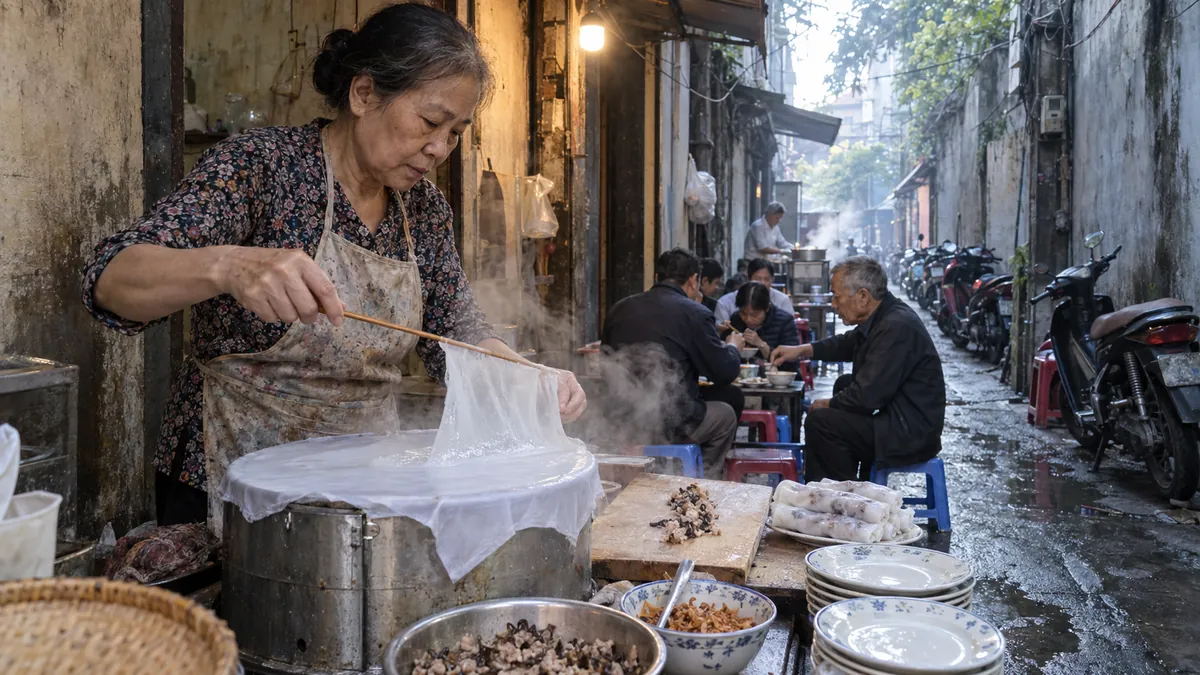
A couple run separate stalls deep in the alley at No. 29
Running the shop are Nguyễn Thị Thu Hà (61), who steams the batter at the entrance of the alley, and her husband Phạm Văn Chinh (65), who mans a second stall more than 100 meters away. Though it’s a single family business, the couple takes the unusual approach of each making the same banh cuon at a separate location. The aim is to spread out the morning crowd and catch regulars at both ends of the alley.
Hà stretches a white cloth over a pot of boiling water and spreads a thin layer of rice flour batter mixed with water over it. After the batter steams for a few dozen seconds, she lifts it off with a bamboo stick and rolls it around pork stir-fried with wood ear mushroom. She also makes the fried shallots herself. Every step is done by hand, giving a thinness in the finished product that mechanized, mass-production shops can’t match.
15,000 dong, barely changed in 70 years
This stall’s origins go back to the 1950s. It was first opened by Chinh’s mother, and the couple took over the business in the mid-1980s. Counting from the mother’s generation, that’s about 70 years of history; even counting only the couple’s own run, it’s nearly 40 years. Hanoi’s prices have risen many times over during that span, but the price per plate has only crept up very gradually.
The foundation of the low price is a family-run operation with no labor costs and minimal, self-managed sourcing. Banh cuon alone costs 15,000 dong, and the side of meatballs (chả) costs 5,000 dong (about 29 yen). A dish that would run tens of thousands of dong per serving at a tourist-oriented shop is kept at a price local office workers can afford to stop by for every morning. They wake before dawn at 4 a.m. to start prepping, and the stall is open from 6 a.m. until 11 a.m. or noon. The busiest time is 7 to 8:30 a.m., when regulars stop by one after another on their way to work.
How cheap this plate is, compared with the going rate nearby
Here’s where the price stands, alongside a rough yen conversion. As of September 2026, the exchange rate used is approximately 1 yen = 175 dong, or 10,000 dong ≈ 57 yen.
| Item | Price (dong) | Yen guide |
|---|---|---|
| This shop’s banh cuon | 15,000 | About 86 yen |
| Side of chả (meatballs) | 5,000 | About 29 yen |
| Average going rate for the same dish in Hanoi | About 30,000 | About 171 yen |
| Hours | 6 a.m.–11 a.m. or noon (busiest 7–8:30 a.m.) | |
| Share of regulars | About 70% of customers have been coming for decades | |
Lining up the numbers shows this plate sits at half the going rate, while still involving the labor of hand-steaming each portion. The low price isn’t a compromise on quality — it’s made possible by the family handling every step of the process themselves.
A 4.7 rating on Google, yet still described as ‘cramped’
Reviews of the shop are mixed. On Google it scores a high 4.7 out of 5, with many comments noting the quality relative to the price. Customers who’ve been coming for decades make up about 70% of visitors, and trust in the taste and price has built a base of loyal regulars.
At the same time, because it’s a stall tucked deep in an alley, seating is cramped and the chairs are simple ones lined up on the street. Comments about the space feeling cramped remain. It’s not suited for travelers expecting a clean interior or air conditioning. What happens here is a relationship where people satisfied with the taste and price just keep quietly coming back — this isn’t a shop selling comfort. Knowing this gap in expectations ahead of time will save travelers from being caught off guard by this back-alley breakfast.
How travelers can find their own go-to spot
What this shop demonstrates is a way to spot a satisfying breakfast in Hanoi. Lining up at a famous shop listed in a travel guide is one option, but alleys where local office workers stop by before heading to work still have shops that strike a good balance between price and taste. You can narrow the judgment down to three factors.
First, are seats turning over with local customers between 7 and 8 a.m.? Second, is the batter being hand-steamed on the spot, or is it pre-made and reheated? Third, does the price fall within the local range (10,000–20,000-something dong) rather than the tourist range (tens of thousands of dong)? Hanoi’s breakfast culture runs deep not only in pho and banh mi but in stalls like this one serving banh cuon. Visiting both the famous shops with lines and the alley shops that have blended into local life reveals the full range of food this city has to offer.
In a Vietnam where prices keep rising and both ingredients and utility costs are climbing, keeping the price unchanged is a tightrope walk for the business. Even so, the reason the couple sticks to this price is probably that their long relationship with regulars forms the foundation of their sales. For travelers, it’s an experience of being let in on that foundation, just once.
When to visit, and how to find your way down the alley
If you’re visiting, go around 9 a.m. when the crowds ease up, or between 7 and 8 a.m. if you want to experience the liveliness. The location is about 50 meters down the alley at No. 29 Thuy Khue Street. Since the couple run two stalls, if you don’t find one at the entrance, there’s another further down the alley. Cash is the safest bet for payment, and having 10,000-dong and 5,000-dong notes ready makes checkout smoother. In Vietnam, motorbikes line the sidewalks along morning alleys, so it’s safer to carry your bag in front of you as you walk.
For those who want to dig further into Hanoi’s breakfast scene, an article touring famous pho shops (Hanoi pho: lines stretched outside historic and Michelin-listed shops on National Day morning) and a story about someone who took over the family food business (A 3-time-Michelin eel glass noodle shop taken over by a daughter who closed her US nail salon) are also worth reading to get a sense of this city’s food depth. If you want to compare the price gap between street stalls and shops with lines,A 2030-yen hot-plate banh mi in Saigon, 6 to 10 times the street price, still draws a linethat’s another useful reference.
Next time you wake up to a morning in Hanoi, consider skipping the hotel buffet and walking down to this alley instead. That 86-yen plate offers, beyond its price, a breakfast that lets you taste the time of someone who has put down long roots in this city.
Sources: VnExpress「Hàng bánh cuốn ‘vợ chồng’ bán giá 15.000 đồng trong ngõ ở Hà Nội」