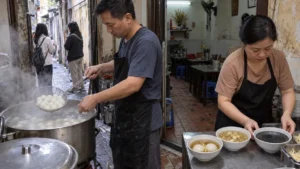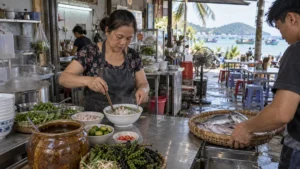
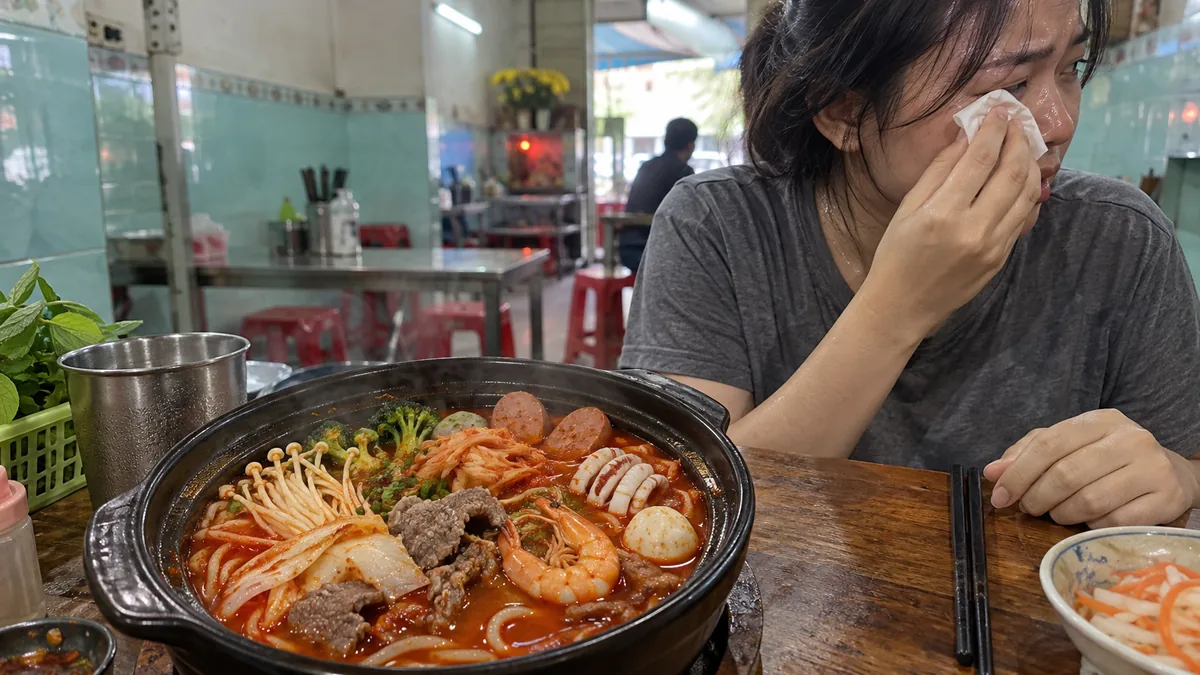
Wiping away sweat and tears while slurping a bright-red broth—the '7-level super-spicy noodles (mi cay)' that have become familiar on Vietnamese social media. The name that first comes up as the spark is 'Sasin,' created by actor Quoc Truong. Lately, though, a Vietnamese TikTok user has argued that 'the real originator isn't Sasin,' setting off a small debate. The name called out is 'Mi cay Omega,' open since 2012 in Can Tho, the central city of the Mekong Delta. It reportedly served these super-spicy noodles a full four years before Sasin went nationwide. For travelers, that means one more pleasure: hunting down 'another originator' that isn't a tourist spot with a queue.
What Exactly Is the "Seven-Level Spicy Noodle"?
Mi cay is a local food born where Korean instant-noodle culture met Vietnamese street noodles. Thick noodles simmered in a bright-red, chili-spiked broth, with the heat selectable by level — that's its biggest feature. The gradations vary by shop, but a rough guide is seven levels: the lower ones are a pleasant tingle even for Japanese palates, while the top levels become a "challenge tier" that has sweat bursting out with every bite. In Vietnam, a game spread of filming yourself taking on the top heat and posting the teary-eyed footage to Facebook or YouTube. That was the driving force that pushed mi cay from a passing fad to a fixture.
Beef, shrimp, squid, enoki mushrooms, fish paste, fried fish balls, sausage, kimchi, broccoli, pickled daikon—the generous pile of toppings is another reason this noodle dish satisfies as a meal. It’s cheap, filling, and photogenic. For young Vietnamese, few meals out check all three boxes like this.
Sasin, the “face” of the boom
Mi cay exploded nationwide around 2016 to 2018. The face of that wave was Sasin, run by popular actor Quoc Truong. Helped by the clarity of a celebrity brand, its outlets multiplied quickly, especially in urban student districts, and the image of 'super-spicy noodles = Sasin' took hold. For many people, their first experience of mi cay was, you could say, Sasin's red broth.
The Question of Who's "the Original"
The one who threw a stone at this received wisdom is TikTok user Quoi. What he presented was a simple timeline: back in 2012, about four years before Sasin became famous, Omega in Can Tho was already serving the same seven-level ultra-spicy noodles — that was his point. Rather than claiming to be the "originator" on the strength of nationwide name recognition, it reframes the question of who actually started first.
What’s interesting is that Omega still quietly survives. With a plain look in blue and black, it doesn’t stand out next to flashy celebrity brands. Yet its reputation for flavor runs deep, and plenty say “the broth is richer—I prefer this one.” Losing on flash, it’s starting to be re-evaluated as a place with taste and history to talk about.
Omega in numbers
| Item | Details |
|---|---|
| Founded | 2012 (Can Tho) |
| The Difference from Sa Sin | About four years earlier |
| A rough guide per bowl | about 70,000 dong (about 420 yen) |
| Spiciness | Choose from 7 levels |
| Current presence | Various parts of the south, including Can Tho, Ho Chi Minh City, Soc Trang, and Vinh Long |
*Yen conversions at roughly 60 yen per 10,000 dong (a guide as of July 2026; exchange rates fluctuate). 70,000 dong is the price range for the works (thap cam); with fewer toppings you can eat a bit cheaper.
How travelers can enjoy it
Omega's appeal lies in being able to taste an “everyday local meal” at non-tourist prices just as it is. A bowl priced at about 420 yen is less than half the price of ramen in Japan. You are asked to pick a spice level when ordering, so if it is your first time, starting at level 2 or 3 is safe. If it feels lacking, bump it up a notch next time. Ordering the top level right away and leaving it unfinished is a common failure in Vietnam too, and there is no need to force it. Even people who handle spice well feel the perceived temperature change sharply from around level 5, so keep water and tissues within reach.
When choosing a place, whether it's packed with locals is one gauge. In Vietnam, the more a shop's customers are almost all locals, the more likely it is a hitThe golden rule for picking a good shopand the same goes for finding a spicy-noodle shop. You'll go wrong less often trusting how crowded the shop in front of you is than a celebrity's name. Can Tho, with things like durian buffets,A food experience unique to the source regionis also strong in this city, so pairing it with the ultra-spicy noodles for a day of “eating your way through the Mekong” is fun.
What mi cay reflects about Vietnam's dining-out scene today
That this 'originator debate' catches fire on social media at all reflects the maturing of Vietnam's dining scene. Where 'famous shop = the right answer' once ruled, a crowd that digs into origins and stories for fun has now grown up. In Japan too, as is well known, there's a pleasure in seeking out a bowl loved by locals over a shop with a queue. In Ho Chi Minh City as well,Eating Your Way Through the Alleys in Search of Regional Flavorsis winning support, and the reappraisal of mi cay is part of that flow. Light falling on a shop that has quietly carried on in the shadow of flashy brands is a welcome change for travelers too.
Summary
Sa Sin certainly popularized the seven-level ultra-spicy noodles. But the one that actually started first was Omega in Can Tho—that’s the point here. Next time you have a chance to visit the Mekong Delta, look for the plain blue-and-black sign. About 420 yen a bowl, and you choose the heat yourself. Whether you shed tears is up to your level.