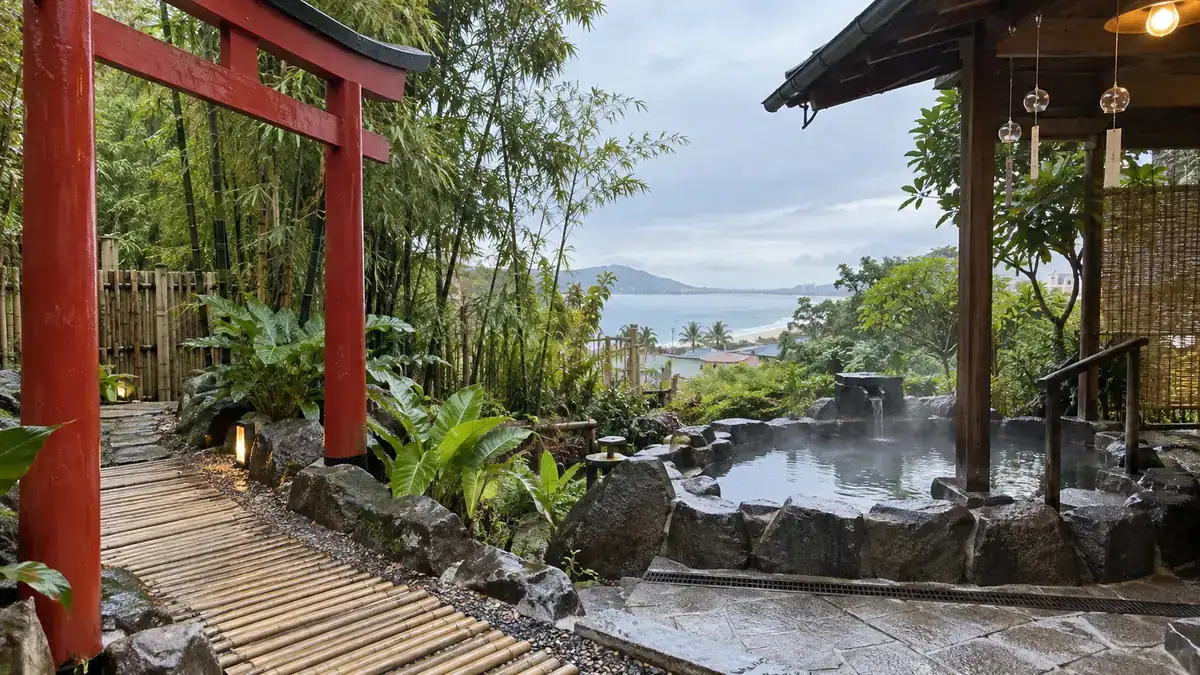
Along the beach in Quy Nhon, there's a Japanese-style facility where passing through a red torii gate brings you to open-air baths and bluefin tuna sashimi. It's Yuragi Chaya Quy Nhon. On July 9, 2026, Gia Lai Province's tourism authorities officially designated it a 'tourist site.' Torii gates and hot springs familiar to Japanese visitors have become an official destination on the central Vietnamese coast, giving Quy Nhon trips one more reason to stop by.
Gia Lai Province Grants "Tourist Site" Designation on July 9
The designation came from Gia Lai Province's tourism, culture, and sports authority, dated July 9, 2026. Alongside Yuragi Chaya Quy Nhon, sites including Kon Ka Kinh National Park, Ham Ho Rosa Alba, and the FLC Quy Nhon wildlife park were also recognized as tourist attractions at the same time. Behind this is the "Vietnam National Tourism Year 2026 (Nam Du lich Quoc gia 2026)," overseen by Gia Lai, and a province-wide push to unearth new destinations continues. With the 2025 provincial reorganization merging Binh Dinh into Gia Lai, it's also notable that a province once thought of as landlocked now holds Quy Nhon, a seaside tourist city.
Red torii and open-air baths: inside “little Japan”
The facility opened on October 10, 2024. Located in Hoi Son, Nhon Hoi district, it is known locally as “Little Japan.” A red torii gate and a bamboo path run through the grounds, and wind chimes hang from the eaves. At its heart is a hot spring, with open-air baths, family baths, a sauna, and a path to walk barefoot. You can rent yukata and try a tea ceremony, and it has spread on local social media as a photogenic Japanese-style space.
The dining centerpiece is the on-site Japanese restaurant 'Tuna House.' Alongside bluefin tuna sashimi, there's Kagoshima wagyu and lava-grilled wagyu. The cafe-and-breakfast area 'RIKIRIKI' also offers BBQ. There's no lodging, but with morning baths and breakfast on offer, it's built so you can stay through from morning to night.
Run by a Japanese Tuna Company, with Freshness as Its Weapon
The tea house is said to be run by EverTrust Foods, a Japanese company that processes and exports tuna in Vietnam. That the restaurant is named "Tuna House" and puts bluefin front and center is the kind of idea only a company that handles seafood itself would have. Being a tourist facility, yet run by a food player with strengths in raw materials and freshness, sets it apart from a mere "Japanese-style theme park." On the central Vietnamese coast, it sells an experience that fuses Japanese hot-spring culture with its own tuna — a practitioner's build that designs food and tourism as a continuous whole.
What it means for Japanese travelers
Honestly, travelers from Japan have little reason to go out of their way for something “Japanese-style.” The real value lies rather in how it raises the walkability of Quy Nhon as a city. Yuragi Chaya sits 15 minutes from the Eo Gio scenic area and 15 minutes from the Quy Nhon Twin Towers, positioned to tour together with nearby sights. Known for its clifftop scenery,At Eo Gio, a seaside show sends up large fireworks at nighthas also begun, making a plan of beaches and scenery by day and a soak in the hot spring in the evening realistic. Ease a body worn out from long-distance travel in the open-air bath before heading to the next town—used that way, it will resonate plenty with Japanese travelers.
The other is its value as a "nearby retreat" for Japanese living in Vietnam. There aren't many seaside spots you can reach on a single domestic flight from Ho Chi Minh City or Hanoi where a bathtub and breakfast await. The repeat demand of a weekend with the family may actually be the bigger draw.
How to get there, and rough costs
Quy Nhon’s air gateway is Phu Cat Airport (UIH). Domestic flights operate from Ho Chi Minh City, Hanoi, Da Nang, and elsewhere, and from Japan you’ll generally connect in one of these cities. The airport to downtown is roughly 30–40 minutes by car.This summer, Vietnam's domestic flights are being greatly increasedso seats are easier to get than before. If you prefer rail, the nearest station is Dieu Tri on the North–South line, andA period when summer rail fares are 10% offyou can also keep long-distance sleeper travel cheap.
What’s published on pricing is a monthly membership plan at 3 million dong (about 18,000 yen at 10,000 dong ≒ 60 yen). It gives a 50% ticket discount and use of the open-air baths up to twice a day. Since one-off admission and meal prices aren’t officially stated, check directly with the facility before visiting. It’s said to open from an early-morning bath through to night, with a discount set for the 7 p.m. to 9 p.m. window.
Summary
Yuragi Chaya Quy Nhon is less a place where Japanese go to see “Japan” than a practical stop where you can take a breather in a hot spring during a Quy Nhon trip. Fold it into a half-day plan together with the Eo Gio fireworks and the Twin Towers, and time your visit for the season of increased domestic flights—that suits how to enjoy it now. Just note that single-visit prices are not public, so be sure to confirm in advance.