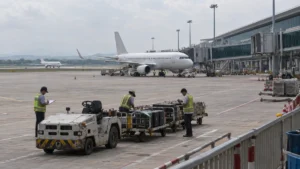
On July 10, 2026, Dong Nai Province in southern Vietnam simultaneously held groundbreaking ceremonies for three trunk roads leading to the Long Thanh International Airport under construction. The total sum being poured in is about 12 trillion dong, or roughly 456 million U.S. dollars (converted at about 26,000 dong to the dollar). The airport itself completed a technical opening in December 2025, and the start of commercial operations at year-end is imminent. About 40km east of central Ho Chi Minh City, in a place long called “the airport in the distant rice fields,” the connecting infrastructure has finally begun to take shape.Long Thanh's new airport, with a within-the-year opening now in sightFrom the standpoint of someone who actually uses it, breaking ground on these roads is the very fork that decides whether it "really becomes convenient."
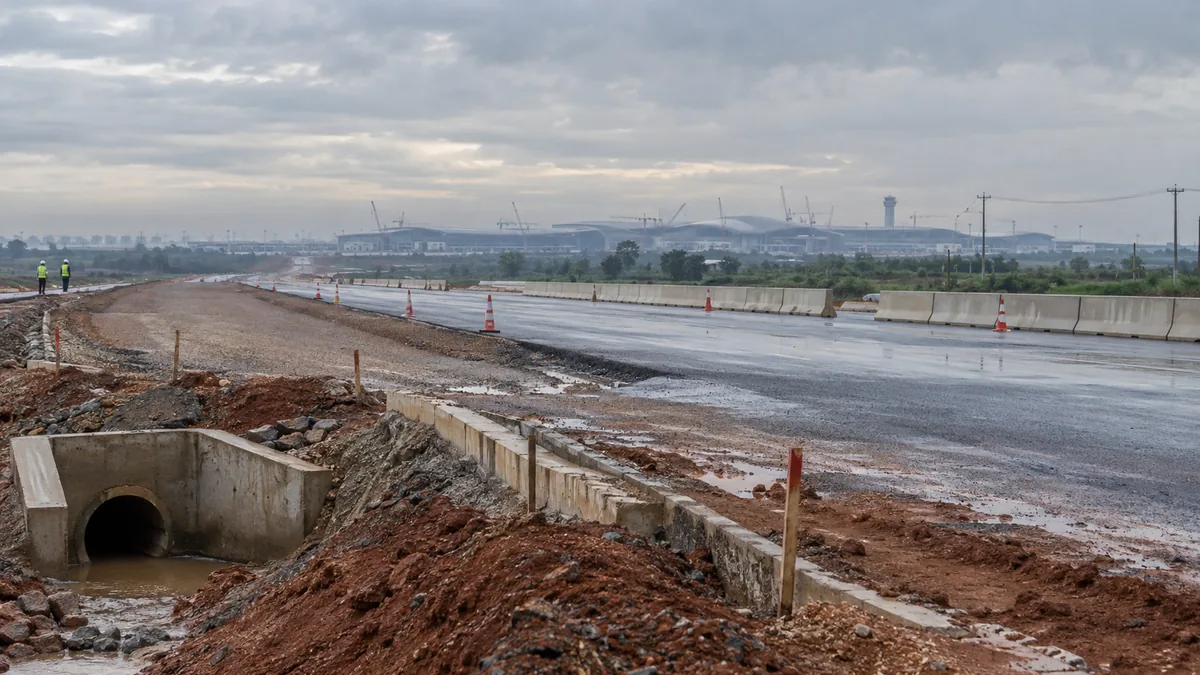
What broke ground: inside the three roads
Broken ground on at the same time were three provincial roads that Dong Nai Province is developing. Each links the airport with existing expressways, national highways, and ports, and the plan reworks not merely “the road in front of the airport” but the region’s very logistics flow.
The centerpiece is the newly built Provincial Road 770B, about 43km long. Designed as a new freight corridor linking National Highway 1, Ring Road 4, and industrial-park clusters with the airport, it requires more than 370 hectares for land alone. Provincial Road 769 is a connector directly linked to the airport's second gate, joining National Highway 1 (Dau Giay intersection) and National Highway 51 (Loc An intersection). Provincial Road 773 widens an existing road to 6–8 lanes, with a design speed of 80 km/h.
Opening at year-end: why this timing now
Long Thanh Airport is planned to handle 25 million passengers a year in its first phase, and once complete, the lead role for international flights in the Ho Chi Minh City area shifts here from Tan Son Nhat. Already,The plan to move Ho Chi Minh City's international flights to Long Thanhis taking shape, and even if the runways and terminals are finished, users will be worn down by the journey if the roads reaching the airport are thin.
Prime Minister Pham Minh Chinh set the deadline for commercial operations at the fourth quarter of 2026 and has repeatedly urged speeding up expressways such as Bien Hoa–Vung Tau, Ben Luc–Long Thanh, and Ho Chi Minh City–Long Thanh–Dau Giay. These three provincial roads are the pieces that fill the “last few kilometers” between that expressway network and the airport gates. It is natural to see this as a last-minute groundbreaking to keep the opening and road construction in step.
The scale of investment in numbers
Lining up the scale of the three roads and the airport itself makes clear that this project isn't confined to Dong Nai Province alone.
| Item | Scale | Investment amount |
|---|---|---|
| Provincial Road 770B (new) | about 43 km, 6 lanes plus 2 mixed lanes | About 4.7 trillion dong (about 179 million dollars) |
| Provincial Road 769 (widened, directly linked to the airport) | About 29 km, six or more lanes | About 2.8 trillion dong (about 106 million dollars) |
| Provincial Road 773 (widening) | About 39km, 6–8 lanes | About 4.3 trillion dong (roughly $164 million) |
| Total for the three roads | About 111 km | about 12 trillion dong (about 456 million dollars) |
| Long Thanh Airport itself | Phase 1: 25 million passengers a year | About 336 trillion dong (about 12.8 billion dollars) |
The 456 million dollars for roads is only about 3.5% of the airport's own 12.8 billion dollars. Even so, what determines the passenger's felt experience is, more often than not, this "3.5%" side.
What’s being said locally
Picking up the points raised by stakeholders and reports around the groundbreaking, it becomes clear that the roads aim at logistics and congestion relief before tourism.
- Provincial Road 770B is a trunk corridor linking the expressway, industrial parks, logistics hubs, and the airport; once complete, it will open a new freight route and is expected to ease congestion on existing roads and lower transport costs, Dong Nai Province explains.
- The prime minister also cited a plan for an urban railway linking Suoi Tien, Bien Hoa, and Long Thanh, signaling an approach that builds airport access on both road and rail.
- Running in parallel, the widening of the Ho Chi Minh City–Long Thanh expressway (to 8–10 lanes, about 610 million dollars) targets service in December 2026, and the whole road group is moving in step with the airport's opening.
The practical meaning for travelers and residents
Let's consider what this construction brings to our travel, narrowed to three practical points.
First,'Opening' doesn't mean 'instantly convenient'A cool head is called for here. Even if commercial operations begin at year-end, major new construction and widening like Provincial Roads 770B and 773 are multi-year projects. If you use flights to and from Long Thanh right after it opens, traffic will concentrate on the Ho Chi Minh City–Long Thanh expressway for the time being, so figure around an hour for the 40 km from the city center—more during congestion or events—to be safe. You need to consider the airport's glamorous opening news and the on-the-ground travel time separately.
Second,Confirming your departure airport becomes the top priority in trip planningFor the time being, in the Ho Chi Minh City area, the ones near the city centerTan Son Nhat Airport, expanded with Terminal 3and Long Thanh, 40 km to the east, will coexist. Even for the same 'Ho Chi Minh City' trip, a different arrival airport means a different distance and different means into the city. It's wise to always check the airport code on your ticket or e-ticket (Tan Son Nhat is SGN; Long Thanh gets a new code) before deciding on transfers or hotel location.
Third,Options to Stay and Play on the Dong Nai Side Become RealisticThat's the point. Once the road network is in place, the area around the airport and the Bien Hoa direction turn into "within reach as a side trip on a connection." For business travelers heading to Vung Tau's beaches or the eastern industrial zones, a route emerges that goes straight from the airport without detouring through central Ho Chi Minh City. Even on a short stay, you can use the idea of shifting your base east of the Ho Chi Minh City center.
Long Thanh Airport access basics
| Item | Details |
|---|---|
| Airport location | Long Thanh, Dong Nai Province (about 40 km east of central Ho Chi Minh City) |
| Technical opening | December 19, 2025 |
| Commercial operations target | Q4 2026 (year-end) |
| Phase 1 handling capacity | 25 million passengers a year |
| Main access expressways | HCMC–Long Thanh–Dau Giay Expressway, Bien Hoa–Vung Tau Expressway |
| The provincial roads begun this time | 770B, 769, 773 (about 111km in total, about 456 million dollars) |
Summary: three things to confirm
Breaking ground on Dong Nai Province's roads all at once is a grounded step toward keeping Long Thanh Airport from ending up as "just a box." But for travelers and residents, convenience is decided not by the opening ribbon-cutting but by when the roads enter service. Three things are worth nailing down before you travel. First, whether your flight uses Tan Son Nhat or Long Thanh. Second, if it's Long Thanh, the means and time to get into the city and the going rate for fares. Third, whether the Ho Chi Minh City–Long Thanh expressway widening opens on schedule at the end of 2026. Tracking the progress of these roads, not just the airport's opening date, is the shortcut to planning travel in southern Vietnam wisely.