West of central Hanoi, down a narrow alley at 29 Thuy Khue Street, a married couple sells banh cuon for 15,000 dong a plate — about ¥89. The wife works a steamer near the alley entrance; the husband works his further in, in front of their home. As VnExpress reported on September 10, 2026, the shop opens every morning at 6, with customers concentrated between 7 and 8:30. In a city where the same plate often goes for around 30,000 dong, why does a price close to half the going rate draw attention? We dig into both the value of stepping one alley further in as a traveler, and what a food business owner can take from it.
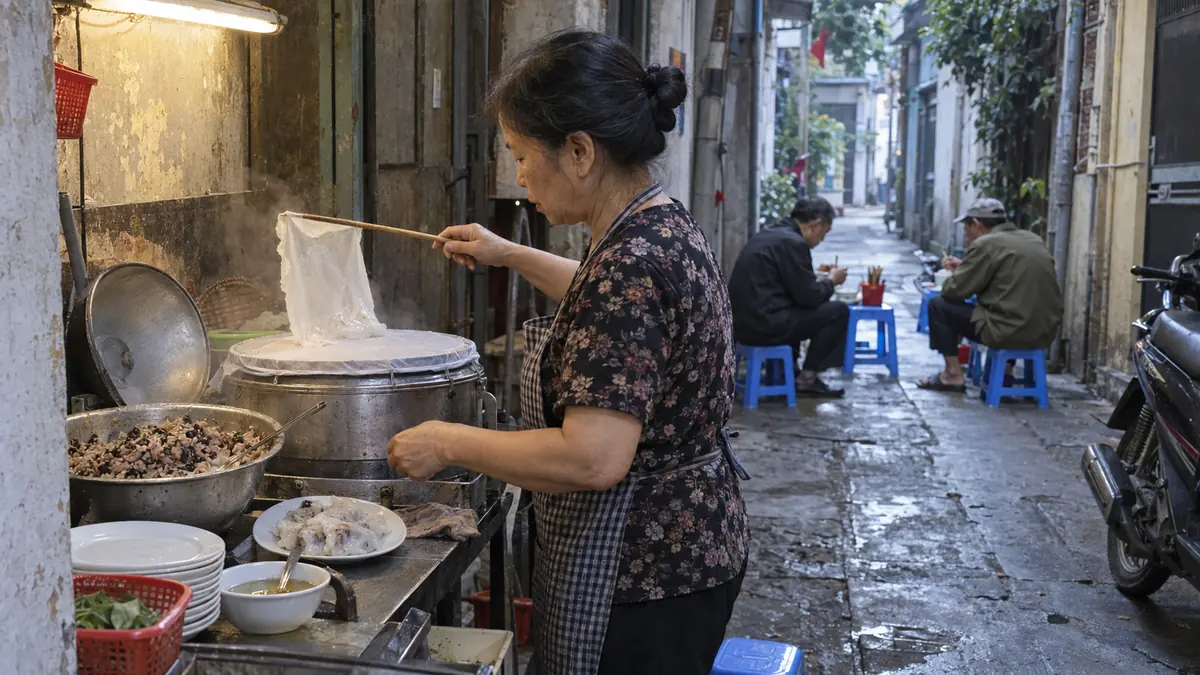
The wife at the entrance, the husband further in — two steamers run by a married couple
Running the shop are the wife, Nguyen Thi Thu Ha (61), and the husband, Pham Van Chinh (65). Banh cuon has been the family's trade since Chinh's mother started it in the 1950s at the top of La Pho slope (dau doc La Pho), and the couple took it over in the mid-1980s. VnExpress introduces the family's banh cuon as a “70-year” tradition. Now based in the alley off 29 Thuy Khue, Ha steams at a small stand about 50 meters from the entrance, while Chinh works about 100 meters further in, in front of their home. It's less a single storefront than a couple splitting the alley between two spots.
To make banh cuon, rice batter mixed with water is spread thin over a cloth stretched across a steamer, and once it's cooked through, it's rolled up with a thin bamboo stick. The filling is pork and wood ear mushroom that Ha stir-fries herself. The couple gets up at 4 every morning to start prepping and opens at 6. No machines — just cloth and a bamboo stick, steaming sheet by sheet, run this shop's mornings.
Why can they sell it for 15,000 dong?
VnExpress reports that a plate of traditional banh cuon costs 15,000 dong, with the side of cha (a pork paste product) at 5,000 dong. In Hanoi, the same plate often goes for around 30,000 dong, and the article positions this shop as “among the cheapest in Hanoi.” That said, the article doesn't explain why it's this cheap. The reasoning behind the price has to be read from how the shop is run and who its customers are.
No hired staff — a business run by just the couple
What is clear is that the couple handles everything themselves — sourcing, prep, steaming, and plating — at their small alley stand. They don't hire staff and don't run the business from a spacious storefront or prominent location. It's natural to assume that without a large dining area or a prime spot, their outside costs stay low. Still, since rent, cost of goods, and profit margin aren't disclosed, you can't pin down the “breakdown of the low price” in numbers. What's worth taking away here is simply the fact that a family business with minimal staffing and a modest location coexists with a low price.
A base of roughly 70% regulars
Chinh says, “About 70% of our customers are regulars, and we recognize almost every face.” A business where the same faces show up every morning works on different pricing assumptions than a shop chasing a broad base of first-time customers. Whether the low price drew the regulars, or the regulars are what lets the price stay low, isn't something you can settle without data. Even so, the fact that price and a loyal customer base coexist here is a clue for not reading the price purely as a marketing gimmick.
In a Hanoi where the going rate is 30,000 dong, how does an ¥89 plate look?
Converting the figures to yen makes this shop's position easier to see. The exchange rate used is about 168 dong per yen, as of September 10, 2026.
| Item | Price (dong) | Yen equivalent (approx.) |
|---|---|---|
| One plate of banh cuon | 15,000 | ¥89 |
| Cha (side dish) | 5,000 | ¥30 |
| Typical Hanoi going rate | About 30,000 | About ¥179 |
By Japanese standards, that's a breakfast plate under ¥100. When gauging whether a meal out is a good deal, the cost of living in Hanoi isn't uniform either. In September, for instance, household gas prices rose again, pushing up the cost of cooking at home (household gas prices rose again this September). Even as living costs shift around it in the same city, this 15,000-dong plate holding steady is what makes the shop stand out.
What can Japanese restaurants and food makers take from this?
What this one plate offers goes beyond a simple “cheap and delicious” story. It's about keeping a low price without cutting corners on the work, and running the business on a relationship with regular customers. From here on, read this not as the shop's own circumstances, but as a perspective for Japanese food producers to apply to their own operations.
Think of low prices as a “relationship,” not a “discount”
In Japan's restaurant and food-making world too, rising costs often force a choice between raising prices or shrinking portions. With a high share of regulars like this shop, it's easier to see who's buying how often. Remembering the faces of the people who keep coming back, rather than chasing new customers first — even at a completely different scale, that's a hint for not treating pricing as pure arithmetic.
Don't hide the handwork — show it
Steaming sheet by sheet with cloth and a bamboo stick is a process that, viewed purely for efficiency, is a candidate for automation. And yet, seeing customers walk all the way down the alley for it shows that showing the handwork itself explains the taste and builds trust. For Japanese producers and food-processing operations — including dried vegetables — not hiding a labor-intensive process, and instead communicating it, can build a sense that the price is justified. It reads as one example of how low prices and careful craftsmanship can coexist.
What do regulars and reviews say about the shop?
The shop's reputation shows up both in its rating and in the comments. The Google rating VnExpress cited stood at 4.7 out of 5 at the time of reporting. Reviews lean toward satisfaction with the price, though some mention the cramped space and the awkward access.
- In Google reviews, satisfaction with the price is at the center of the rating.
- On the other hand, some mention it's hard to find in the alley and that seating is tight.
- The score reflects the time of reporting and may shift up or down as more reviews come in over time.
Having both satisfaction with the price and complaints about tightness and access sitting in the same reviews shows the reputation isn't just about taste. Getting a high score despite the drawbacks likely means satisfaction with the price and flavor outweighs them.
How to get to 29 Thuy Khue Street, and tips for ordering
It's tucked in an alley, and the address alone isn't enough to find the stand. It helps to remember that the stand near the entrance belongs to the wife, Ha, and about 100 meters further in is the husband, Chinh. To avoid the crowds, right after opening at 6, or around 9 once the peak eases, are the easiest times to visit.
| Item | Details |
|---|---|
| Location | The alley at 29 Thuy Khue Street (Ngo 29 Thuy Khue, Hanoi) |
| Sales floor | About 50m from the entrance = wife Ha / about 100m further in = husband Chinh |
| Hours | Daily, 6:00–11:00 or 12:00 |
| Busy hours | 7:00〜8:30 |
| Rough bill | Banh cuon 15,000 dong + cha 5,000 dong (about ¥119) |
| Google rating | 4.7 / 5 (at time of reporting) |
Rather than finishing your morning with just one shop, you could treat it as the start of a food crawl. Hanoi's pho crawl, where lines stretched at old-guard shops and a Michelin pick alike on National Day morning (Hanoi pho: lines stretched outside historic and Michelin-listed shops on National Day morning) was an article about the crowds of a special day, but it makes good reading material to compare against this alley's cheap plate. If you want to see the opposite end of the price spectrum, Saigon's griddled banh mi, sold at several times a street stall's price yet still drawing lines (Saigon's ¥2030 griddled banh mi) sits alongside it — put them together and you can see Vietnamese dining stretching across both “cheap” and “premium.”
Next time, step one alley into a Hanoi morning
This 15,000-dong banh cuon isn't a shop you can sum up by price alone. A family's handwork going back to the 1950s, and a relationship with regulars whose faces they know, are what hold up a plate that comes to ¥89. If you find yourself in Hanoi some morning, it's worth peeking down the alley at 29 Thuy Khue before stepping into a shop on the main road. Order a plate at the entrance stand, add the cha, and it comes to about ¥119. There's a case for starting your first morning of the trip right here.
Sources:
VnExpress, “Hang banh cuon vo chong ban gia 15.000 dong trong ngo o Ha Noi” (September 10, 2026)VnExpress article
Exchange rate: exchangerate-api (about 168 dong per yen, as of September 10, 2026)