Christine Ha, the Vietnamese-American chef who won season 3 of the US audition show 'MasterChef,' is rewriting the food memories she inherited from her family into a new story. She is a blind cook who lost her sight, and without hands-on teaching from her mother, she has recreated Vietnamese dishes relying only on the memory of their taste. This portrait, conveyed by local media Saigoneer in late June 2026, doesn't end as a mere feel-good tale. For travelers who want to taste Vietnamese food more deeply than as "a dish at a tourist spot," it's a perfect entry point to learn the history and regional differences behind the food.
A cuisine that began in a kitchen without a mother
Christine Ha was born to a family with roots in northern Vietnam. The family moved south around the 1954 Geneva Accords, and on April 29, 1975, her father is said to have hurried to marry her mother just before fleeing to the United States. After the Philippines, Guam, Pennsylvania, and Chicago, they settled in Houston, Texas, when she was two.
Her mother passed away when she was 14, so she was never taught to cook nor left any written recipes. Then, while studying creative writing in graduate school, she developed a rare autoimmune disease, neuromyelitis optica (NMO), and gradually lost her sight. No taste of her mother's cooking, no steps seen with her own eyes. All that remained to her was what her tongue had memorized as a child. This work of 'filling in the missing pieces' is at the core of her cooking.
From the blog "The Blind Cook" to the top of TV
The turning point was the blog "The Blind Cook," which her then-boyfriend (now husband) John Suh helped launch. A casting scout found it, leading to her appearance on 'MasterChef' season 3, broadcast in 2012. What she served at the audition was the Vietnamese home dish cá kho tộ (catfish braised in a clay pot). She didn't cut the fish Western-style but served it cut lengthwise, the way they do it in Vietnamese markets. The unadorned dish moved the judges.
She beat about 100 contestants to win, taking home 250,000 dollars in prize money and a book deal. The cookbook born from the show, "Recipes From My Home Kitchen: Asian and American Comfort Food," became a New York Times bestseller. She then sat on the judging panel of "MasterChef Vietnam (Vua Đầu Bếp)" Season 3 in 2015 - the first "former contestant to become a regular judge" on any country's MasterChef.
The “northern pho” and home cooking she talks about
The home cooking Ha describes carries regional differences that travelers rarely notice from guidebooks alone. In her family, rooted in the north, pho had thicker noodles and was eaten with herbs and condiments kept to a minimum. It's a completely different thing from the southern style you meet in Ho Chi Minh City, piled with fresh herbs and bean sprouts. Many travelers have surely felt that 'it's the same pho, yet the taste differs from shop to shop,' and one cause of that difference lies in this distance between northern and southern food cultures.
The dish she recalls eating "most often growing up" is thit kho (thịt kho / caramelized braised pork). At Tet (Lunar New Year), her mother made eight-inch-square banh chung (bánh chưng / a sticky-rice dish wrapped like a parcel). Both are dishes deeply rooted in Vietnamese home cooking—the taste of everyday memory, unlike the showy plates of stalls and restaurants.
Vietnamese food, "rewritten" in Houston
In 2019, Ha opened "The Blind Goat," a 15-seat open kitchen inside a Houston food hall. Born in the Year of the Goat and a blind cook - the name layers those two. Here, dishes where memory and experiment cross paths line up, such as one inspired by McDonald's apple pie but accented with a caramel of star anise, ginger and nuoc mam (fish sauce).
In September 2020 she opened “Xin Chao” with Tony Nguyen of Saigon House, serving modern Vietnamese food paired with cocktails made from tequila and sugarcane. The contrast between her — “less is more; I want to keep the seasoning restrained” — and Tony, who favors bold flavors, gives the restaurant its shape. She sees Vietnamese-American food as having been “stuck” since the 1970s, but says she is strongly drawn to new street foods created by the younger generation, such as bánh tráng trộn and bánh tráng nướng.
A takeaway for travelers — make a dish's 'backstory' your souvenir
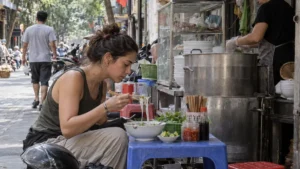
What Ha's story teaches travelers is that if you take Vietnamese food not just as "where and what you ate" but as "why it tastes that way," the memories of the trip grow many times richer. Why pho noodles and herbs differ between north and south, the meaning of wrapping banh chung at Tet, how a home cook's thit kho differs from a shop's. Knowing even one of these backstories, the bowl you have when you sit down on a stall's stool enters your mouth not as mere local food but as "the story of that place."
In practice, it's recommended to be conscious of comparing north and south as you travel. In Hanoi, the clear northern-style pho and bun cha; in Ho Chi Minh City, the herb-heavy southern style. If you order on the premise that the contents change even for the same dish name, failures turn into discoveries. The movement of the street stalls themselves is part of the fun of travel, and it helps to grasp changes in city transport in advance. In Ho Chi Minh City,From July, 134 bus routes become freeand it has become easy to use as a way to get around on a food crawl.
The 'taste of Vietnam' carried worldwide by overseas-Vietnamese chefs
Like Ha, overseas-raised Viet Kieu chefs spreading their homeland's flavors to the world have become a current of their own. Someone chasing a Michelin star in Singapore, a couple fermenting nuoc mam in a Greek garden to recreate the taste of home, a woman who quit a job at Google to bake banh mi—Vietnamese food is opening from "something only of its homeland" into "something rewritten anywhere in the world." As these figures put home memories and regional stories on the plate, the depth of Vietnamese cuisine grows year by year.
This movement isn't unrelated to people who enjoy Vietnamese food in Japan, either. Beyond pho and banh mi taking root in Japanese towns, what will draw attention next is likely a deeper context like "regional differences" and "home cooking." Background knowledge picked up on a trip also raises the resolution with which you choose Vietnamese restaurants after returning home.
Practical information and related links
If you're making Vietnamese food one of your trip's goals, it's smart to combine cities where you can taste the north-south differences. Touring northern Hanoi and southern Ho Chi Minh City on a single trip gives you contrasting food experiences even with something as simple as pho. If you're interested in the stories of overseas Viet chefs making their mark abroad,The overseas-Vietnamese woman who quit a Google executive role to bake banh mi in Singaporethe story of, andAn overseas-Vietnamese couple who spent two years fermenting nuoc mam in Greece to recreate the taste of home, read before or after your trip, deepens the flavor of the local food even more.
Summary
Christine Ha's journey shows that cooking is something "taught" and, at the same time, something "reclaimed from memory." If you travel Vietnam next, before slurping a bowl of pho, look up just one thing about how north and south differ. When you sit down on a stall's stool, the dish in front of you should feel that much more three-dimensional. And after returning home, order the same dish at a Vietnamese restaurant in Japan, and the memory of the trip comes back once more. That's the most luxurious way to bring a trip home through food.