A couple who rebuilt the "taste of home" from scratch in a Greek garden
On the outskirts of Thessaloniki, Greece's second-largest city, sits a 5,700-square-meter plot of land. There, a Vietnamese couple, Trúc and Quỳnh, grow vegetables in their own garden, mill rice into noodles, and ferment fish sauce (nước mắm) by salting fish bought at the port. They spend two years deliberately making, by hand, condiments they could simply buy. Behind this lies the situation of the Việt kiều (overseas Vietnamese), who had no choice but to rebuild the "taste of home" from the ground up in their new country. As interest in moving abroad and dual-base living grows in Japan too, it's a story rich with insight for anyone thinking about how far food culture can travel.
Many people bring back local ingredients and seasonings before or after a trip to Vietnam, but this couple's efforts go a step further. Without relying on imports, they complete the entire process on-site, from growing the raw materials to fermentation.
Time gained through investment migration, work that wasn't permitted
The couple moved to Thessaloniki in 2019, using a European residency-by-investment program (so-called investment migration). The following year, in 2020, they bought a house with land. However, the residency status they obtained did not permit salaried employment. So at the age of fifty, the two chose to "retire" and began studying Greek with the goal of obtaining citizenship.
As the only Vietnamese household in the area, the couple began recreating fragments of their home life by hand to ease their homesickness. The garden became the centerpiece of that effort.
Bringing saplings from Hanoi, only to be thwarted by snow
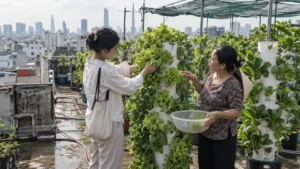
Quỳnh's husband went back to Hanoi once, bought fruit-tree saplings and vegetable seeds, and brought them back to Greece. They installed an automatic irrigation system on the land and turned it into a full-fledged kitchen garden. At first, they had assumed Greece's climate would be close to that of northern Vietnam.
Reality, however, was not so kind. Winter snowfall killed off many of the Vietnamese plants they had brought. Hanoi's renowned "diện" pomelo, along with dragon fruit, lychee, longan, star apple, and herbs such as Vietnamese balm and rice paddy herb, couldn't survive the winter. The difficulty of bringing tropical and subtropical crops into a Mediterranean climate shows clearly here.
Even so, the couple kept experimenting and shifted their focus to crops suited to the local climate. What began to thrive in the garden included figs, cherries, blackberries, raspberries, loquats, plums, pears, peaches, and grapes. Vegetables such as water spinach, glutinous-rice corn, beans, oriental melon, and mustard greens also began to grow. On top of that, fifty olive trees yield more than 100 liters of olive oil a year.
Two-year fermented fish sauce, made with local fish and salt
The heart of their condiment-making is fish sauce (nước mắm). Quỳnh learned the recipe from a friend in Hanoi and keeps fermenting it at home year-round so she never runs out. The mixture for a batch is as follows.
| Ingredients and process | Details |
|---|---|
| Fish | 4 kg of fresh fish (bought at the port, washed in seawater) |
| Salt | 1 kg of locally sourced coarse salt |
| Other | 1 pineapple |
| Fermentation | About 2 years |
| Aging | About 6 months in the sun after filtering |
The fish and salt are steeped and left to rest for two years, then filtered and aged for another six months under the sun. Only then is a single bottle of fish sauce finished. Vietnam's own traditional nước mắm method shares the practice of long fermentation of fish and salt in wooden barrels or earthen jars, and the couple faithfully follows those basics in their new home. Their thoroughness extends to making mắm tôm (fermented shrimp paste) by fermenting shrimp for about a year.
They don't compromise on the staple food either. Using rice grown locally in Greece, they make rice noodles by hand and put homeland noodle dishes like phở and bún on the table. The fact that the rice itself is locally sourced speaks to how self-reliant this undertaking is.
The Việt kiều's devotion to food, and reactions in various places
Efforts like this couple's resonate with overseas Vietnamese communities around the world. Sorting through the local reactions and similar voices reveals several common threads.
- In areas where the seasonings of home aren't available, many people say there's "no choice but to make it yourself," and households that make their own fermented foods are not unusual.
- From fellow Việt kiều come both praise — "I respect making it from the raw materials this thoroughly" — and practical inquiries asking how to obtain saplings and seeds.
- Even among the local Greeks, there's strong interest in the garden's fruit trees and olive oil, creating points of connection with the community through food.
The couple has also set up a wood-fired cooking arrangement, and Quỳnh says, "When I smell the wood smoke, home feels like it's right nearby." What's striking is how they try to reconstruct "home" not just through taste, but down to the smells and the very gestures of cooking.
Insights for Japanese people considering moving abroad
This story resonates with readers in Japan because it reflects both the deep "roots" of food culture and the realities of migration. Even if investment migration buys you time, when work is restricted, you have to design the fullness of your days yourself. What the couple chose was production, not consumption.
Three lessons can be drawn from this. First, the climate of your destination can differ from what you expected, and the idea of "bringing your homeland's crops over as-is" rarely works. Second, even so, the flavor foundation of your seasonings is worth protecting, even by localizing the raw materials. Third, making your own food can also serve as a device for creating connections with the community in an isolated life abroad.
To understand Vietnamese food culture, your resolution sharpens once you grasp not just the seasonings but how everyday side dishes are put together. Knowing theVietnamese side-dish culturethat makes up the home dining table helps you understand why the couple is so devoted to being self-sufficient in fish sauce. Fish sauce is the foundation of nearly every side dish and sauce in Vietnamese cooking.
The ripple effects of "localization," seen through the food business
The idea of localizing raw materials extends beyond the individual dining table to the food business as well. As demand for Asian ingredients grows overseas, the move to recreate the "taste of home" with local raw materials instead of relying on imports makes sense on both cost and supply-chain fronts. The couple's ingenuity in making Vietnamese rice noodles from Greek rice is a microcosm of that.
Within Vietnam too, the trend of commercializing and modernizing traditional home cooking is gaining momentum. Examples that present the "taste of home" as a value are increasing, such asNgon's effortsto reimagine Vietnamese cuisine in a Hanoi colonial mansion, anda specialty restaurant for home-style flavorsthat puts home cooking front and center. Homemade efforts by overseas Việt kiều and commercialization back home are thickening the roots of Vietnamese food culture from different directions.
Practical info: tips for recreating the "taste of home" abroad
For those who likewise want to make their own fermented condiments and homeland ingredients abroad, here are practical points to take from this couple's example.
- Fish sauce can be substituted with local fresh fish and coarse salt. What matters is the ratio of fish to salt and sticking to the process of long fermentation and sun aging.
- For fruit trees and vegetables, you'll fail less often if you don't fixate on homeland varieties and start with ones suited to your destination's climate. In cold regions, take care with overwintering tropical fruit trees.
- Rice noodles can be made even with locally grown rice. Being able to make your own staple food means the table still works even if imports are cut off.
- Securing a route to obtain saplings and seeds in bulk during trips home makes getting started faster.
Thessaloniki is a port city in northern Greece with a Mediterranean climate. Anyone trying the same approach should realistically choose crops on the premise of the local winter cold and summer dryness.
Summary: flavor can travel, but you need the resolve to rebuild it
The journey of Trúc and Quỳnh shows that "the taste of home can be carried with you, but rather than transporting it as-is, you rebuild it on-site." Their choice to devote the time gained from investment migration to food self-sufficiency, rather than to consumption, gave a backbone to an isolated life in a foreign land.
If you're considering moving abroad or a long-term stay, a good start is to pick one "foundational seasoning" for your homeland's flavors and try recreating it with local raw materials. For Vietnam that would be fish sauce; for Japan, miso or soy sauce. Thinking from the starting point of localizing raw materials reveals a realistic path for carrying food culture with you. If you want to know Vietnamese food more deeply, try recreating the elements that make up the local dining table little by little in your own kitchen.