Sit down at a bia hơi in Saigon and a glass packed with ice arrives before the beer you ordered even does. Deliberately watering down a well-chilled beer with ice, a habit that might make a Japanese drinker pause, is something Ho Chi Minh City's English-language outlet Saigoneer defended head-on in a September 11 piece. Citing a 2019 Q&Me survey that found 75% of Vietnamese beer drinkers add ice to their beer, the article argues this isn't a lesser way to drink but a choice that makes perfect sense in a hot climate. For Japanese travelers, business visitors, and residents joining a Vietnamese drinking table, understanding iced beer is a way to get one step deeper into local culture.
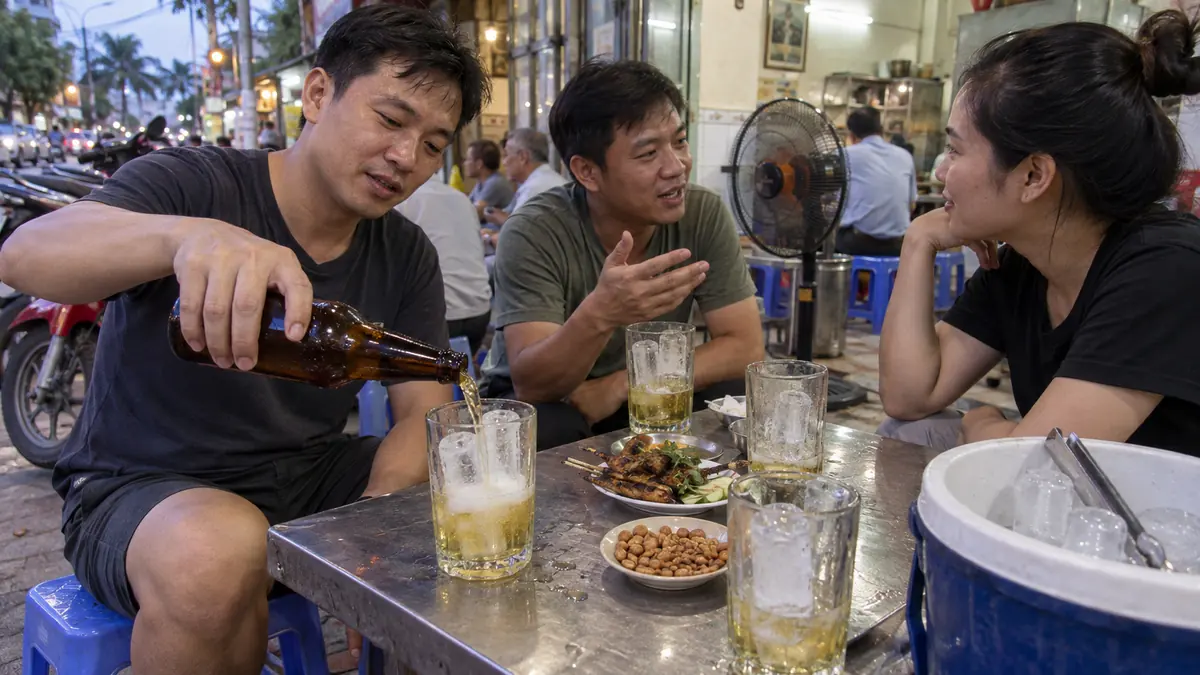
Ice goes in the glass first, beer is poured in after
Saigoneer's piece lines up five arguments against foreigners who look down on iced beer. First, it lets you instantly chill beer that arrives closer to room temperature. Second, popping a calorie-free ice cube in your mouth gives you something to do during the lulls in a slow-moving conversation. Third, splitting the same volume across more glasses creates the satisfaction of having had several rounds. Fourth, the pace at which the ice melts and dilutes the beer works like an hourglass, signaling when it's time to order the next bottle. Fifth, pouring gently onto ice in the glass helps keep the carbonation from going flat. The claim isn't a theory so much as a practice shaped by this place's climate and pace of time.
In Vietnamese, ice is called "đá," and telling staff "cho đá" gets you more. At street stalls Saigon's Japanese-style izakayas and even at well air-conditioned places with proper refrigeration, local customers' tables come with a bucket of ice as a matter of course. It's less about whether a place has the equipment to serve cold beer and more that the way of drinking itself has become a fixed part of the culture.
The 75% figure comes from a 2019 Q&Me survey
The 75% Saigoneer cites is based on a survey published in 2019 by Ho Chi Minh City market research firm Q&Me. It asked 682 beer drinkers, mainly in Hanoi and Ho Chi Minh City, and about 75% said beer "tastes better with ice" or that they'd "rather have it with ice." A separate question about actual behavior found that 79% said they add ice "in most situations," while only 5% said they "never" add ice. The survey is about seven years old and not the most recent data, but the numbers show that drinking beer with ice isn't a quirky minority habit, it's the majority standard.
| How ice is added | Share of respondents |
|---|---|
| Tastes better with ice / would rather have it with ice | About 75% |
| Actually adds ice in most situations | 79% |
| Never adds ice | 5% |
The source for both figures is the same 2019 Q&Me survey (682 respondents), and the numbers reported by Saigoneer and the English-language paper VnExpress match. Worth reading with the caveat that it isn't the most recent data.
Heat and an ice-delivery culture shaped beer's temperature
Ho Chi Minh City sees daytime temperatures above 30 degrees Celsius for much of the year, and at outdoor plastic-chair joints, beer starts warming up the moment it's poured. The habit of using plenty of ice isn't limited to beer, it also shows up in "cà phê đá," strong condensed-milk coffee cut with ice, and "nước mía," sugarcane juice. Ice vendors delivering large ice blocks have long reached every corner of the city, letting food and drink spots use ice freely. Even now that refrigerators are common, the preferred style has stayed one of sipping slowly over a long stretch, kept cold with ice, rather than finishing a drink fast before it warms up.
If dilution bothers you, here's how drinkers deal with it
Not everyone is on board with iced beer. Opinions are split even among local drinkers. Common responses include, first, a split by type, no ice for craft beer or beer meant to be savored for its aroma, ice for cheap mass-market beer meant to be drunk in quantity. Second, the counterargument that you just need to finish it before the ice melts, and dilution is the fault of a slow drinker. Third, the practical view that since the alcohol content is a light 4-5% anyway and you're expected to sweat in the heat, diluting it a little is just right. How people drink depends on the venue and the brand.
A phrase for travelers ordering beer in Saigon
Knowing that iced beer is the default helps you avoid confusion at a local spot. If you want it without ice, just say "không đá" (khong da, no ice). To try it the local way, pour about half your beer into the glass of ice that arrives, then top it up as it melts. If hygiene is a concern, look for places that use factory-made cylindrical ice with a hole through the center (machine-made ice meant for drinking), and go easy at street stalls that only have crushed, irregular ice. Vietnam's food culture has even been voted number one in the world by readers in one poll, that's how deep it runs, and the etiquette around drinking is part of what makes it enjoyable.
From bia hơi to craft beer, a map of drinking styles split by ice
Iced-beer culture is inseparable from how Vietnam's beer market has run on being "cheap, plentiful, and slow." Bia hơi, where a glass costs just a few cents, is a business built to keep costs down while balancing turnover with long stays, and ice has been the lubricant for that. Meanwhile, the craft beer bars that have grown in Saigon over the past few years take a different route, serving beer at controlled, proper temperatures and skipping the ice altogether. Whether ice is added has become a dividing line that reflects price point and clientele. For Japanese restaurants welcoming Vietnamese guests, just not being surprised when asked for ice can already change the impression you leave.
A checklist for trying iced beer once
If you want to experience iced beer locally, a few phrases and guidelines are worth remembering.
- cho đá (cho da) = please give me ice
- không đá (khong da) = no ice, please
- một chai nữa (mot chai nua) = one more bottle
- Choosing a place with factory-made cylindrical ice is an easier way to feel at ease about hygiene
- Mass-market beer around 4-5% ABV pairs especially well with ice
If you're pairing street food with beer,Saigon's famous banh mi a salty dish like that makes good "nhậu" (drinking snacks), and ice-diluted beer goes down just right alongside it.
Start with one glass, ordered the local way
Iced beer is a local rationality born from a drinking culture built around heat that warms drinks fast and sessions that run long. Travelers should start at one bia hơi full of local customers, take the glass of ice, pour, dilute, and drink. If it feels too weak, order craft beer without ice at the next place. Just that comparison is enough to feel, firsthand, that Vietnamese beer has two faces split by price and venue. Whether you decline or accept the ice comes down to preference, either way is a legitimate order here.
Sources:Saigoneer「In Defense of Ice in Beer」 / VnExpress (reporting on the Q&Me survey)