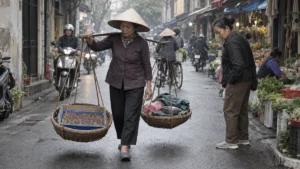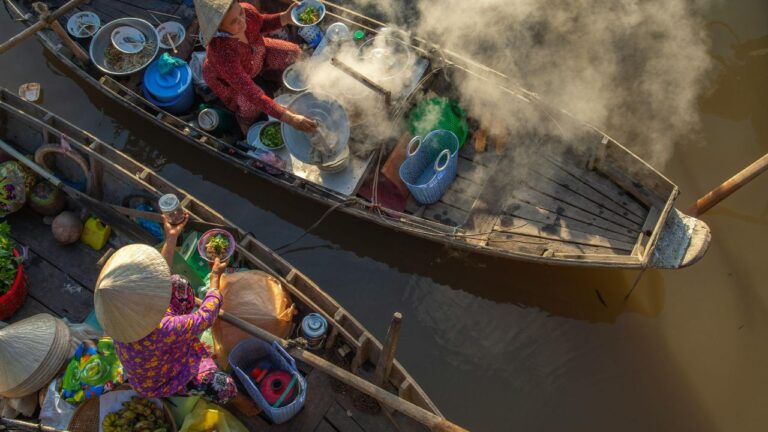
About 10 minutes by car from Hue's Old Quarter, at 78 Nguyen Lo Trach Street in the Vy Da area, 77-year-old Ms. Sa simmers reddish rice porridge topped with small fish braised sweet and spicy, "cháo gạo đỏ" (red rice porridge), under a corrugated tin roof. It costs 10,000 dong a bowl, roughly 55 yen. The local paper Tuoi Tre reported on this breakfast on August 17, and it's the kind of place that never shows up in tourist guides. For travelers wanting to walk early-morning Hue like a local, and for Hue residents looking to expand their list of good finds, this bowl works for both.
No. 78 in the Vy Da area: just two pots under a tin roof
Ms. Sa's stall has no sign. Under a small tin roof jutting out in front of her house sit just two pots, one for the porridge, one for the braised fish. It opens around 6 a.m. every morning. Neighborhood regulars come and go, emptying their bowls before scattering off to work or school. For nearly 40 years, she's kept serving the same breakfast in this spot. There's no gimmick built for lines, no staging for social media. People who've learned the taste come back, and that alone is enough to empty the pot every day.
When it comes to Hue breakfast, bun bo Hue with its bright red broth and rice-flour cakes have become the traveler's standard. Ms. Sa's red rice porridge sits one street back from that bustle. That's exactly why it's a good target for anyone wanting to step halfway into the rhythm of local life.
Red rice "heo giang" and finger-sized fish, a combination unique to Hue
The rice itself determines the porridge's color. Ms. Sa uses native varieties grown around Hue called "heo giang" and "chiem," milled lightly so a thin layer of bran remains. That layer is what gives the porridge its red tint and toasty aroma. When cooking, she's careful not to stir too much, so the grains don't break down. Unlike the smooth, uniform texture of white rice porridge, the result keeps the outline of each grain on the tongue.
The fish on top are small, finger-sized. They're seasoned with nuoc mam (fish sauce), salt, pepper, sugar, and chili, then simmered with pork fat and red chili until the sauce reduces down. The result, "cá kho keo" (sweet-and-spicy braised fish), layers sweetness, saltiness, and heat, giving structure to the plain red rice porridge. The porridge alone is modest, but this braised fish resets the flavor with every spoonful. Hue is known as a city of royal cuisine, but at its feet, humble dishes like this one have put down roots.
Why 10,000 dong a bowl has held for 40 years: the regulars' "Is it good?"
The price is 10,000 dong a bowl. Converted at roughly 1 USD = 148 yen and 1 yen = 175 dong, that comes to about 55-57 yen (exchange rates fluctuate; this is an estimate). The price includes both the red rice porridge and the sweet-and-spicy braised fish. In a Vietnam where costs and labor keep rising, holding this price for nearly 40 years looks less like a business strategy and more like a trade whose purpose is simply to keep going.
Ms. Sa's standard line to regulars is "Is it good?" That single exchange, traded every time someone picks up their bowl, stands in for a shop sign. For travelers, just nodding along to that question is enough to start a conversation. It's not the low price but this closeness that stays in the memory of a Hue morning.
What sustains this stall is neighborhood regulars who know the taste. It's not a place tourists flood into; the daily pot is kept turning by 40 years of familiar faces coming and going. Travelers can only join that circle for a brief morning window. That's exactly why it's worth cutting one crowded famous shop from your list to make room for this quiet bowl. By the time you finish scraping the bowl, Hue should feel a touch different in temperature.
One bowl deeper into Hue's mornings, in the shadow of bun bo Hue
When planning breakfast in Hue, it's worth combining the busy centerpiece with the quieter, everyday side of things.Hue's bun bo Hue, which made news for a record certificationis the city's signature breakfast, then Ms. Sa's red rice porridge is that same city's unnamed one. Trace both in a single day and the face of Hue you see changes entirely. For eating noodles and rice-flour cakes cheaply on foot,our Hue food-trail routeis a practical addition, adding this bowl as the very first stop of the morning. Starting the day with a 10,000-dong bowl of porridge leaves both your stomach and your wallet with room to spare.
As for a cheap, early-morning bowl, this isn't unique to Hue. At an old Thai Binh morning market,a 62-yen layered rice cake, cooked after waking at 2 a.m.is another example: rural Vietnam still has plenty of breakfast traditions that rise with the dawn and vanish before noon. Ms. Sa's stall is one of them, and if you arrive late, the pot is already empty. Going in the morning decides everything.
Getting there by 6 a.m.: how to plan around the red rice porridge
If you're targeting this bowl, deciding your route and timing in advance keeps you from missing it.
- Location: 78 Nguyen Lo Trach Street, Vy Da area (about 10 minutes by car or motorbike from central Hue)
- Time: from around 6 a.m. As with rural morning markets, expect it to close once sold out, so head over early
- Price: 10,000 dong a bowl (roughly 55-57 yen). Having small bills ready speeds up paying
- How to order: the standard bowl, red rice porridge topped with sweet-and-spicy braised fish, is a complete meal on its own. The heat runs fairly strong, so ask for less fish if you're sensitive to spice
- Combination: start light with the porridge, then move to the Old Quarter for noodles and rice-flour cakes, a way to work through two or three Hue breakfast dishes without strain
A signless bowl down an alley won't show up in a map app's star ratings. Build one morning into your itinerary where you can nod along to Ms. Sa's "Is it good?" and your stay in Hue won't end with just the grandeur of the royal court. Next time you head to Hue, set your alarm for 6 a.m. on day one.