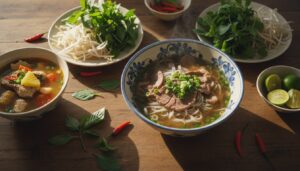
Instant pho lets you enjoy pho, Vietnam's national dish, just by pouring hot water or briefly simmering it. You can easily savor the smooth texture unique to flat noodles made from rice and tapioca starch, along with a light broth. It's light and cheap with a wide variety, so it suits share-around souvenirs for the workplace or friends. It also becomes a bowl that recalls your Vietnam trip after returning home, and is chosen as a stock for yourself too.
What is instant pho?
Characteristics
Instant pho is an instant noodle in which pho's rice noodles are dried and packed together with a soup base. Unlike wheat-noodle instants, you can enjoy the chewy texture and light mouthfeel unique to rice noodles. There are fried noodles deep-fried in hot oil and non-fried noodles dried without frying, and the non-fried ones have a smoother texture closer to real pho. Local standards like beef-broth "phở bò" and chicken-broth "phở gà" have been turned directly into products.
Why it's chosen as a souvenir
- Light and not bulky, so even buying in bulk doesn't cramp your suitcase
- The price per serving is cheap, suited to a share-around for many people
- You can make it just by pouring hot water or briefly simmering, so anyone can do it with little failure
- You can choose the shape, such as a bag or cup, making it easy to match the recipient's setting
Types and how to choose
Choosing instant pho by "soup flavor" and "container shape" makes it easier to organize. Choosing while picturing who you'll share it with and the setting you'll eat it in helps you find just the right item.
Type
| Pho bo (beef) | A beef-broth-based soup. It has richness from the aroma of aromatic vegetables and is popular as the standard |
|---|---|
| Pho ga (chicken) | A light chicken-broth soup. Little in the way of strong notes, easy to eat |
| Spicy type | A soup with chili. For people who like a stimulating flavor |
- Bag-noodle type — transfer to a bowl to make. Cheap per serving and ideal for a share-around
- Cup type — make it right in the container, easy and simple. Handy for a meal at the workplace or hotel
- With dried ingredients — comes with toppings like scallions and meat, for a good-looking bowl
Points for choosing
- Type of broth— choose the crowd-pleasing beef broth, or chicken broth for those who like it lighter
- Container form— for lightness, choose bag noodles; for convenience, choose a cup
- Presence of ingredients— choose the ones with dried ingredients if you want more substance
- Spiciness— for recipients who don't like spicy food, choosing the regular type is safe
Major brands and labels
The three brands that are standards in the supermarket instant-noodle aisle are as follows. All are widely distributed locally with a reliable, consistent flavor.
| Vifon | A Vietnamese instant-noodle maker founded in 1963. A pioneer of the country's instant-noodle industry, with a deep selection of pho-type products, exported to more than 80 countries |
|---|---|
| Acecook | A maker that Japanese-owned Acecook operates in Vietnam. It has a large share with the instant noodle "Hảo Hảo" and also handles pho products |
| Mama | A brand made by Thailand's Thai President Foods. Widely distributed in Southeast Asia, with reasonable prices as its appeal |
Recommended ways to eat and enjoy
It's plenty tasty just by pouring hot water, but a little extra effort brings it closer to an authentic bowl.Vietnamese soup and noodle guideUse it as a reference to add local-style toppings.
- Squeeze lime and top with cilantro and bean sprouts to finish it authentic-style
- Add thinly sliced beef or chicken for more volume
- Add a little chili sauce to enjoy a sweet-and-spicy flavor change
- Scatter green onion and black pepper to bring out the aroma
If you want to lean toward the authentic taste with toppings, fish sauce (nuoc mam) and chili sauce come in handy. Just adding a little changes the soup's contour.
Where to buy and price ranges
Supermarkets have the most variety and lowest prices for instant pho. It's an item easy to get even between sightseeing.
- Supermarkets (Lotte Mart, Big C, Co.op Mart)— many types and the cheapest. Suited to buying in bulk
- Markets— items aimed at locals line up and can be bought affordably
- Convenience stores— can be bought in small quantities, handy when short on time
- Airport duty-free shops— you can make up for forgotten purchases before departure. Prices are a bit higher
Price range
| Bag-noodle type (1 serving) | About 30–80 yen |
|---|---|
| Cup type (1 serving) | About 80–150 yen |
| Bulk buy (multiple bags) | Often drops to around 40 yen per serving |
Tips for making it a souvenir
While light and easy to share, the noodles break easily, so taking a little care with packing lets you hand them over looking good.
- Packing— wrap in clothing so the noodles don't break, and place in the center of the suitcase
- Keeping quality— being dry noodles, the shelf life is long. Check the display on the back of the container
- Customs / in-flight— dry noodles are easy to bring in, but for those with meat extract, check the regulations of the country you're entering
- Dividing among people— buy bag noodles in bulk and portion them out 1–2 servings at a time to make sharing easier
Reading together the guide to getting around Hanoi, where authentic pho is a specialty, and a full guide to Vietnam's soup noodles and cuisine, connects local food-touring with souvenir choosing.

Frequently asked questions
- What's the difference between pho bo and pho ga?
-
Pho bo is beef-broth-based and rich, while pho ga is chicken-broth with a light flavor. If you're choosing for a lack of strong notes, chicken broth suits; if you want a solid umami, beef broth suits.
- Can it be made just by pouring hot water?
-
For bag noodles, the basics are to transfer them to a bowl and pour hot water or simmer for a few minutes, and for cup types, the common method is to pour hot water and wait a few minutes. It's plenty enjoyable with just the basic flavor, but adding lime, cilantro, bean sprouts, or thinly sliced meat brings it closer to a local bowl.
- About how many should I buy for share-around souvenirs?
-
Since each serving is cheap and light, buying enough for the number of people you'll share with, plus a little spare, is just right. Buying in bulk lowers the unit price per serving, letting you prepare them at good value.
- Won't they break when carrying them home?
-
Since dry noodles can break from impact, wrapping them in clothing and placing them in the center of the suitcase is reassuring. For cup types, surrounding them with cushioning so the container doesn't get crushed is good.