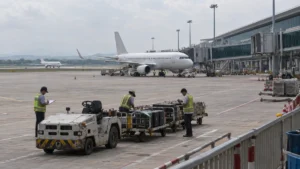
A rail proposal to directly link Long Thanh International Airport, whose opening this autumn is nearing in southern Vietnam, with the beach resort of Vung Tau by metro surfaced in July 2026 from Ho Chi Minh City's urban rail management authority. If realized, the estimate is as little as 30 minutes from airport to shore.Long Thanh Airport, Whose Construction Has Entered Its Final Stage Toward This Year's Openingsits about 40 km east of central Ho Chi Minh City. That a line was drawn for arriving travelers to head straight south to the beaches is something southern-bound Japanese travelers can't overlook either. That said, you need to note first that it's only a "concept" at this point, at a stage where even a feasibility study hasn't begun.
What was proposed is an extension of “Metro Line 3” from Vung Tau
What the Ho Chi Minh City Urban Railway Management Authority (MAUR) presented is a plan to extend the planned Metro Line 3 to Long Thanh Airport. Line 3 was originally conceived as a roughly 40km line starting from central Vung Tau and linking Ba Ria and Phu My, designed to reach the border with Dong Nai Province along National Highway 51. The new proposal extends the route further from that terminus toward the airport, with a path traced along 3/2 Street, the Chi Linh tourist area, the Vung Tau–Binh Chau road, the coastal road, and Route 55 to connect into the airport area.
With the former Ba Ria–Vung Tau Province and Binh Duong Province merged into Ho Chi Minh City in 2025, this wide-area railway shifted to being 'a line running within a single city.' The redrawing of administrative boundaries is helping drive the idea of linking airport and beach on one track.
Why Now: The Distance Between the Soon-to-Open Long Thanh and Vung Tau
Behind it is the imminent opening of Long Thanh Airport. The airport wrapped up a ceremony with a technical flight in December 2025, commercial operations are expected to begin in the latter half of this year, and the lead role for Ho Chi Minh City's international flights is shifting from Tan Son Nhat to here.Which routes will move to Long Thanhis a point worth checking before you travel; if the arrival airport changes, the routes to your lodging and the beach have to be rebuilt from scratch.
Vung Tau, for its part, is a seaside town about 96 km southeast of central Ho Chi Minh City. A go-to resort that residents flock to on weekends, it has had no rail service, so travel has relied on buses, cars, or hydrofoils. Linking the two crowd-drawing points—airport and beach—by rail would create a new, transfer-free tourist route. That's the aim of the proposal.
Travel Time by the Numbers: 30 Minutes if Direct
The planners' preliminary estimates give concrete travel times when using the extension section. It's designed so that express services with fewer stops differ from all-stop services that stop frequently. Lined up against current means of travel, the impact once the rail line is in place comes into view.
| Segment / mode | Estimated travel time |
|---|---|
| Vung Tau–Long Thanh Airport (extended metro, express / concept figure) | About 30 minutes |
| Vung Tau–Long Thanh Airport (extended metro, all stops / conceptual figures) | About 50 minutes |
| Central Ho Chi Minh City to Vung Tau (express bus) | About 2 to 2.5 hours |
| Central Ho Chi Minh City–Vung Tau (private car / ride-hail) | About 2–3 hours |
| Central Ho Chi Minh City–Vung Tau (high-speed ferry) | About 2 hours |
What to keep in mind is that the 30-minute and 50-minute figures are concept values “if realized.” At present that vehicle does not even exist, and as noted below the opening timing is not in sight either. The current means in the lower part of the table are the reality for the time being.
Where it stands on paper: still at the 'let's look into it' stage
Pulling from public information on where this route stands now brings its outline into focus.
- the stage — not a formal decision, but a proposal calling for a feasibility study to be carried out. The design and budget are still to be worked out.
- Timing—the Vung Tau-side routes were originally set to begin after 2030, and the five routes shown together this time are a medium-term plan split across 2026–2030 and 2031–2035. This is not an opening in the near future.
- Funding and jurisdiction—because the extension section reaches into the Dong Nai side, agreement is needed in advance on who bears the cost and takes on construction. The assumption is to proceed via public investment or PPP (public-private partnership).
In other words, it isn't 'a line opening soon' but 'a line under discussion as to whether it's even worth studying'—that's the accurate current position. It's not something you can build into a travel plan as is.
What Travelers and Residents Should Take Away
Even at the conception stage, there are two practical takeaways from this proposal.
First,Long Thanh is being designed not as a “stand-alone airport” but as a hubis that. The proposal depicts the extended metro connecting with three railways converging at the airport—the North-South high-speed railway, the Thu Thiem–Long Thanh line, and the Ben Thanh–Suoi Tien metro extension. It is a future picture in which, from the airport where you arrive, you scatter to central Ho Chi Minh City, the beach, and other cities on a single track. Moves to handle airport access by rail are common across Vietnam, andIn Hanoi, too, airport access is being overhauled as five metro lines break ground together. On the assumption that the starting point for travel in the south will shift over several years from Tan Son Nhat to Long Thanh, it doesn't hurt to start thinking now about arranging lodging and transport around that.
Second,Access to Vung Tau is improving without waiting for railWhile the metro is a concept years away, the Bien Hoa–Vung Tau expressway is opening in stages, and travel from central Ho Chi Minh City to Vung Tau is expected to shrink from about 120 minutes to around 70. For travelers wanting to reach the coast sooner, the near-term star is not the metro but the expressway, buses, and cars. It’s wise to accept that a state where the headline is the metro but what you actually use is the road will continue for a while.
If you're going to Vung Tau now: the realistic options
Until the metro runs, here are the ways to get to Vung Tau from Ho Chi Minh City or the Long Thanh area. The distance to the shore is roughly 96 to 100 km, with travel time swinging depending on traffic. Express bus fares run around 100,000 to 200,000-plus dong one way (about 600 to 1,200 yen, at 10,000 dong ≒ 60 yen) as a guide, but they move with the service and season.
| Means | Characteristics | Estimated time required |
|---|---|---|
| Express bus (limousine bus) | Frequent service and easy booking. Cars with a driver are comfortable | About 2 to 2.5 hours |
| Private car / ride-hailing (Grab, etc.) | Good for families with a lot of luggage; can be shortened by using the expressway | About 2–3 hours |
| Hydrofoil (Saigon–Vung Tau) | A sea route that avoids road congestion. You can enjoy the scenery, too | About 2 hours |
Fares move with the flight and the season, so check the latest amount on a booking site before departure. Once airport functions fully switch to Long Thanh, developing direct buses and shuttles from the airport to Vung Tau becomes the realistic next focus, ahead of the metro.
Summary: Don’t get swept up in “30 minutes”—use the road for now
The plan to link Long Thanh Airport and Vung Tau directly by metro holds the potential to change travel in the south. The 30-minute express figure is appealing, but this is a concept value at the proposal stage seeking a feasibility study, with neither construction nor opening decided. The railway on the Vung Tau side was originally a matter for after 2030, and there is no guarantee this extension plan will move any earlier.
There are three things travelers and residents can do now. First, review your routes to your lodging and the beach early, on the assumption that your arrival airport shifts from Tan Son Nhat to Long Thanh. Second, for Vung Tau trips in the near term, choose among express bus, car, or hydrofoil, and factor in the time savings from the progressing Bien Hoa–Vung Tau expressway. Third, follow metro updates by the milestone of 'whether a feasibility study has begun.' Don't get caught up in the headline 30 minutes—start by checking this weekend's usable roads and bus schedules.
Sources
- Vietnam’s Long Thanh mega airport may get new metro line straight from Vung Tau beach(VnExpress International)
- Ho Chi Minh City proposes extending metro line No. 3 to Long Thanh airport(Tuoi Tre News)
- Long Thanh int’l airport set for commercial launch by late 2026(Vietnam Government Portal)
- Expressway to cut travel time from downtown HCMC to Vung Tau by half(VnExpress International)