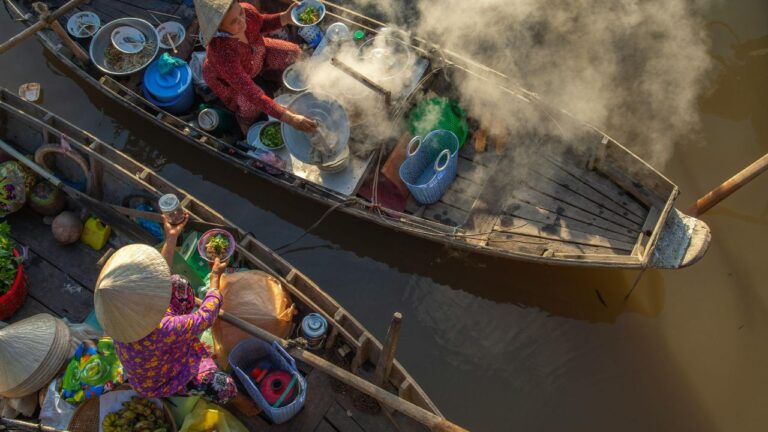
Many think of Côn Đảo, an island off southern Vietnam, as "an island you go to buy quiet." Indeed,Con Dao, ranked No. 1 among the world's hidden islandsthe star is untouched beaches and a national park. But reading a feature on island food put together by the local paper Dan Viet reveals another face of this island. The “moon crab” with a shell just like a full moon, the “vu nang” sea snails clinging to the rocks, squid sun-dried just once—rare seafood that fetches high prices at urban restaurants is surprisingly affordable at the island’s morning markets and fishing villages. Here we’ve laid out what travelers should target locally, when, and for how much, from the angle of how to buy and how to eat.
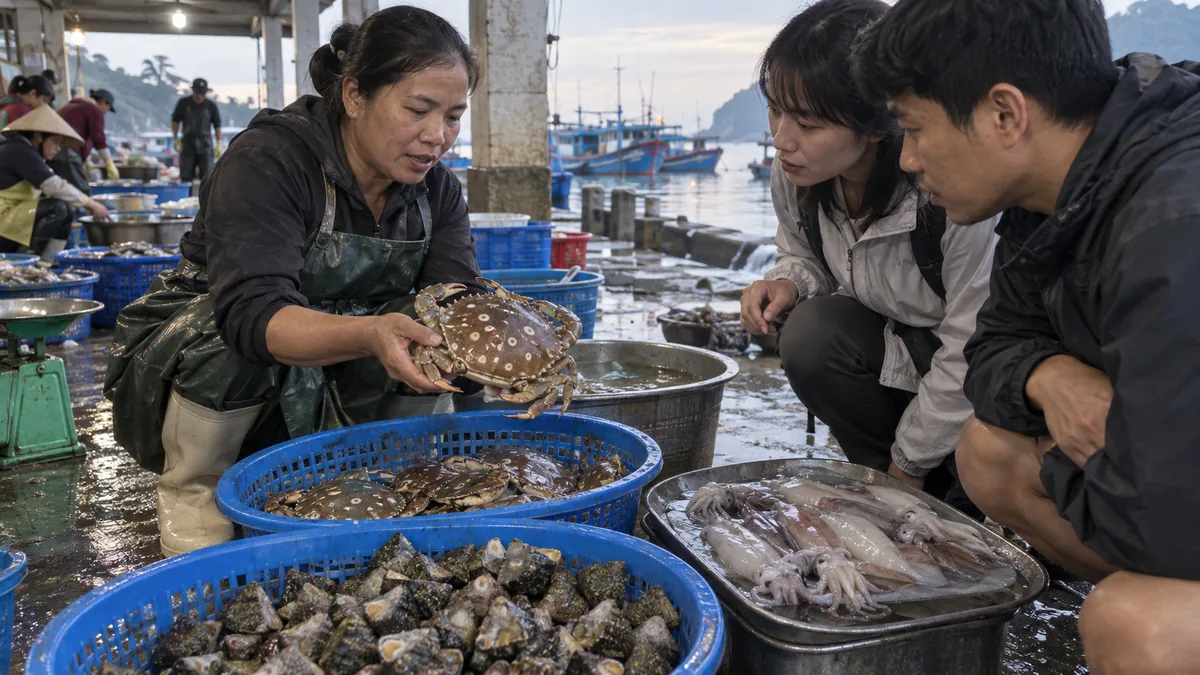
The lineup of “cheap, tasty seafood” the local paper recommends
The island specialties the Dan Viet article named include moon crab (cua mặt trăng), vu nang snail (ốc vú nàng), one-night-dried squid (mực một nắng), red grouper (cá mú đỏ), sea urchin (nhum), and elephant-ear snail (ốc tai tượng). All are a lineup you'd rarely find together in a mainland market—every one raised by the clear waters of Con Dao.
The island's ingredients get little in the way of processing. One-night-dried squid is just fresh squid, rinsed in water or brine and sun-dried a single time. The idea is to let the ingredient itself do the talking rather than elaborate seasoning, which is exactly why it's worth eating on the island rather than shipping it to the mainland, where freshness fades.
How to eat moon crab, vu nang clams, and one-night-dried squid
The signature is the moon crab. It’s named for the white spots scattered on its shell, which look like the pattern of a full moon. The meat is firm and sweet, packed with red roe (miso). Ways to eat it range widely—stir-fried with salt and chili (rang muối ớt), stir-fried with tamarind (rang me), steamed in beer, steamed with lemongrass, and congee (cháo). Start with ginger-steamed or lemongrass-steamed to taste the sweetness of the meat and roe plainly.
The vu nang is a sea snail that grows clinging to the island's rocks. Its selling points are a crunchy bite and a fatty sweetness, and grilling with scallion oil (nướng mỡ hành) is the standard. Fresh off the grill, a plate scented with chopped scallions is an island specialty that keeps the beer flowing. It also transforms into boiled, lemongrass-steamed, and salad (gỏi) versions. Twenty to thirty come on one plate, so it suits sharing among several people. Overnight-dried squid is lightly seared over charcoal and eaten with lime and salt-and-pepper. The sticky sweetness of the semi-dried center settles nicely as a drinking snack or a souvenir. Red grouper is done soy-steamed, as sashimi, or in hotpot. Its rich white-flesh umami makes it a fish that can headline the island's table.
Rough price guide (10,000 dong ≒ 60 yen)
Here are the going prices we gathered on the island, converted to yen. The conversion uses 10,000 dong ≒ 60 yen. Even for the same item, prices rise and fall with size and season, so take them as ranges.
| Ingredients | Local prices | Approximate yen conversion |
|---|---|---|
| Moon crab (cua mặt trăng) | 200,000 to 400,000 dong/kg | About 1,200–2,400 yen/kg |
| Vu nang shellfish (ốc vú nàng), 20 to 30 per plate | 150,000–300,000 dong | About 900–1,800 yen |
| Vu nang sea snails grilled with scallion oil (one dish) | 80,000 to 150,000 dong | About 480–900 yen |
| One-night-dried squid (mực một nắng) | 300,000–400,000 dong per kg | about 1,800–2,400 yen/kg |
| Red grouper (cá mú đỏ) | 700,000–1,500,000 dong/kg | About 4,200 to 9,000 yen/kg |
Moon crab runs around 300,000 dong per kg if small (under 300 g) and tops 400,000 dong if large — the price moves with size. Only red grouper is a high-end fish in a different bracket, but even so, island prices are a bargain compared with ordering it at a Japanese restaurant in the city.
The full moon is the key to the season—don’t miss the timing
The island's seafood isn't available year-round. Pulling together what locals say, the best timing is clear.
- Moon crab is most abundant from March to September and fattens during the southwest monsoon. True to its name, its flavor is said to peak around the full moon.
- Vu nang shellfish is caught year-round, but on the night of a full moon the meat plumps up and firms, becoming most delicious.
- Premium sea cucumber, sa sung (sá sùng), appears only from March to July — a seasonal specialty.
The best time to visit the island itself is March to September. The weather is stable and the sea calm, and June to September overlaps with sea turtle nesting season. A calm sea directly determines the number of days fishing boats can go out—that is, the steadiness of the catch. Conversely, rough periods mean smaller catches and higher prices. If food is your goal, choosing the dry season matters greatly, and if you can line up your dates around the full moon, all the better.
A trip of buying at the morning market, not leaving it to the restaurant
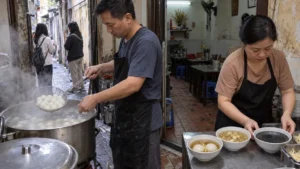
The best-value way to eat on this island is to stand in the morning market. There are three practical benefits for travelers.
First,The prices are honestly cheapAt the central market near Ben Dam port, fishermen sell their catch directly from about 5 to 7 in the morning. Buying here is a guide 20–30% cheaper than restaurant prices, and if you bring it to your lodging and ask them to cook it, the budget for a meal drops sharply.All-you-can-eat durian in Can Tho, where eating fruit at the source makes it dramatically cheaperby the same logic, with island seafood too, the closer you stand to “where it's caught,” the more you gain.
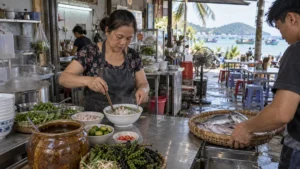
Second,You can pick freshness and the real thing with your own eyes. For both moon crab and vu nang shellfish, freshness is everything, and the flavor drops the farther you get from the island. At the market you can pick live ones and check the size and weight on the spot. Peering into the same basket alongside local customers is itself the way to choose without going wrong.The golden rule for picking a good Vietnamese shop: if it's almost all locals, it's a winnerapplies directly when sizing up a market stall, too.
Third,Confirm the price out loud before buying. Island seafood, with its wide price range, can carry a markup for tourists. Ask 'how much is this?' first, make clear whether it's priced per kilo or per plate, and then order. Just that one question clears away any unease at the bill.
How to Get to Con Dao Island and Basic Information
Being a remote island, the routes there are limited. Here are the main options.
| Means | Route / time | Notes |
|---|---|---|
| Airplane | About 45 minutes from Ho Chi Minh City / Can Tho | Vietnam Airlines propeller planes. A few flights a day |
| High-speed ferry (Ho Chi Minh City) | About 4 hours from Hiep Phuoc port | Three departures a week; boats leave the port around 7 a.m. |
| High-speed boat (Soc Trang) | 2.5 to 4 hours from Tran De port | Travel time varies by service |
| Where to buy seafood | The central market near Ben Dam Port | Aim for 5–7 a.m. Direct sales at the fishing village too |
Lodging fills up easily on holidays and during summer break, so reservations are a must. Since travel is limited to flights and hydrofoils, it's reassuring to leave slack around your connecting services in your schedule.
Summary: Start the Day at the Early-Morning Market
Con Dao is an island of quiet and, at the same time, an island of seafood where moon crab and vu nang clams await. What travelers should do comes down to three things. First, don't miss the season. Moon crab and vu nang clams are best around the full moon, in the dry months of March to September. Second, stand at the central market from 5 to 7 in the morning and pick live ones yourself. Third, always confirm the price before ordering. Keep these three and you can happily eat your fill of rare seafood that runs expensive in the city, at the feel of about 60 yen per 10,000 dong. Between the beach and the national park, try setting the early-morning market as the day's starting point.