On August 6, 2026, NAPAS (National Payment Corporation of Vietnam), which controls Vietnam's payment infrastructure, announced it had launched a cross-border QR payment connection together with BIDV (Bank for Investment and Development of Vietnam) and China's Weixin Pay (WeChat Pay). This means more than a billion Weixin Pay users in mainland China can now pay at stores across Vietnam simply by holding up their phones. Reading only the headline, it's easy to assume "WeChat Pay is now allowed in Vietnam," but the users who actually benefit are those in China — Japanese travelers and residents don't get this benefit directly. Getting this mixed up can cause real trouble on the ground. Here's a practical breakdown of what this connection does and doesn't change, from the perspective of travelers and residents.
Weixin Pay users can now pay at "VietQRGlobal" stores
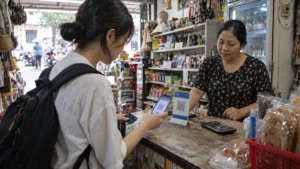
This new system lets users of China's Weixin appscan a VietQRGlobal code to pay— it's a one-way arrangement. VietQRGlobal is a cross-border extension of VietQR, the interbank transfer standard widely used within Vietnam, expanded by NAPAS so it can be scanned by foreign payment apps. It has been in operation since 2025. Users in Thailand, Laos, Cambodia, and Singapore can already scan it with their own banking apps, and China's Weixin Pay has now joined that list.
This isn't limited to a few spots in big cities — it covers retailers, restaurants, hotels, accommodations, and tourist attractions across the entire NAPAS merchant network nationwide. Payments are processed on the infrastructure connecting NAPAS and Weixin Pay, with BIDV handling settlement. Exchange-rate conversion and record-keeping happen automatically, so from a Chinese user's point of view, it's designed to feel like paying with Weixin as usual.
The "third Chinese payment provider" — following UnionPay and Alipay
NAPAS is positioning this Weixin Pay connection as "the third Chinese payment provider to complete the cross-border QR link-up." The first two were UnionPay and Alipay — Alipay had already connected to VietQRGlobal in April 2026 through a partnership with Ant International and Vietcombank. With this addition, all three major payment brands that Chinese tourists use daily at home are now in place.
| Chinese payment provider | Partner bank for the connection | Period |
|---|---|---|
| UnionPay | Via NAPAS | Connected earlier |
| Alipay | Vietcombank / Ant International | April 2026 |
| Weixin Pay (WeChat Pay) | BIDV | August 2026 |
Behind Vietnam's rush to accept Chinese payment platforms lies the makeup of its tourist base. Around 2.7 million Chinese visitors came to Vietnam in the first half of 2026, roughly 22% of the 12.3 million international arrivals — one of the largest visitor groups by nationality. Creating an environment where this group can pay as easily as reaching for their wallet, without exchanging cash, translates directly into sales for local merchants. Pham Anh Tuan, director of the State Bank of Vietnam's (the central bank's) payment department, called the connection "a milestone in building a modern, secure cross-border payment ecosystem."
Japanese travelers can't use Weixin Pay — the real effect is on "the merchant side"
This is the point most likely to be misunderstood. VietQRGlobal works by having a foreign app scan a Vietnamese store's QR code, but only apps from connected countries can do the scanning. China's Weixin Pay and Alipay, and banking apps from Singapore and Thailand, are included, butJapanese payment apps are not part of this connection. This announcement doesn't make it possible for Japanese travelers to pay by scanning a Vietnamese store's QR code with PayPay or their own banking app.
That doesn't mean it's irrelevant to Japanese readers, though. The real effect lands on the merchant side. As acceptance of the three Chinese payment brands spreads nationwide, even small shops, street stalls, and souvenir stands that used to take only cash will start displaying QR acceptance signs. Staff get used to handling QR payments, and more stores permanently set up a scanner or code sheet by the register. As a result, the overall pool of "stores that accept something other than cash" widens — which also benefits travelers and residents who want to pay by card or VietQR. In cities with large numbers of Chinese tourists, such as Da Nang, Nha Trang, and Phu Quoc, this shift will show up earlier and more strongly.
What actually changes for residents, and pitfalls to watch for
Residents with Vietnamese bank accounts already handle both domestic transfers and in-store payments via VietQR as part of daily life. This connection doesn't add new payment methods for residents themselves, but the details of daily life do shift a little. QR checkout lines can get busier during hours when Chinese customers are around, and some stores will start displaying separate codes — one for "domestic VietQR" and one for "cross-border VietQRGlobal." The basic rule stays the same: scan the domestic code if you're paying from your own account app, so it helps to get in the habit of checking the signage for a moment before scanning to avoid grabbing the wrong one.
In some tourist areas, more prices may end up quoted in yuan or set up assuming payment in yuan, aimed at Chinese customers. It's worth keeping up the basic habit of checking the actual price in dong before paying. For how to think about currency exchange itself,Recommended Ways to Exchange Money in Vietnam, and for whether individual stores accept cards,Can You Use a Credit Card in Vietnamese Cities?we've covered that separately, so checking both will save you some guesswork.
Cash, cards, and QR — the same mix works for now
In short, this news doesn't change what Japanese travelers should actually do on the ground. The basic approach is still: cards at hotels and large stores that accept international brands, cash at street stalls and small shops. Vietnamese ATMs tend to dispense a lot of high-denomination 500,000 dong notes (about ¥3,100 at roughly 160 dong per yen), which small shops struggle to break. Breaking those notes early after you arrive is a habit that will still serve you well even as QR spreads. For a general sense of prices in dong,Vietnam Price Guide, it's worth checking that out.
NAPAS and BIDV have also revealed that, as a next step, they're considering the "reverse" function — letting Vietnamese users scan Chinese QR codes with their own banking apps to pay. If that gets built, it will change how Vietnamese residents pay when they travel or go on business trips to China. Whether Japanese payment apps ever join VietQRGlobal remains to be seen, but the map of cross-border QR payments looks set to keep being redrawn over the next year or two. If you're planning to shop in a city with many Chinese tourists, taking a moment to check whether a store's QR display is for domestic or cross-border use will save you confusion when it's time to pay.
Sources
- VietnamNet「Over 1 billion Weixin Pay users can make QR code payments in Vietnam」(2026-08-06) https://vietnamnet.vn/en/over-1-billion-weixin-pay-users-can-make-qr-code-payments-in-vietnam-2542865.html
- Vietnam News「NAPAS, BIDV and Weixin Pay expand cross-border QR payment services between Việt Nam and China」 https://vietnamnews.vn/economy/1796973/…
- TechNode Global「Vietnam’s NAPAS links QR payments with China’s Weixin Pay」(2026-08-07) https://technode.global/2026/08/07/…
- The Paypers, "NAPAS, Ant International and Vietcombank launch Vietnam–China QR payments" (source verifying the Alipay connection) https://thepaypers.com/…