In the popular tourist attractions category of "Travelers' Choice Best of the Best 2026," chosen by Tripadvisor, the world's largest travel review site, three sites from Vietnam were selected. The War Remnants Museum in Ho Chi Minh City ranked 5th, the Hoi An Ancient Town World Heritage Site 8th, and the Cu Chi Tunnels, also near Ho Chi Minh City, 19th. The announcement came in June 2026. Based on travelers' actual reviews and ratings, Best of the Best is awarded to less than the top 1% of the more than 8 million listings worldwide. For anyone planning a trip to Vietnam from here on, it serves as a practical guide to deciding what to prioritize within a limited number of days. This article organizes the highlights and how to get around the three sites as a standard route for Japanese travelers. Currency is converted at 10,000 dong = about 60 yen.
Summary of the news behind this article
According to local English-language media, all three sites that made the ranking are tourist destinations centered on "history and culture." Tripadvisor tallies the reviews and ratings posted by users and ranks popular tourist attractions around the world by region. Vietnam's tourism authorities have taken the simultaneous selection of three sites of differing character, a facility conveying the memory of war, the living culture of a port town, and an underground fortress, as a sign of the breadth of Vietnamese tourism.
It's worth separating what can be confirmed from the reporting and what cannot. What is confirmed is the names of the three sites and their rankings (5th, 8th, and 19th), the name of the ranking, that the selection is review-based, and that Best of the Best is a distinction given to less than the top 1%. On the other hand, the annual number of visitors and specific scores for each facility are not shown in this reporting. Practical information such as admission fees and opening hours is a rough guide cross-checked against multiple travel guides for each facility, and it can change with on-site operational decisions or holidays, so please read it on the premise of confirming before you visit.
What kind of places are the three sites?
The three sites are split between Hoi An in central Vietnam and Ho Chi Minh City and its outskirts in the south. Their characters are clearly different, too.
War Remnants Museum (Ho Chi Minh City, 5th)
A museum exhibiting actual materials and photographs from the Vietnam War, located in District 1 in the city center. Outside stand tanks and aircraft that were actually used, while inside, exhibits of news photographs and the effects of defoliants continue. It's a facility that confronts a heavy theme head-on, and it earns high marks from travelers who want to understand Vietnam's modern history in one place.
- The highlights are the actual weapons outdoors and the news photographs and defoliant exhibits indoors
- Located in the center of District 1, its strength is a good location where you can see everything in half a day
- Given the weight of the exhibits, families with children have room to choose which areas to view
Hoi An Ancient Town (central Vietnam, 8th)
The townscape that flourished as a trading port in the 16th-17th centuries remains intact, and it was registered as a UNESCO World Heritage Site in 1999. Wooden merchant houses, Chinese assembly halls, and the Lai Vien Bridge (Japanese Bridge), said to be a remnant of the Japanese quarter, are gathered within walking distance. Known for its nighttime lantern-lit scenery, it also offers strolls by hand-rowed boat on the Thu Bon River or by bicycle.
- The highlights are the old merchant houses, assembly halls, and Lai Vien Bridge, plus the nighttime lantern scenery
- The town walk itself is free, and if you just want to soak up the atmosphere it works even without an admission ticket
- Because its face changes between day and night, you'll want to secure time from evening onward
Cu Chi Tunnels (near Ho Chi Minh City, 19th)
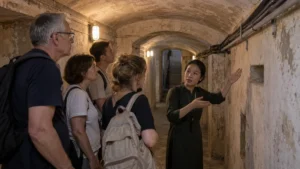
An underground tunnel network several hundred kilometers long, dug by guerrillas during the Vietnam War, located in the northwestern outskirts of Ho Chi Minh City. You can actually crawl through part of the tunnels, and it's highly popular as a facility for experiencing wartime life and tactics firsthand.
- The highlights are the underground tunnels you can actually go down into, and the explanations of wartime life and tactics
- There are two open areas, the Ben Dinh area and the Ben Duoc area
- One and a half to two hours by car from the city center. A day-trip range that takes about half a day
Checking the practical information at a glance
We've compiled the admission fees, opening hours, time required, and access for the three sites in a table. Fees are converted to yen at 10,000 dong = about 60 yen, based on the local-currency figures confirmed as of 2026 (fractions have been rounded). Because admission fees and hours change with holidays and operational decisions, we recommend checking the latest information before you visit.
| Site | Admission fee (guide) | Opening hours (guide) | Time required | Access |
|---|---|---|---|---|
| War Remnants Museum | Adults 40,000 dong (about 240 yen) / ages 6-16 20,000 dong (about 120 yen) / under 6 free | Around 7:30-17:30 (last entry before closing) | 1.5-2 hours | Central District 1, Ho Chi Minh City. A short trip from the city by taxi or ride-hailing app |
| Hoi An Ancient Town | Combined ticket 120,000 dong (about 720 yen / choose 5 of 25 sites to enter, valid for 3 days). The town walk itself is free | The town is open all day; ticketed facilities are open around 7:00-18:00 | Half a day to a full day (from evening onward if you include the night lanterns) | About a 45-minute to one-hour drive from Da Nang. A day trip is possible while staying in Da Nang |
| Cu Chi Tunnels | Ben Dinh area 110,000 dong (about 660 yen) / Ben Duoc area 90,000 dong (about 540 yen). Going with a tour is common | 7:00-17:00 (ticket sales until around 16:00) | Half a day including travel | Ben Dinh is about 50 km from the city center, Ben Duoc about 70 km. 1.5-2 hours by car |
In many cases, fees are basically paid in cash (Vietnamese dong) on-site. For the Cu Chi Tunnels, using a half-day tour from Ho Chi Minh City involves less travel hassle than piecing together public transport on your own, and comes with a guide, so you'll understand it more deeply.
How travelers respond
Because these rankings are built purely on user reviews, the tone of the ratings comes through clearly in travelers' own words. Rather than quoting specific individual comments, we've organized the recurring, widely shared impressions.
- The War Remnants Museum stands out for reviews that treat it as a learning experience: "the exhibits are heavy and stay with you," and "visiting before or after your Vietnam trip changes how you see the country."
- For Hoi An, many voices highlight how pleasant it is to spend time there: "the evening lanterns and riverside atmosphere are in a class of their own," and "walking the town is free and easy to do."
- The Cu Chi Tunnels win praise for being hands-on: "you can actually crawl in and feel it," and "the guide's commentary brings the history to life in three dimensions."
What all three sites share is that they involve physical, bodily experiences: walking, crawling, feeling, not just looking. The museum lets you take in modern history in a half-day within the city, the Cu Chi Tunnels let you actually crawl inside, and Hoi An transforms its scenery between day and night. It's these elements that go beyond simply looking at something that drive the high review scores.
Designing a standard route for Japanese travelers
Because the three sites are geographically split between central Vietnam (Hoi An) and the south (Ho Chi Minh City), they're hard to string together in a single line. Below are model itineraries broken down by number of nights, right down to morning and afternoon blocks and travel segments.
One-day Ho Chi Minh City plan (the two southern sites only)
Both the War Remnants Museum and the Cu Chi Tunnels start from Ho Chi Minh City, so you can cover both in a single day.
- Morning: Take a half-day tour from the city to the Cu Chi Tunnels (about 4 hours including travel and the experience)
- Midday: Head back into the city for lunch (roughly 1.5 to 2 hours by car each way)
- Afternoon: Tour the War Remnants Museum for 1.5 to 2 hours
Both share the theme of "the memory of war," and visiting them back to back deepens your understanding, but it makes for an intense day of touring. If you're with companions who aren't as interested in history, you could swap the afternoon for food or souvenir shopping in the city.
Three-day, two-night plan (focused on Ho Chi Minh City)
If you settle into the south, you can comfortably cover the two southern sites among the three.
- Day 1: Arrive in the afternoon and stroll around the War Remnants Museum in District 1 and its surroundings
- Day 2: A full-day Cu Chi Tunnels tour. Set out in the morning to avoid the heat and crowds
- Day 3: Explore the city's food and souvenirs, then depart
Four-day, three-night plan (adding Hoi An)
Hoi An is about a 45-minute to one-hour drive from Da Nang Airport in central Vietnam, making it a separate itinerary from Ho Chi Minh City. Since there are direct flights from Japan to Da Nang, you can link north and south by domestic flight.
- Days 1-2: The War Remnants Museum and Cu Chi Tunnels in Ho Chi Minh City (the one-day plan above)
- Day 3: Fly domestically to Da Nang and stay near Hoi An's Old Town. Enjoy the lanterns from evening into the night
- Day 4: In the morning, visit Hoi An's merchant houses and assembly halls with a combined ticket, then depart from Da Nang
Because Hoi An looks completely different by day and by its evening lanterns, staying a night to secure the evening hours brings far more satisfaction than a day trip.
Ways to boost satisfaction even on a tight schedule
- Hoi An's combined ticket covers five sites and is valid for three days. Even on a short stay, narrowing your choices to one or two assembly halls or merchant houses makes it worthwhile
- The Cu Chi Tunnels can wear you out with travel under the blazing sun and the underground experience. Going early in the morning helps you dodge the heat and the crowds
- The War Remnants Museum is mostly indoors and less affected by weather, making it a good backup plan during the rainy, squall-prone season
Why these three spots were chosen together
It's telling for trip planning that three history- and culture-focused sites, rather than beaches or resorts, all ranked near the top. The strong reviews for the War Remnants Museum and Cu Chi Tunnels, facilities that convey "the memory of war," reflect a growing number of travelers who want learning and hands-on experiences rather than sightseeing you simply gaze at. Hoi An's setup, where walking the town is free and you can pick only what you need with a combined ticket, makes costs easy to adjust yourself and keeps it approachable even on a first visit. When you're a second- or third-time visitor to Vietnam wondering "where to next," these three sites are hard to leave off the list.
Summary
The three Vietnamese sites chosen among TripAdvisor's popular spots in Asia offer experiences of distinctly different character: the memory of war (the War Remnants Museum and Cu Chi Tunnels) and the culture of a port town (Hoi An). If it's your first time in Vietnam, a good structure is to base yourself in Ho Chi Minh City and cover the museum and Cu Chi Tunnels in a single day, then, if your schedule allows a trip to central Vietnam, add a night in Hoi An via Da Nang and savor the evening lanterns. By using local systems like the three-day combined ticket and guided tours, you can cover everything comfortably even on limited days. If you're planning your next trip, try building your schedule around these three review-honed sites.
Frequently asked questions
Can I visit all three sites in one trip?
Geographically, the War Remnants Museum and Cu Chi Tunnels are in southern Ho Chi Minh City while Hoi An is in central Vietnam, so covering all of them efficiently realistically calls for a trip of about three to four days including a domestic flight. If you stick to just the two southern sites, you can manage them in a single day.
Can I visit the Cu Chi Tunnels on my own?
Since they're about 50 to 70 km from central Ho Chi Minh City, joining a local tour is the usual approach. It cuts down on travel hassle and comes with a guide's commentary that makes the history easier to grasp. The tunnels are open roughly from 7:00 to 17:00, and if you want to avoid the heat and crowds, early morning is best.
How much is admission in Hoi An?
The combined ticket is 120,000 dong (about 720 yen), letting you enter 5 of 25 sites and valid for three days. Walking the Old Town itself is free, so you can enjoy the atmosphere without a ticket. Prices may change, so we recommend checking before your visit.
Related reading
- Non la painting experience: make a travel memory with your own hands
- Da Nang: savoring street-stall culture at the carrying-pole food festival
- Vietnam souvenir know-how, from the classics to hidden gems
Source: