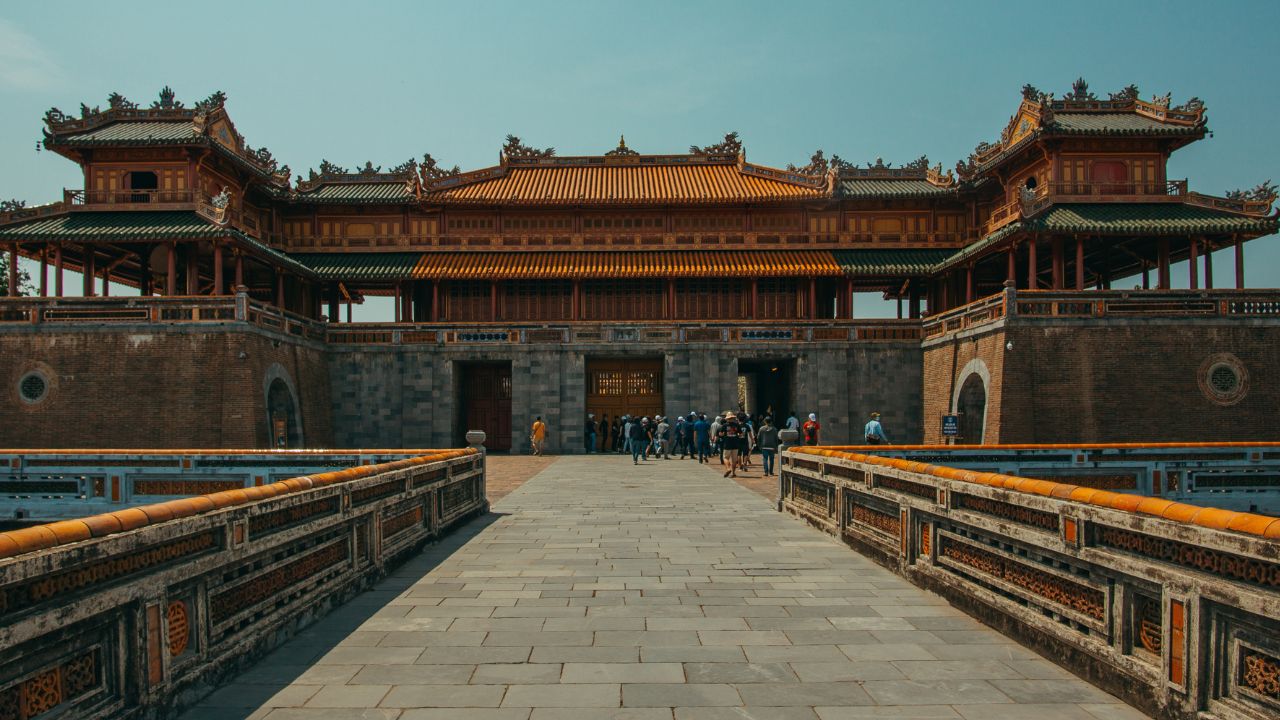
Hue is the last capital of the Nguyễn dynasty, located in central Vietnam. Along the Perfume River sit its royal citadel and imperial tombs, where UNESCO World Heritage architecture meets refined royal cuisine. It's a quiet, historic city suited to travelers who want to dig deep into Vietnam's history and traditional culture. This page covers the city's overall shape, how to get around, must-see spots, model itineraries, food, and souvenirs, and links out to separate articles on cafés, news, and souvenirs.
| Location | Hue City, central Vietnam (became a centrally governed city in 2025) |
|---|---|
| Population | About 450,000 people |
| Best season | February–April (the dry season runs December–May) |
| Suggested days | 1–2 days |
| Language | Vietnamese (English also understood in tourist areas) |
| Currency | Vietnamese dong (VND) |
| Time difference from Japan | -2 hours |
What kind of city is Hue
Hue became a centrally governed city in 2025, with a metro population of about 1.24 million (around 450,000 in the city center). It served as the capital of Vietnam's last dynasty, the Nguyễn dynasty, from 1802 to 1945. Along the Perfume River (Sông Hương) running through the city center sit the UNESCO World Heritage Imperial City (Hue Citadel) and a string of emperors' tombs. Hue is also known as a fierce battleground during the Vietnam War, but much of its dynastic architecture survives, making it an essential stop for central Vietnam sightseeing. It's also the birthplace of royal cuisine, known for its delicate flavors. The Imperial City is a vast walled complex modeled on Beijing's Forbidden City, with a perimeter over 10km; inside are the emperor's offices, the inner court, and shrines spread across an area that can take a full day to explore. Seven imperial tombs lie in the hills on the south bank of the Perfume River, with the tombs of Emperor Minh Mạng (a magnificent garden), Emperor Khải Định (ornate decoration), and Emperor Tự Đức (a poetic space blended into nature) standing out as the three most celebrated. A chartered car (about 2,500 yen for 4 hours) or a boat tour is the standard way to move between the tombs. Hue University and traditional music performances are among the other cultural experiences on offer in this classic old capital.
Access to Hue and how to get around
Hue has no direct flights from Japan, so you'll either connect through a domestic flight in Hanoi or Ho Chi Minh City, orfly into Da Nang and head north overland— that's the basic pattern. From Da Nang it's about 100km, roughly 2–3 hours whether by train or car, making it an easy add-on to a Da Nang/Hoi An itinerary.
From Phu Bai Airport into the city
Hue's gateway airport isPhu Bai International Airport (HUI). It's southeast of the city center,about 15km away, roughly a 30–45 minute ride. It's served by Vietnam Airlines and Vietjet, so treat it essentially as a domestic airport.
| Mode of transport | Fare guide | Notes |
|---|---|---|
| Local bus (routes 2 and 11) | 7,000–10,000 dong | The cheapest option, running roughly 5:30 AM–6:00 PM |
| GrabBike (motorbike) | 80,000–100,000 dong | Good if you're traveling light |
| Grab (car) | 120,000–150,000 dong | Reassuring since the fare is fixed upfront |
| Regular taxi | 250,000–300,000 dong | Fares are sometimes negotiable |
By train from Da Nang — famous for the views
For Da Nang–Hue,the train is especially worth it. The line winds along the coast over the Hải Vân Pass, so you get coastal views you can't see by road. The trip takes 2 hours 25 minutes to 3 hours, and fares run 80,000–150,000 dong for a seat or about 200,000 dong for a berth.
Since 2024,a sightseeing train called the “Heritage Connection (Kết nối di sản)”has also been running. From Da Nang,HĐ2 departs 7:50 AM and arrives 11:05 AM、HĐ4 departs 3:00 PM and arrives 5:45 PM. Fares run about 150,000–180,000 dong, and one nice touch is a 10–15 minute stop at Lang Co station for photos along the way. Book through Vietnam Railways' official site (dsvn.vn) or at the station counter.
Bus and car options
| Limousine bus | 150,000–200,000 dong / about 2.5 hours. Departs from and arrives in central Da Nang |
|---|---|
| Shared van | 150,000–200,000 dong / 2–3 hours. Sometimes includes hotel pickup |
| Local bus | 70,000–120,000 dong / 2–3 hours. Cheapest, but timing is hard to predict |
| Private taxi charter | 1,200,000–1,500,000 dong / 2–2.5 hours. Lets you stop along the Hải Vân Pass |
Getting around the city
Straddling the Perfume River (Sông Hương),the old quarter with the Imperial City sits on the north bank、while restaurants and hotels cluster in the new quarter on the south bank. The two banks are linked by Trường Tiền Bridge, and from a hotel on the south bank to the Imperial City isabout a 15-minute walk. You can cover the central area entirely on foot.
The catch is thatthe imperial tombs are scattered on the outskirts. You can't reach them on foot, so chartering a taxi, Grab, or motorbike is the practical option. Bus route 5 also runs out toward the tombs, but with hard-to-predict frequency and timing, we'd recommend arranging a car if your visit is short.
| Grab / taxi | Flag fare around 11,000 dong. Grab and Green SM (Xanh SM) both operate here |
|---|---|
| Motorbike rental | 80,000–160,000 dong per day. Some shops will drop the bike off at the airport or Hue station |
| Half-day charter | The most efficient way to cover the imperial tombs |
Standard sightseeing spots in Hue
We've summed up the representative spots in a quick-reference table. Use it as a guide when planning your route.
| Spot | Notes |
|---|---|
| Hue royal palace (Hue Citadel) | The Nguyen dynasty's royal citadel, the core of the World Heritage site |
| Thien Mu Pagoda | A seven-tier octagonal tower overlooking the river |
| Khai Dinh's tomb | A decorated tomb blending French, Chinese, and Vietnamese styles |
| Minh Mang's tomb | Feng shui design of gardens and ponds |
| Dong Ba Market | Hue's largest local market |
Hue royal palace (Hue Citadel)
The Nguyen dynasty's royal citadel spreading along the north bank of the Perfume River, a center of politics and ceremony surrounded by moats and walls modeled on the Qing Forbidden City. Pass through the Meridian Gate (Ngo Mon) and the Thai Hoa Palace, the site of the Purple Forbidden City, and a group of palaces under restoration are dotted about, letting you feel the dynasty's dignity and the scars of war at once. It's vast, so even narrowing your walk to the highlights, allow 2–3 hours; the morning before the sun grows strong, or the evening, is the easier time to walk. Since the ticket office at the entrance also handles combination tickets with each royal tomb, if you'll tour the tombs too, buying them all at the start is efficient.
Thien Mu Pagoda
A leading Buddhist temple of Hue, said to have been founded in 1601, whose symbol is the seven-tier octagonal Phuoc Duyen tower standing on a hill overlooking the Perfume River. In the grounds, an old car said to have carried the monk who self-immolated in protest in Saigon in 1963 is also preserved, letting you touch one facet of religious history. About 5 km from the city center along the river, it's generally reached by dragon boat, taxi, or motorbike. Early morning has few people and makes it easy to photograph the tower; in the evening the scenery reflected on the river is calm — its expression changes by time of day.
Khai Dinh's tomb
The tomb of the 12th emperor, Khai Dinh, featuring a weighty concrete exterior and interior mosaic decoration of porcelain and glass filling every surface. Influenced by the French colonial era, its distinctive splendor mixing French, Chinese, and Vietnamese designs is the highlight, and it's worth seeing all the way to the ceiling paintings and the emperor's statue in the inner Khai Thanh Palace. About 15–20 minutes by car or motorbike from the city, and with a structure of climbing a long stone stairway from the entrance, a visit is generally about an hour. The outdoor stone steps have little shade, so it's comfortable to visit avoiding the hot hours.
Minh Mang's tomb
The tomb of the 2nd emperor, Minh Mang, whose appeal is the vast grounds reflecting the Nguyen dynasty's peak and the symmetrical landscaping arranging ponds, bridges, and stone statues. Based on feng shui thought, the halls and water features are lined along an axis, and the very design of strolling across a bridge over a lotus pond is a highlight. Somewhat far from the city center, allowing about an hour for a visit gives you room. Green and quiet with lots of waterside, it suits those who want to stroll in calm, in contrast to the crowded palace.
Dong Ba Market
Standing along the Perfume River, one of Hue's largest markets, a commoners' kitchen with everything from fresh food to dried goods, daily necessities, and souvenirs. The real pleasure is surveying Hue's food culture at once — bun bo Hue, sweet che, local seasonings, and more. Close to the palace and the Perfume River, it's a location easy to combine with sightseeing in the same riverside area. Since it's lively there's a lot of crowding and touting, so keep valuables on you and check prices before buying to feel at ease.
A model course for Hue
In Hue,how you use the combo tickets changes both your route and your costs. It pays to understand the pricing structure before planning your course.
Worth knowing upfront: admission fees and combo tickets
| Tickets | Fee | Details |
|---|---|---|
| Imperial City (Nguyễn Dynasty Citadel) alone | 200,000 dong | Children (ages 7–12): 40,000 dong |
| Imperial tombs, individually | 150,000 dong each | Khải Định / Minh Mạng / Tự Đức |
| 3-site combo | 420,000 dong | Imperial City plus any 2 tombs of your choice |
| 4-site combo | 530,000 dong | Imperial City plus Khải Định, Minh Mạng, and Tự Đức.The most commonly used |
| 3-tomb set | 360,000 dong | For those skipping the Imperial City. 90,000 dong cheaper than buying individually |
| 3-day all-sites pass | 580,000 dong | For those exploring thoroughly |
Buying individually, the Imperial City plus 3 tombs comes to 650,000 dong, butthe 4-site combo is 530,000 dong, a saving of about 120,000 dong. Even if you split your visit across two days, the combo ticket is still the better deal, since a same-day Imperial City ticket can't be used the following day. Tickets can be bought at local counters, through the Hue-S app, or on the official website.
If you only have one day
Start the morning withthe Imperial City. Spend 2–3 hours walking through the area from the Noon Gate to Thai Hoa Palace and the site of the Forbidden Purple City. It's large, so it's best to go in while it's still cool in the morning.
At midday, around Dong Ba Market, tryBun bo HueandBanh beoand other local dishes. Taking a look at the market at the same time saves you a separate trip for souvenirs later.
In the afternoon, charter a car or motorbike and head tothe imperial tombs. If you only have one day, Emperor Tự Đức's tomb and Emperor Khải Định's tomb are the two realistic choices. Khải Định's tomb stands out among Hue's imperial tombs for its distinctive eclectic style, blending concrete with ceramic mosaics.
In the evening, takea cruise on the Perfume River. From the boat,Thien Mu Pagodayou can view the seven-story pagoda, then wrap up the night at the pedestrian street on the south bank.
If you have two days
| Day 1 | Imperial City and Antiquities Museum → Dong Ba Market → in the evening, “Ca Huế” (a traditional music performance on the river) |
|---|---|
| Day 2 | A half-day to full-day charter covering the three tombs (Minh Mạng, Tự Đức, Khải Định) plus Thiên Mụ Pagoda |
With this route,the 4-site combo ticket (530,000 dong)pays off nicely. Since the imperial tombs sit 5–10km apart on the outskirts, it's most efficient to bundle them into one continuous charter on your second day.
Perfume River cruise prices
| Ca Huế (traditional music boat ride) | 150,000 dong for foreigners |
|---|---|
| Dinner cruise | 500,000–900,000 dong per person |
| Private dragon boat charter | 1,200,000 dong for 8 seats, 1,500,000 dong for 27 seats |
| Departure point | The “Toa Kham” tourist boat pier at 49 Lê Lợi |
From the boat you can see Dong Ba Market, Trường Tiền Bridge, Kim Long village, and Thiên Mụ Pagoda. Some plans also include a lantern-floating segment.
Food and specialties of Hue
Here's a table of the local flavors you'll want to taste in Hue.
| Dish | Characteristics |
|---|---|
| Bun bo Hue | A spicy noodle dish fragrant with lemongrass and beef bone, a representative local dish bearing Hue's name as its birthplace. It contains beef, pork trotters, meatballs, and more, and you adjust it to your own taste with chili and aromatic vegetables. |
| Banh beo | A Hue steamed dim sum eaten with steamed rice batter in small dishes, topped with dried-shrimp floss, fried scallions, and fish-sauce dressing. The style of stacking many bite-sized dishes evokes a remnant of court food culture. |
| Com hen | A Hue commoners' dish eaten by mixing small basket clams, condiments, herbs, and fried bits with rice. Full of ingredients and richly fragrant, it's beloved locally as a breakfast or light meal. |
| Banh bot loc | A chewy steamed dumpling wrapping shrimp and pork in a translucent tapioca-flour dough. The aroma from finishing it wrapped in banana leaves is also a feature, and you taste it with a fish-sauce dressing. |
| Che | A Vietnamese-style hot-or-cold sweet combining beans, taro, jelly, and the like with sweet syrup or coconut milk. Hue is known for the abundance of varieties said to derive from the court, and you can enjoy tasting and comparing them at markets and specialty shops. |
Cafés in Hue
Here's a table of cafés you'll want to drop by in Hue (from the shop name to its individual page).
| Shop name | Genre | Characteristics |
|---|---|---|
| Maison Marou | Chocolate | Bean-to-bar chocolate from Vietnamese cacao. Thick hot chocolate |
Souvenirs to buy in Hue
Hue's souvenirs fall intoelegant items befitting a city with royal court cultureandfermented foods and other edibles. You can find pretty much everything at Dong Ba Market, so it's efficient to do all your shopping there on your last day.
| Item | Price guide | What it is |
|---|---|---|
| Mè xửng | 30,000–60,000 dong per box | Hue's signature confection. A soft candy of malt syrup, peanuts, and roasted sesame. Keeps well and is easy to give as a gift |
| Tôm chua | 60,000–110,000 dong | A spicy fermented shrimp relish that's a staple of the Hue table. Comes in a jar, so it's easy to carry home |
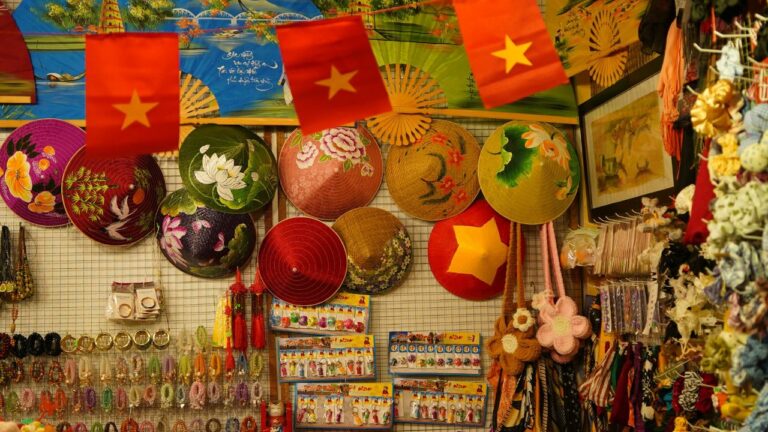
| Nón lá bài thơ | 150,000–250,000 dong | A conical hat that's a Hue specialty. Hold it up to the light and a poem woven into the inner layer appears |
| Mắm ruốc | To be confirmed | A fermented krill paste. It's the backbone of the flavor in bún bò Huế |
| Ao dai | To be confirmed | Hue has a tailoring tradition. Fabric shops and tailors line the streets around the market |
Buy at Dong Ba Market
Dong Ba Market (Chợ Đông Ba)sits on the north bank of the Perfume River at 02 Trần Hưng Đạo, and it's Hue's largest market. Pretty much everything listed above is available here. It's popular with tourists too, so many items aren't price-tagged — asking the price before buying is standard practice. Comparing a few stalls will give you a feel for the going rate.
When buying edible souvenirs,just watch the expiration date and how you manage the temperature on the way home. Some fermented foods have a strong smell, so it's a good idea to bring a sealable bag.
Best season, budget, and trip preparation
In Hue,One of the rainiest cities even by Vietnamese standards. Annual rainfall is about 3,200mm, roughly double Japan's average. What's more,about 70% of it falls in the four months from September to December. Think of choosing the right season as directly shaping how much you'll enjoy this city.
The best months are February–April
The most comfortable stretch isFebruary to April. Temperatures run 20–28°C with little rain, and it's when the gardens at the Imperial City and the tombs look their best. More broadly, December–May counts as the dry season.
| Period | Climate | Rating |
|---|---|---|
| February–April | 20–28°C, little rain | ◎ Best season |
| May–August | Highs can top 34°C | ○ Hot, but not very rainy |
| September–December | Rainy season. About 70% of annual rainfall falls in this stretch | △ Rain gear essential |
| October–November | Peak typhoon season | × Flood risk |
If you're traveling in October or November
There's a concrete reason to avoid this stretch if you can.In October 2025, a 24-hour rainfall total across the Hue area topped 1,000mm. It's the highest ever recorded in Vietnam, and the second-highest 24-hour rainfall total ever recorded anywhere in the world. The old quarter flooded, and several countries' embassies issued warnings.
Of course, it doesn't rain this hard every year. Still,October and November carry the highest risk of typhoons and flooding, and that's worth keeping in mind. If you're traveling during this window, build slack into your itinerary and check the weather regularly.
Budget guide
Hue is known for accommodation of a given grade running30–40% cheaperthan in other tourist cities in Vietnam. For a World Heritage city, that's remarkable value.
| Accommodation type | Per night, as a guide (2 people) |
|---|---|
| Dormitory | $7–12 |
| A private room in a guesthouse | $18–30 |
| A 3-star hotel | $28–50 |
| A boutique 4-star | $70–130 |
| A 5-star resort | $150–350 |
| Street food / snacks | 7,000–20,000 dong |
|---|---|
| A main dish at a local eatery | 30,000–50,000 dong |
| A main dish at a restaurant | 80,000–200,000 dong |
| Grab / taxi within the city | 50,000–120,000 dong |
| Daily budget, as a guide | About $23 on a budget / $55–100 for a mid-range trip |
One thing worth flagging is thatadmission fees end up as the biggest line item in your Hue budget. Touring the Imperial City and the tombs alone comes to over 3,000 yen. Thecombo ticketscovered in the next section can cut this down quite a bit.
Points to note
- Lots of walking: both the Imperial City and the tombs cover large grounds, and some areas have little shade. Bring comfortable shoes and sun protection
- Admission fees are charged separately at each site: each imperial tomb is an independent facility with its own fee. Consider a combo ticket
- Tickets are valid same-day only: the Imperial City ticket is only valid on the day of purchase. If you're splitting your visit across two days, a combo ticket is the better option
- Ticket counters close in the late afternoon: admission to the sites generally runs 7:00 AM–5:00 PM. You won't be able to get in if you start touring in the late afternoon
- The river in the rainy season: the Perfume River can rise from September to December. If you're planning a cruise, check whether it's running
Hue hotels and where to stay
Hue's accommodations split clearly by character depending on whether they're onthe south or north bank of the Perfume River. Which one you choose can noticeably change your impression of the trip, so it's worth deciding deliberately.
South bank (new quarter) — the default choice for first-timers
Most tourist accommodation clusters onthe south bank. Hotels, hostels, restaurants, and bars are all packed into a few blocks. Dinner, laundry, ride-hailing, and coffee are all within walking distance, soif it's your first time in Hue, this is generally the right call.
| Area | Characteristics | Suited to |
|---|---|---|
| Phạm Ngũ Lão Streetarea | The backpacker district. Bars and hostels cluster here. On weekend nights it becomes a pedestrian street together with Chu Văn An and Võ Thị Sáu | Good for budget travelers and anyone who wants nightlife too |
| Nguyễn Đình Chiểu(along the river) | A pedestrian street at night, with food stalls, live music, and the lit-up bridge to admire | Good for anyone who wants to enjoy the riverside atmosphere |
| Nguyễn Tri Phươngthe back lanes of | No noisy bars, quiet, with plenty of guesthouses | Good for anyone who prioritizes quiet |
North bank (old quarter) — quiet and historic
The north bank,home to the Imperial City,is quieter and retains more of a historic feel compared with the south bank. If you want to be first into the Imperial City in the morning, or you're a couple looking for a calm stay, this side may suit you better — though it has fewer dining options than the south bank.
Note that under the July 2025 administrative reorganization, Hue City no longer has “ward (quận)” divisions. It's now split intoPhú Xuân ward on the Imperial City side、and Thuận Hóa ward at the center of the south bank. A lot of information still uses the old address format, so it's safest to confirm bookings by street name.
Hue on the map