On the slope of Núi Sam, a mountain rising alone amid the rice paddies of Vinh Te Ward (formerly downtown Chau Doc) in An Giang Province, Mekong Delta, an 81-meter seated statue of Shakyamuni Buddha is being carved into the rock. According to local papers Tuoi Tre and VnExpress, which reported in early September 2026, the statue is being carved as a single piece directly out of the mountain's bedrock, with completion expected by the end of 2027. Once finished, it's expected to surpass China's Leshan Giant Buddha in Sichuan (71 meters), becoming the tallest Buddha statue carved into a rock face in the world.
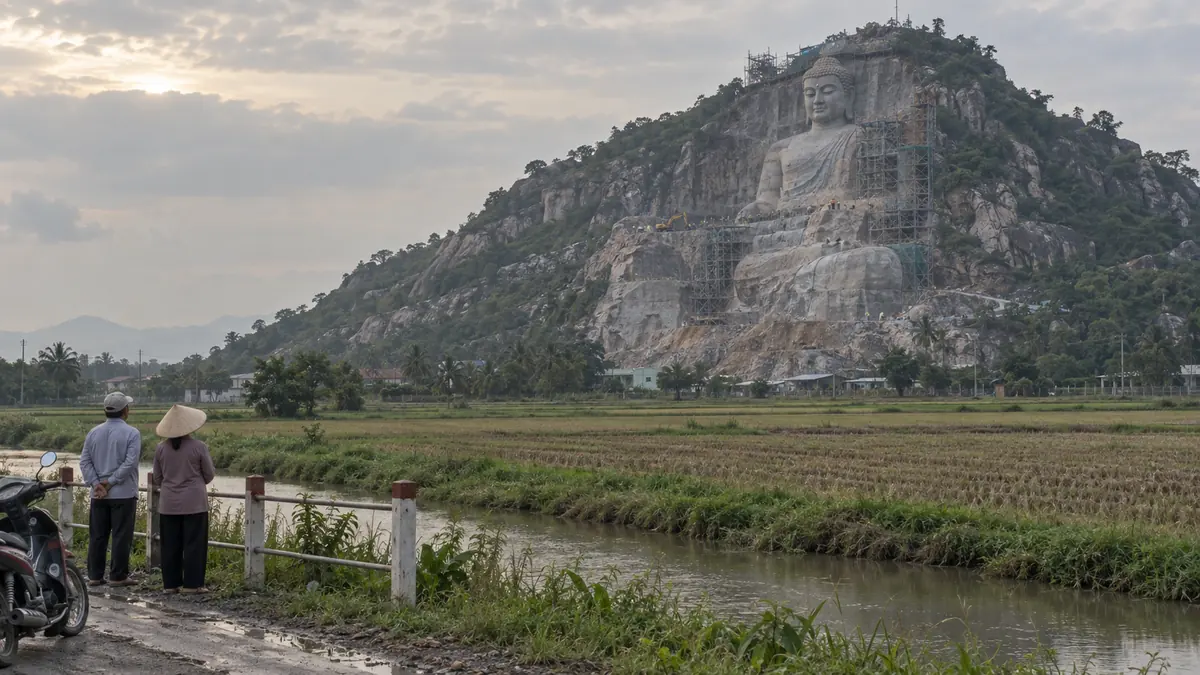
What makes this worth reading now is that it isn't a finished tourist attraction yet. Even before its unveiling, the construction site itself is already becoming an object of pilgrimage and curiosity. For people traveling Vietnam, anyone planning a trip built around worship or a memorial service, and businesses handling Buddhist-related souvenirs and food, right now — before completion — is exactly the time to sketch out the route in advance.
An 81-Meter Seated Buddha Carved From an Entire Mountain: How Far Has Construction Come?
What sets this statue apart from an ordinary one is that it isn't cast elsewhere and brought in — it's carved directly out of Núi Sam's own bedrock into the shape of a seated Buddha. VnExpress reported that about 70% of the work is done, with around 50 people between excavation and carving crews still working on site. The volume of rock that needs to be excavated for grading and shaping the statue's form is planned at roughly 198,000 cubic meters. These figures all come from VnExpress alone; Tuoi Tre cites different numbers, such as the investment amount, so details vary by source.
Carved as One Piece — It Can't Be Moved or Relocated
Carving it as a single piece means the mountain and the statue are physically one continuous thing. Since it can't be moved or repositioned once finished, the site selection and design had to be right the first time. Put another way, the mountain itself is the pedestal and the backdrop, inseparable from the surrounding landscape. Visitors come closer to a feeling of “going to meet the mountain” than “going to see a statue.” That inseparability is also why it's discussed together with the cluster of nearby pilgrimage sites, covered below.
A Long Project: Started in 2015, Finishing in 2027
According to Tuoi Tre, groundbreaking took place in March 2015 — meaning the mountain has been carved for over a decade already. VnExpress reported that the statue itself is expected to be finished by the end of 2027, with the surrounding park completed around June 2028. In other words, as of autumn 2026, the statue's outline has taken shape, but the approach road and park are still mid-development. If you visit, going in expecting “a major project in progress” rather than “a finished attraction” will match reality more closely.
Why Is a Statue That Surpasses the Leshan Giant Buddha Being Built in a Mekong Town?
The Chau Doc area around Núi Sam is already one of the leading pilgrimage destinations in southern Vietnam. At the foot of the mountain sits Ba Chua Xu Temple, renowned for its spiritual power, drawing worshippers from across the south from Lunar New Year through roughly the fourth lunar month. Faith brings people, and people bring spending — a cycle rooted in this land for centuries.
In An Giang, Worship Drives the Local Economy
The 81-meter seated Buddha adds a new landmark on top of that existing cycle. Worshipping at a temple is a quiet, indoor act, but a giant Buddha on a mountainside is visible from far away and hard to resist photographing. A photogenic subject you can see from a distance tends to draw in younger visitors and foreigners — this is the writer's own read, but when a place of worship gains visual talkability, the pool of potential visitors tends to widen.
Claiming “World's Tallest”: Where Regional Tourism Stakes Its Bet
A title like “taller than the Leshan Giant Buddha, the world's tallest rock-carved statue” is a powerful banner for a region trying to draw in people and money. In fact, according to Tuoi Tre, this project's funding comes from socialization (donations and offerings) and the Núi Sam temple's management committee. Unlike coastal resorts such as Da Nang or Nha Trang, the inland Mekong Delta is a destination without a coastline. That's exactly why building a strategy around “a one-of-a-kind landmark found nowhere else” makes sense. The push to compete on distinctive landscapes like terraced fields and fishing villages is happening elsewhere in the country too — including the villageswith terraced fields and pine foreststhat Vietnam put forward as its five candidates for World's Best Tourism Village. Set alongside that lineup, Núi Sam's giant Buddha belongs to the same trend of building an unmatched landmark.
How Much Does the 81m Buddha Cost? What's the Difference Between 255 tỷ and 456 tỷ?
This part calls for some care. The two major papers cite different amounts, but a closer read suggests the discrepancy likely comes down to “different scope,” not a contradiction. Rather than dismissing it as an error, it's worth treating each figure separately for what it actually covers.
What Both Papers Agree On
| Item | Details | Source |
|---|---|---|
| Height of the statue | 81 meters | Tuoi Tre / VnExpress |
| Format | Carved directly from the mountain's rock as a single piece (seated Shakyamuni Buddha) | Both papers |
| Location | Vinh Te Ward, An Giang Province, at Núi Sam | Both papers |
| Status | Under construction (VnExpress reports about 70% complete) | Both papers |
| Scheduled completion | The statue itself by the end of 2027 | Both papers |
| Comparison | Expected to surpass China's Leshan Giant Buddha (71m) once complete | Both papers |
255 tỷ for the Statue, 456 tỷ for the Whole Park — Two Figures, Two Different Scopes
Tuoi Tre reports the total investment for building the giant Buddha itself at about 255 tỷ đồng (roughly 255 billion dong), funded through socialization (donations and offerings) and the Núi Sam temple management committee. VnExpress, meanwhile, puts the total investment for the broader “Núi Sam Cultural Park Project,” of which the giant Buddha is the main facility, at over 456 tỷ đồng (over roughly 456 billion dong). The former likely refers to the statue alone, the latter to the whole park — reading these as two papers simply contradicting each other on the same number would be a mistake. Rather than settling on one figure as definitive, it's safer to keep both, along with what each one actually covers.
How Much Is That in Yen, and How to Read the Digits
For reference, converting at roughly 1 yen ≈ 175 dong (an approximation as of September 2026; exchange rates fluctuate), 255 billion dong comes to about 1.4–1.5 billion yen, and 456 billion dong to about 2.6 billion yen. In Vietnamese currency terms, tỷ means billion and triệu means million; misreading tỷ against the Japanese unit for hundred million throws the figure off by a wide margin. It's safest to keep the original figures in their native notation (dong).
Vinh Te Drew Over 4.5 Million Visitors in 2026 — What's Happening Around It
According to Tuoi Tre, the Vinh Te area has drawn over 4.5 million visitor trips since the start of 2026. This isn't a figure for the giant Buddha alone — it covers the whole area, including Ba Chua Xu Temple, Thoai Ngoc Hau Tomb, and Hang Cave Temple. The giant Buddha slots into that already-strong pilgrimage demand as “one more reason to stop by.”
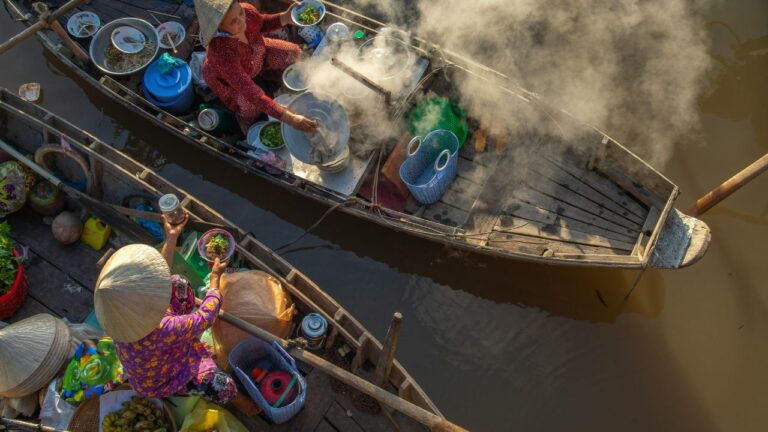
A Mekong Delta trip tends to gain more value from stepping into the river and daily life than from ticking off sights one by one. Take the article onforeigners being invited into a memorial feast and touching the hospitality of the Mekong— that kind of route, one that lets you taste the local way of life itself, pairs well with worship at Núi Sam. A two-day, one-night trip where you look up at the statue and then head over to a nearby market or riverside eatery could become the classic route once the project is complete.
What This Project Signals for Japanese Travelers and Food Businesses
From here, this is the writer's own read. The giant Buddha, still unfinished, means something different to two kinds of readers on the Japan side.
For Travelers, There's a Different Kind of Interest Right Now, Mid-Construction
After completion at the end of 2027, visitor numbers could climb even further. This area already draws around 4.5 million visitor trips, so it was never a place to expect quiet. Even so, right now, mid-construction, is a window where you can watch the mountainside mid-transformation into a statue from safe spots along the public road or canal. Since the site involves quarrying and scaffolding, though, staying out of the construction zone and following local regulations is a given. If you want to time a visit to a religious event, there's thethree-day Vu Lan (Ghost Festival) observanceheld at Marble Mountains in Da Nang around the same time as Japan's Obon — building a trip around a festival's schedule like that lets you feel the intensity of local devotion that ordinary sightseeing misses. At Núi Sam too, timing your visit around the lunar-calendar temple festival will put you in the middle of the town's highest energy.
Food and Souvenir Businesses Should Aim at “Pilgrimage Spending”
Around pilgrimage sites, it isn't just incense and offerings that sell — long-lasting sweets, dried goods, and local ingredients move as souvenirs too. Whether the giant Buddha generates a genuinely new flow of visitors won't be clear until it's finished, but the souvenir market is already substantial just from existing pilgrimage demand. Lightweight, shelf-stable, gift-friendly foods — dried fruit or dried vegetables made in Vietnam, for instance — are a plausible fit for pilgrims' habit of “buying something to bring back for someone.” Mapping out now, before completion, which route and which shop should carry what gives businesses a head start on their move for 2027 and beyond.
Location, Timing, and Access to Know Before You Go
As of now, the site is under construction, and there's no visitor facility or defined area open to the public yet. What follows is practical information confirmable as of September 2026 from news reports and general geography; prices and public access status remain fluid.
| Item | Details |
|---|---|
| Location | Vinh Te Ward, An Giang Province (formerly downtown Chau Doc), at Núi Sam |
| Current state | Under construction (VnExpress reports about 70% complete). The statue itself is due by the end of 2027, the surrounding park around June 2028 |
| Nearby Sights | Ba Chua Xu Temple, Thoai Ngoc Hau Tomb, Hang Cave Temple |
| Getting there, roughly | About 6 hours by car west of Ho Chi Minh City. A few kilometers from downtown Chau Doc to the foot of Núi Sam |
| Recommended Timing | The lunar-calendar temple festival season (typically around the fourth lunar month) draws the biggest crowds. For a quieter visit, go on a weekday |
*Travel times are rough estimates based on general geography, not confirmed figures from news reports. Actual road conditions may vary.
Two Years Until Completion: What You Can Do at Núi Sam Now
If there's one concrete step to take now, it's this: tentatively pencil in a trip to see the statue mid-construction before it's finished at the end of 2027. Visitor numbers may climb further after completion, but watching the giant Buddha take shape from a public road is a window open only for now. Pair an overnight stay built around worship at the neighboring Ba Chua Xu Temple with one detour into Mekong life or a local festival, and Núi Sam's giant Buddha becomes less “tourism that consumes a finished product” and more “witnessing a place in the middle of changing.”