A foreign couple who came to Hanoi meaning to stay "just a year" now receive as many as 8,600 travel inquiries every week. Vietnam's English-language outlet VnExpress International profiled Liam Gordon (30) from the UK and Sarah James (25) from Canada. What the two tell inquirers again and again is a yardstick for picking places: "if about 40 of the diners are Vietnamese and only one is a foreigner, it's a winner." This "40:1 rule," found in no guidebook or review site, is exactly the kind of thinking that helps Japanese travelers who are too afraid of getting overcharged to step into a local eatery. This article introduces the couple's journey and then translates the rule into practical tips for Japanese travelers.
The British-Canadian couple "Two Peas Abroad," who receive 8,600 queries a week
According to VnExpress, in 2017 Gordon was drawn to Hanoi during a three-week trip to Vietnam, but at the time he prioritized his career as a software developer and stayed in the UK. He later met James, and in 2023 the two moved together on a plan to "live in Hanoi for a year, then return to the UK or Canada."
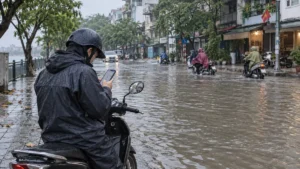
The turning point was the day their motorbike broke down in a Hanoi downpour. A passing man helped push the bike all the way to a repair shop, and even used a translation app to explain the details of the repair. James recalls, “that sense of community turned all our plans upside down.” Their plan to leave after a year was scrapped, and the two still live in Hanoi’s Cau Giay district.
Instagram travel posts that started for friends and family eventually drew questions from strangers like 'Could you plan my itinerary?' and 'How's the safety there?' Putting his developer skills to use, Gordon built his own tools to automatically sort inquiries and a feature that generates an itinerary and destinations when you paste a video link. The inbox of the couple's platform, 'Two Peas Abroad,' grew to receive about 8,600 inquiries a week. Gordon says, 'Those messages are the greatest reward for us.'
"If 39 of 40 are locals, it's a winner" — three reasons the rule works
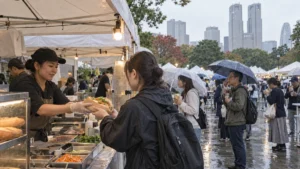
The couple's headline piece of advice is the one from the opening,The 40:1 ruleGordon puts it this way: “The place is packed with local Vietnamese customers, and foreigners are about one in 40. That’s a good sign.” He says it is a rule of thumb he has tested himself in Da Nang and Hanoi.
Why can this ratio be used to judge a good shop? Breaking it down in my own way, there are three reasons.
- Locals choose a place only for a price and taste they can return to every day. In other words, a crowd of locals is proof that price and quality are in balance
- Shops kept going by regulars turn over ingredients fast, so freshness-critical items like soup and rice noodles are in especially good shape
- Because local customers know the going rate, it's structurally hard for shops to set dual pricing (foreigner prices)
Flip it around, and a place where “nearly all the customers are foreigners” is likely one whose taste and prices are optimized for tourists. At the long-established Michelin-recognized steamed rice crepe shop in Ho Chi Minh City, too, the ones in line were mainly local regulars (A veteran steamed rice crepe shop earns a Michelin nod, a smart pick for a Saigon breakfast). The ratings of an authoritative guide and the 40:1 rule line up cleanly in their conclusions.
Five steps to put the "40:1 rule" into practice for Japanese travelers
That said, you can't just stand in front of a shop counting customers. To make this usable on an actual trip for Japanese travelers, we'll break it into steps.
| Steps | What to do | What to look for |
|---|---|---|
| 1. Match the time of day | Pass by the shop between 7–8 a.m. and 11:30 a.m.–1 p.m. | Does it overlap with the local peak? Don't judge by empty seats during quiet hours |
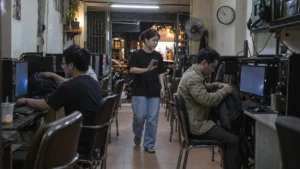
| 2. Take a quick look at the clientele | Scan the customers' tables from the entrance | If it’s all backpacks and cameras, judge it as tourist-oriented |
| 3. Check the menu | Check the language on the sign and the menu out front | Shops that are mostly in Vietnamese with a small menu are likely geared to locals |
| 4. Look for price displays | Check whether the walls or menu have prices | If prices are clearly stated, there's little to worry about with dual pricing |
| 5. When in doubt, pick the busier one | On a street lined with the same kind of shops, go to the side with the line | Locals line up after comparing several nearby shops |
The time of day is especially telling. Vietnamese local eateries concentrate their business in the morning and midday, and the more popular a spot, the earlier it closes. In Ho Chi Minh City there are even regional-noodle shops that sell out by 9:30 a.m. (To Ho Chi Minh City in search of regional flavors—a bowl of home that sells out by 9:30 a.m.), and 'I went in the afternoon and it was closed' is, if anything, routine for good local shops. When planning an itinerary, the standard move is to assign your search for good shops to breakfast and lunch.
When the rule doesn't work — protecting yourself in the heart of tourist areas
The 40:1 rule has a weakness, too. In tourist-dense spots like Hanoi's Old Quarter or around Hoan Kiem Lake, most of the people walking around are foreigners to begin with. In areas without the local customers that form the denominator, observing the ratio doesn't work.
In such places, add the following guideline.
- Step one alley in off the main street. Just 50 meters off the tourist path, the clientele often changes completely
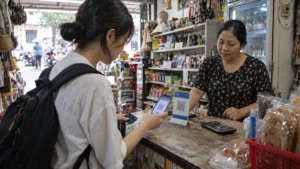
- At stalls or fruit sellers with no listed prices, confirm the amount before ordering by pointing or using your phone's calculator
- At payment, check items and amounts against a receipt or handwritten slip, and don't pay on a verbal, mental-math total alone
- Treat shops whose staff aggressively hawk to passersby on the street with an extra notch of caution, as a sign that locals aren't coming back
The important thing is not to avoid local shops themselves out of fear of getting ripped off. Gordon tells those who consult him: "Once you've come, you'll realize the worries you had before coming had no basis at all." Making the rounds of only tourist-oriented shops out of excessive caution amounts to throwing away the tastiest part of a Vietnam trip yourself.
“Ask the residents” has become the main battleground for travel information
The volume of 8,600 inquiries a week can't be explained by the couple's personalities alone. Guidebooks update on a yearly cycle, review sites are hit-or-miss, and social media is fragmentary. There's a shortage of sources that can answer 'right now, in this city, on my terms,' and 'locally based creators' fit neatly into that gap. That they even built a system that returns an itinerary when you paste a video link shows travel consulting is shifting from personal kindness to a systematized service.
This picture applies in reverse to Japan's inbound tourism operators too. Visitors to Japan are likewise looking for "a resident's real answer," and the guide role played by foreign creators living in Japan should only grow. It suggests that the partners local tourism boards and restaurants should team up with are not just big media but these individual platforms.
James's words cut to the heart of this phenomenon. "If you can connect with the people here, you'll understand why travelers fall in love with this country and come back again and again." What the two are selling isn't an itinerary but a translation of trust between locals and travelers.
Summary - three things to try on your next Vietnam trip
Finally, let’s narrow the takeaways from this article to three actions.
- Make breakfast and lunch your practice slots for the '40:1 rule.' Observe the storefront during locals' peak hours before going in
- In tourist hubs, step one alley off the main drag and make checking prices in advance and cross-checking the slip a habit
- Save on transport costs and put it toward food. In central Hanoi you can also use bus routes that have been made free (Buses in central Hanoi go free for a year — here's how travelers' transport changes)
What turned a "just one year" stay into a home base for life was the kindness of a stranger who pushed his motorbike for him on a day of heavy rain. The 40:1 rule isn't merely a money-saving trick; it's a signpost that guides travelers to places where that kindness flows as everyday life. On your next trip, walk past the shops full of foreigners and sit down at one packed with locals.