
Vietnam's standard voltage is 220V. Before looking at the plug shape, check the "INPUT" label on your charger or appliance. If it reads "100–240V," a voltage converter is generally not needed, but if it reads "100V" only, plugging it in directly carries a risk of damage or overheating.
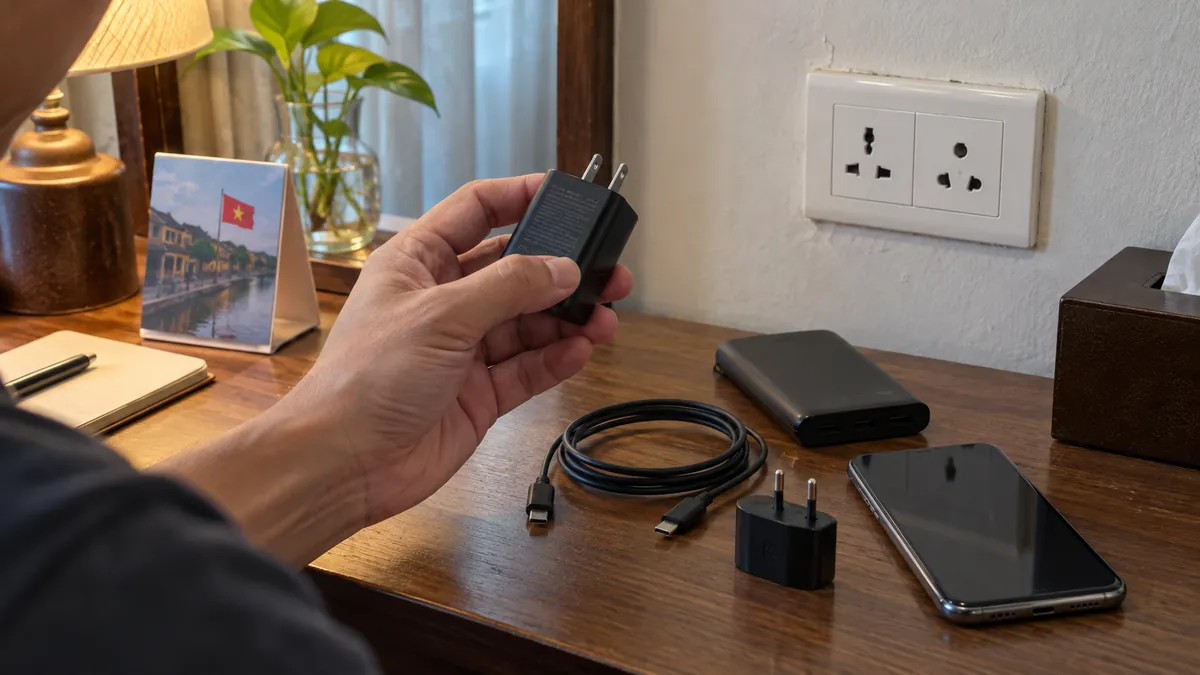
Smartphone chargers are often compatible with international voltages, but hair dryers and beauty appliances may still be 100V-only. In addition, rules on the number of power banks, their capacity, and their use on board vary by airline. This article addresses voltage, plugs, and aviation rules separately.
Bottom line first: what to check before you pack
- Check whether the INPUT on the device itself or its charger reads 100–240V
- For high-wattage appliances that are 100V-only, consider switching to a travel-compatible international version
- Prepare one small conversion plug compatible with Type A and Type C outlets
- Check the Wh rating on your power bank and your airline's limit on the number allowed, and pack it in your carry-on
Vietnam's voltage and plugs
| Voltage | 220V (Japan is 100V) |
|---|---|
| Frequency | 50Hz |
| Plug shape | Mainly A and C types (A/C dual-compatible outlets are common too) |
How to tell the plug shape
The outlets you'll see in Vietnam are mainly two kinds. Knowing the shapes saves you from panicking "it won't fit" on the ground.
- Type A— The same two flat prongs as Japan. At newer hotels' A/C dual-compatible outlets, it often plugs in as is
- Type C— Two round prongs. Common in Europe and the standard in Vietnam. In rural areas and older buildings it may be C-only
- Rarely, Type D or F— Very occasionally seen in old buildings and the like. Have a multi-type plug adapter and you'll almost never have trouble with the shape
Can Japanese appliances be used as is?
Since Japanese plugs are Type A, they often plug into A/C dual-compatible outlets as is. The issue, however, is voltage. Plugging a Japanese 100V-only product in as is risks failure, so checking the compatible voltage is essential.
- Products compatible with "100–240V"— Many chargers for phones and laptops fall here, and no converter is needed
- 100V-only products— Some hair dryers and beauty appliances. A voltage converter is needed to use them
- If the plug won't fit— For C-only outlets in old rural buildings, an A/C adapter gives peace of mind
A quick-reference chart by device
| Chargers for phones, tablets, and laptops | Most are 100–240V compatible. No converter needed |
|---|---|
| Chargers for digital cameras and mobile batteries | Many are overseas-compatible. Check the INPUT label |
| Hair dryers and hair irons | Many Japanese ones are 100V-only. An overseas-compatible product or a converter is needed |
| Electric shavers and electric toothbrushes | Depends on the model. Check in advance whether it's overseas-compatible |
Things to have for peace of mind
- An A/C-compatible plug adapter (a multi-type is handy)
- A charger labeled "100–240V" compatible
- A charger or mobile battery with many USB ports (to charge several devices at once)
How to choose a plug adapter and charger
- A multi-type plug adapter— If it covers A/C plus countries worldwide, you can reuse it on other trips
- Consolidate into a charger with USB ports— Charge a phone, earbuds, and camera at once from one unit, saving outlet slots
- USB-C PD compatible— If you can cover a laptop or tablet with a single charger too, luggage shrinks
- A GaN (gallium nitride) charger is handy— Small and light at the same output, and a model with several USB-C ports lets you consolidate into one charger. Fewer outlet slots and less luggage
- A small power strip— Hotels may have few outlets, and being able to multiply one slot is convenient
The hotel power situation
A common gripe at hotels is "there's no outlet where I want to charge." Knowing in advance makes it easier to cope.
- Few outlets— Older hotels may have only a few in the room. A charger with many USB ports or a small strip lets you charge several devices at once
- None by the bedside— You may want to charge at your pillow but there's no slot nearby. Having one longish charging cable gives peace of mind
- Power cuts off when the card key is removed— Some hotels cut room power when you pull the key from the in-room card-key holder. To charge while out, find another always-on outlet or ask the front desk
How to choose when you need a voltage converter
A voltage converter (transformer) is needed only when using devices not compatible with "100–240V." When choosing, always check that it handles the device's power consumption (W).
- Check the power consumption (W)— Choose a converter with a rated capacity larger than the wattage shown on the device. High-output devices like hair dryers need a converter with a larger capacity too
- The option of going overseas-compatible in the first place— Using a travel "100–240V" hair dryer or hair iron means no converter is needed and lighter luggage
- A plug adapter and a voltage converter are different things— A plug adapter only matches the "shape" and doesn't change voltage. When you want to lower the voltage, a converter is needed
Handling mobile batteries
Power banks and lithium batteries must be carried on board as a rule and cannot be checked in. Capacity is measured in Wh (watt-hours); a rough guide is approximately 37 Wh for 10,000 mAh and approximately 100 Wh for around 27,000 mAh. Even for capacities under 100 Wh, the limit on the number of units varies by airline. Vietjet, for example, states a maximum of two units under 100 Wh. Items between 100 and 160 Wh may require prior approval, and those over 160 Wh are generally not permitted on board. Always check the regulations of the airline you are flying with.
Vietnamese airlines restrict in-flight use of mobile batteries
Vietnam Airlines and VietJet Air restrict in-flight use of mobile batteries for safety. Not being able to check them is common to all carriers, but Vietnamese airlines require extra care with in-flight handling.
- Charging in flight is not allowed— Using a mobile battery to charge a device during flight is prohibited. Turn it off and store it
- Don't put it in the overhead bin— You're asked not to put it in the overhead bin but to keep it in a visible place around your seat
- Charging via the in-seat USB port is also not allowed— Using the seat's USB port to charge the mobile battery body itself is also prohibited
- Check the latest rules with each carrier— Since capacity and quantity limits and operations can change, check the official guidance of the airline you're flying before departure
Points to note
- Always check the compatible voltage on the "INPUT" label of chargers and adapters
- Don't use 100V-only high-output devices (hair dryers, etc.) without a voltage converter
- At some hotels you can borrow a plug adapter at the front desk
Frequently asked questions
- What are Vietnam's voltage and plugs?
-
The voltage is 220V and the frequency is 50Hz. Plugs are mainly A and C types, and A/C dual-compatible outlets are common too. Since Japan is 100V, you need to check your devices' compatible voltage.
- Can I use my Japanese phone charger as is?
-
Many phone and PC chargers are "100–240V" compatible, so they work without a converter. The Japanese Type A plug often plugs in as is too, but having a plug adapter gives peace of mind for C-only outlets.
- Do I need a voltage converter?
-
Not for a "100–240V" compatible device. A converter is only needed when using a Japanese 100V-only product (some hair dryers and beauty appliances, etc.).
- Are there enough outlets at hotels?
-
Mid-range and up hotels have several in the room, and USB-port ones are increasing. However, some rooms have few, or no slot by the bedside, so a charger with USB ports, a small power strip, and a longish charging cable let you charge several devices at once, which is handy.
- Can I bring a mobile battery on the plane?
-
Carry-on is the rule; checked baggage is not permitted. Check capacity in Wh, and note that even under 100 Wh, the number of units allowed varies by airline (approximately 37 Wh per 10,000 mAh as a guide). Vietjet states a maximum of two units. There are also restrictions on using power banks in-flight and charging via seat USB ports, so check the latest guidance from your airline before traveling.
Please also check the overall packing list and the season together.

Summary: check INPUT and Wh before worrying about the plug adapter
Smartphones and laptops are often 100–240V compatible, but 100V-only appliances are a different matter. The most important thing is not to make assumptions without reading the label. Power banks should not be checked in—protect the terminals, place them in your carry-on, and follow your airline's latest regulations regarding quantity, in-flight use, and storage location.