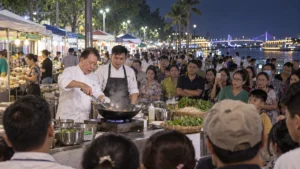
In July 2026, a different kind of night has come to the old quarter around Hoan Kiem Lake, Hanoi's symbol. Under the 'low-emission zone (LEZ)' trial the city launched on July 1, vehicles are banned from 12 central streets from 7 p.m. to midnight on Friday, Saturday, and Sunday. Those streets, known for their torrents of motorbikes, become almost entirely pedestrian on weekend nights, except for official and emergency vehicles. For residents it's a change in transport rules; for travelers, a new way to enjoy the old quarter. This article sorts out the change from both sides — 'the practicalities of not breaking the rule' and 'how to walk the pedestrianized nights.'
On Friday, Saturday, and Sunday nights, cars vanished from 12 streets around Hoan Kiem Lake
According to VnExpress, Hanoi began a trial of a low-emission zone in the Hoan Kiem district from July 1. The pillar of Phase 1 (July 1 to December 31, 2026) is 12 streets designated as Zone 1, where from 7 p.m. to midnight on Fridays, Saturdays and SundaysA ban on vehicles entering, including motorbikes and carsIt's a measure to do so. Actual enforcement started on the evening of Friday, July 3.
The 12 streets covered run from the east bank of Hoan Kiem Lake into the heart of the Old Quarter. They include Trang Tien, Hang Khay, Le Thai To, Hang Dao, Hang Ngang, Hang Buom, Ma May, Hang Bac, Hang Mam, Nguyen Huu Huan, Ly Thai To, and Ngo Quyen. They almost entirely overlap the routes travelers walk at night—the Hang Dao–Hang Ngang axis where the night market sets up, and Ma May and Hang Buom, lined with old houses and bars.
The weekend pedestrian zone itself has existed for a while, but this framework is a formalization for air-pollution control, not "creating a lively atmosphere." On the planning stage before introduction,An article decoding the Old Quarter's vehicle-restriction planas introduced, and it has now started to move for real from the beginning of July.
The practicalities of not breaking the rule — from where to where, from what time, and which vehicles
The first thing residents and business travelers should grasp is "which restriction your own movement falls under." The Phase 1 restrictions can be laid out as follows.
| Classification | Coverage area | Time slot | What the rules cover |
|---|---|---|---|
| Zone 1 | the 12 streets of Trang Tien, Hang Khay, Le Thai To, Hang Dao, Hang Ngang, Hang Buom, Ma May, Hang Bac, Hang Mam, Nguyen Huu Huan, Ly Thai To, and Ngo Quyen | Friday, Saturday, and Sunday, 7 p.m. to midnight | A ban on vehicles including motorbikes and cars entering |
| Zone 2 | Surrounding streets such as Trang Thi, To Nhuom, Hang Bong, Phung Hung, Phan Dinh Phung, Hang Dau, Tran Nhat Duat, and Tran Quang Khai | Daily, 6 a.m.-9 a.m. and 4 p.m.-7:30 p.m. | Restrictions on tour buses and large buses seating 16 or more (school buses excluded) |
| Freight vehicles | Within the zone | Nighttime only depending on vehicle class, etc. | Time limits such as vehicles over 3.5 tons allowed through only 9 p.m.–6 a.m. |
As an exception, official vehicles such as defense and public-security cars may pass regardless of the time of day. On fine amounts, no concrete enforcement can be confirmed in current reporting, and the first weekend focused on guidance rather than crackdowns (see below). Still, it's not "no penalty, so you may enter"; police officers stand at each entrance and physically stop vehicles from entering.
What about people whose home or shop is inside Zone 1? In the first weekend’s operation, after explaining the situation to a police officer,Get off the motorbike and push it on foot. The guidance is that if you cut the engine and push, you're treated as a pedestrian. Since ride-hailing apps will pick you up and drop you off outside the zone boundary, if you're heading to a hotel inside the Old Quarter on a Friday, Saturday, or Sunday night, plan on walking a few hundred meters with your luggage.
The first weekend on the ground—loudspeaker guidance and puzzled drivers
On the first weekend of July 3-4, DTiNews (the English edition of Dan Tri) reported the scene on the ground. Police prioritized publicity over applying penalties, using loudspeakers at each intersection to urge detours. It was largely complied with, though confusion was notable on the first night.
Picking up the reactions that appear in reports gives a sense of the mood on the ground.
- A Grab driver mid-delivery was refused entry and, bewildered, said, 'I couldn't complete the delivery into the zone'
- A 28-year-old who lives in the zone backed the restriction itself while commenting that "residents need time to get used to the new rules"
- Police stated clearly that "in the initial stage we prioritize guidance and outreach over enforcement," and allowed residents to pass through pushing their motorbikes
In short, the rollout is "soft operation." But this is only a transitional measure, and once citizens get used to it, operation tightening up is a pattern we've seen with other Vietnamese regulations too (mandatory helmets, tougher drunk-driving penalties).
How the target area expands — reading the phased plan
This weekend-night restriction is only the entrance to a larger roadmap. The phased plan reported by local media (VietnamNet) is designed to widen the covered area step by step while tightening vehicle restrictions by emissions standard as each phase advances.
| phase | Period | Main measures |
|---|---|---|
| Phase 1 | July to December 2026 | In Zone 1, all vehicles banned on Friday–Sunday nights; in Zone 2, large buses restricted |
| Phase 2 | 2027 | Expanding to Hoan Kiem and Cua Nam wards (14 streets). Regulating vehicles that don't meet Euro 4-equivalent emissions standards, ride-hailing gasoline motorbikes, and trucks over 3.5 tons |
| Phase 3 | 2028–2029 | Expanded to the nine districts inside Ring Road 1 (Vành đai 1). Petrol motorbikes that don't meet emission standard level 3 are restricted |
| 2030 and beyond | — | Continue evaluating operation and considering expansion |
In parallel, the supporting infrastructure is also being put in place. Within Ring Road No. 1, route buses became fare-free for one year starting July 1, 2026 (for details,Article on the one-year free buses in central Hanoiexplains it). According to VnExpress, plans are also underway for support for poor households to buy electric vehicles (up to 20 million dong = about 120,000 yen), 44 rental-bicycle stations with 456 bikes, and 10 park-and-ride facilities. It's designed to run "tighten with rules" and "provide alternatives" at the same time.
How residents and travelers should each act
For residents there are three practical points. First, if you have a route that cuts through Zone 1 on Friday, Saturday, or Sunday nights, establish a separate weekday route now. Since Ly Thai To and Ngo Quyen streets on the east bank of Hoan Kiem Lake are covered, weekend-night travel running north–south along the lake’s east side is affected. Second, commercial trips such as food delivery and shop restocking need to be completed before 19:00 or switched to handoffs at the boundary. Grab drivers got stuck on the first weekend because this adjustment had not yet taken hold. Third, over the longer term, with the 2027–2028 emissions-standard regulations in view, anyone buying a motorbike or car in Hanoi from now on has entered a phase where they should check the emissions-compliance level. If you’re replacing a vehicle, electric is becoming a realistic option.
For travelers, on the other hand, this restriction is more of a boon than a constraint. Hoan Kiem on Friday, Saturday, and Sunday nights becomes a 'walkable old quarter' — a rarity in Southeast Asia — freed from motorbike horns and exhaust. A recommended route: enter just after 7 p.m. from the Opera House end of Trang Tien Street, head north along lakeside Le Thai To Street, browse the Hang Dao–Hang Ngang night market, then settle into a bar or cafe on Ma May and Hang Buom streets, where old houses remain. A night shot of the old quarter taken from the middle of the road is a composition that was impossible amid the waves of motorbikes. The story that Hanoi's cafes are seeing their background-music situation change over music copyright fees is alsoAnother article, as we wrote, but the combination of quieted streets and cafés where spoken-word recordings play is something you can only experience in today's Hanoi.
It affects choosing accommodation too. If you arrive at a hotel inside Zone 1 on a Friday–Sunday, taxis go only to the zone boundary. Since you'll end up dragging your suitcase several hundred meters over cobblestones, if you have large luggage it's realistic to book lodging outside the boundary (toward Hang Bong Street or Tran Quang Khai Street) or to arrange a check-in before 7 p.m. Conversely, if you "want to fully enjoy the quiet Old Quarter at night," it's now worth staying inside Zone 1 on purpose.
Stepping back one more level, this is an emerging-Asia version of the LEZ (low-emission zone) that London and Milan pioneered. Whereas Europe's LEZs steer toward low-emission vehicles through charges and fines, Hanoi is characteristically pushing "creating a pedestrian space that becomes a tourist draw" and "exhaust countermeasures" as one, an unusual structure where regulation generates a tourism resource. How far this plan progresses in a city with among the world's highest motorbike-ownership rates will be a touchstone for policy in Ho Chi Minh City and other Asian cities.
Practical information and summary
| Item | Details |
|---|---|
| Restricted areas | Zone 1 of Hanoi's Hoan Kiem district (12 streets, east bank of Hoan Kiem Lake to the Old Quarter) |
| Regulated days and times | 7 p.m. to midnight on Fridays, Saturdays and Sundays (operation began the night of July 3, 2026) |
| Target | Vehicles including motorbikes and cars (official vehicles are the exception; residents may pass if they push their motorbike) |
| Impact on travelers | Taxis and ride-hailing only to the zone boundary. Walk to hotels inside the zone |
| Measures worth combining | Free route buses inside Ring Road 1 (July 1, 2026 to June 30, 2027) |
As your next action, if you plan to go to Hanoi on a weekend, try rebuilding your itinerary on the premise of spending Friday, Saturday, and Sunday nights on foot exploring the Old Quarter. Combined with the free buses, you can bring your downtown travel cost to nearly zero. For residents, now is the time to take stock of your own weekend travel and your preparations for the post-2027 vehicle regulations. The trial runs through the end of December, so we too will follow up if operation is tightened or the target area expands.