Mekong Delta Cai Rang Floating Market guide | Experience the 100-year-old 5 a.m. market in April, the final month of the dry season
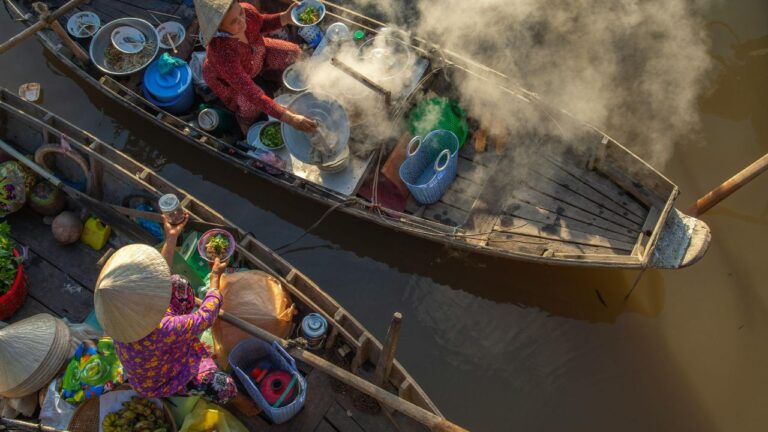
The over-100-year-old "Cai Rang Floating Market" in Can Tho, the central city of the Mekong Delta, is one of the highlights of sightseeing in southern Vietnam. For just a few hours from 5 to 9 in the morning, 300 to 400 small boats gather on the river to buy and sell fruit, vegetables, rice, coffee, and noodle dishes—a scene registered as Vietnamese national intangible cultural heritage in 2016.
April is the final month of the Mekong Delta's dry season, the "best season" with the least rainfall and stable boat operation. Once the rainy season begins in May, the morning weather grows more unstable and the number of vendors decreases, so a visit within April is the timing with the highest completeness as a sightseeing experience. We've organized access, boat fares, how to get around, and food as practical information for Japanese travelers.
The starting point of Cai Rang Floating Market | Why a "100-year-old morning market" is special
We organize the history and features of the market that symbolizes the Mekong Delta's water-transport culture.
Basic market information
| Item | Details |
|---|---|
| Name | Cai Rang Floating Market (Chợ nổi Cái Răng) |
| Location | Cai Rang District, Can Tho City, Can Tho Province |
| Established | Early 1900s (estimated over 100 years ago) |
| Cultural heritage registration | 2016 (Vietnamese national intangible cultural heritage) |
| Hours | 5:00–9:00 (the effective peak is 5:00–7:00) |
| Number of small boats per day | 300–400 boats |
| Admission | Free |
| Distance from the city center | About 5 km |
| Distance from Ninh Kieu Wharf | About 30 minutes by boat, about 15 minutes by motorbike |
The tradition of "Cây Bẹo"
The biggest feature of Cai Rang Floating Market is the 3–5 m bamboo pole called "Cây Bẹo." Merchants hang the goods they sell (pineapple, coconut, watermelon, and so on) on the tip of the pole so that anyone can tell at a glance, even from a distance, what a boat is dealing in. It's a distinctive "advertising method" of the Mekong River basin that has continued since an age without electronic signboards or smartphone ads.
Background | The Mekong Delta's water-transport culture and the market's role
Can Tho sits on the Hau River, one of the distributaries of the Mekong (known in Vietnam as the Song Cuu Long), and has functioned as a rice export hub for Indochina since the 19th century. The floating market developed as a produce collection point in an era before roads were built, and it still functions today as a "wholesale market" where farmers from dozens of nearby provinces gather by boat.
Balancing tourism and the original wholesale function
| Aspect | Details |
|---|---|
| Up to the 1990s | A pure wholesale market (almost zero tourists) |
| The 2000s | Word spread among international backpackers |
| 2010s | Can Tho City developed it as a tourism resource |
| 2016 | Registered as national intangible cultural heritage |
| The 2020s | A two-layer structure: wholesale in the early 5 o'clock hour, catering to tourists after 6 |
The 5:00–6:30 morning window is still centered on wholesale trading among local merchants. Boatmen guiding tourists increase after 6:00, and the two hours from 5:30 to 7:30 offer the highest completeness as a sightseeing experience.
Data table | Monthly rainfall and visit suitability (Can Tho)
We organize this based on data from the Can Tho City weather observatory.
| Month | Average rainfall | Average temperature | Visit suitability | Notes |
|---|---|---|---|---|
| January | 6mm | 25.6℃ | ◎ | Best of the dry season |
| February | 4mm | 26.4℃ | ◎ | Dry season |
| March | 12mm | 27.5℃ | ◎ | Dry season |
| April | 39mm | 28.5℃ | ◎ | Final month of the dry season, hottest |
| May | 158mm | 28.0℃ | △ | Start of the rainy season |
| June | 224mm | 27.5℃ | × | Rainy season in full swing |
| July | 232mm | 27.4℃ | × | Rainy season |
| August | 245mm | 27.3℃ | × | Peak of the rainy season |
| September | 270mm | 27.0℃ | × | Rainy season |
| October | 285mm | 27.0℃ | × | End of the rainy season |
| November | 165mm | 26.7℃ | △ | End of the rainy season |
| December | 32mm | 25.8℃ | ◎ | Dry season |
While April has the highest temperatures (some daytimes exceed 30°C), the 5–7 a.m. window is comfortable at around 25°C, and the chance of rain is less than one-fifth of the rainy season. It can be called the ideal month for travelers visiting during the first half of Japan's Golden Week.
Local reactions | Voices of boatmen, tourists, and locals
We paraphrase and anonymously excerpt three items from Can Tho Tourism Bureau's public interviews and travel review sites.
Comment 1 (boatman, 60s, male, 30 years in Can Tho)
"My parents did business on this river too. Tourism has made life easier, but the true face of the market is only in the first hour, from 5 to 6. I want to show that, so I leave the harbor every morning at 4:30."
Comment 2 (tourist, 40s, Tokyo resident, male)
"I went on a day trip from Ho Chi Minh City, and because it was April there was no mist on the river and I didn't get seasick. The colors of the pineapples and dragon fruit hung on the Cây Bẹo were striking, and my keeper rate for photos was extremely high."
Comment 3 (local resident, Cai Rang District, 30s, female)
"Breakfast at this market is special for locals too. The custom of eating bun rieu (crab noodles) on a boat can't be imitated anywhere else. It's also a place to share the family's morning time."


Value for Japanese travelers | How to craft the best experience
We organize a plan to elevate Cai Rang Floating Market from "just a tourist attraction" to "an experience of Mekong culture."
Recommended way to get around (a 5-hour model)
| Time | Behavior | Estimated cost |
|---|---|---|
| 4:30 | Gather at Ninh Kieu Wharf | – |
| 4:45 | Charter boat departs | 300,000 VND/group (about 1,765 yen) |
| 5:15 | Arrive at Cai Rang Floating Market | Free admission |
| 5:30 | Breakfast on the boat (bun rieu, pho) | 30,000–50,000 VND/bowl (about 176–294 yen) |
| 6:30 | Photographing the Cây Bẹo and buying fruit | From 50,000 VND/kg (about 294 yen) |
| 7:30 | Travel (small-scale waterway tour) | Included in the charter fee |
| 8:30 | Phong Dien Market (supplementary course) | Free admission |
| 9:30 | Return to Ninh Kieu Wharf | – |
Total cost: about 4,500–7,000 yen per person (meals included, assuming a group charter of 4)
Boat fare guide (as of April 2026)
| Plan | VND | JPY equivalent | Details |
|---|---|---|---|
| Shared individual boat | 100,000-150,000 | About 588–882 yen | One person, shared with other tourists |
| Group charter (4 people) | 300,000-500,000 | About 1,765–2,941 yen | Private for up to 4, 3–4 hours |
| Private tour | 800,000-1,200,000 | About 4,706–7,059 yen | With an English guide |
Access (from Ho Chi Minh City)
| Departure point | Means | Time required | Cost |
|---|---|---|---|
| HCM District 1 → Can Tho | Bus (Phuong Trang) | About 4 hours | 165,000 VND (about 971 yen) |
| HCM District 1 → Can Tho | Limousine van (Futa) | About 3.5 hours | 220,000 VND (about 1,294 yen) |
| HCM District 1 → Can Tho | Rental car + driver | About 3 hours | About 2,500,000 VND (about 14,706 yen) |
| HCM Tan Son Nhat Airport → Can Tho | Domestic flight (VietJet) | About 45 minutes | 800,000–1,500,000 VND (about 4,706–8,824 yen) |
A day trip from Ho Chi Minh City is possible, but to experience the market's 5 a.m. peak, we strongly recommend the "stay-the-night-before" approach of spending one night in Can Tho.
Industry ripple effects | The next decade of Mekong Delta tourism
The Vietnam National Administration of Tourism's 2026–2031 plan sets a goal of growing the Mekong Delta into a destination of "one million foreign tourists a year." Cai Rang Floating Market is a core piece of content, but the challenge is "reconciling tourism with the original wholesale function."
Anticipated changes
| Item | Present (2026) | 2031 forecast |
|---|---|---|
| Foreign visitors per day | 200–400 people | 1,000–1,500 people |
| Number of vendor boats | 300–400 boats | 250–350 boats (decrease) |
| Wholesale trade volume | About 10 billion VND/month | About 6 billion VND/month (decrease) |
| Tourism revenue | About 2.5 billion VND/month | About 12 billion VND/month |
| Ecotourism certification | Not yet obtained | Target to obtain |
The Can Tho Tourism Bureau is advancing measures toward obtaining sustainable tourism certification, including switching boats from diesel to electric, river-cleaning campaigns, and setting up incentives for local merchants. There are also reports that Japan's JICA and the Japan Bank for International Cooperation are considering technical support.
For a sightseeing guide to the whole Mekong Delta, seeSightseeing guide to southern Vietnam; for local tours departing from Ho Chi Minh City, seeLocal culture articles on Saigon's District 1; and for Mekong Delta food culture in general, seeCoffee and souvenir informationis also a helpful reference.
Practical info table | Cai Rang Floating Market visit guide
| Item | Details |
|---|---|
| Name | Cai Rang Floating Market (Chợ nổi Cái Răng) |
| Address | Cai Rang District, Can Tho City, Vietnam |
| Hours | 5:00–9:00 (peak 5:00–7:00) |
| Admission | Free |
| Best season | December–April (especially April, the final month of the dry season) |
| Recommended time to stay | 2–3 hours |
| What to pack | Hat, sunglasses, waterproof bag, small change |
| Note | The boat rocks, so a sense of balance is needed; haggle over fruit prices |
| Toilets | None on the boat; take care of it at Ninh Kieu Wharf |
| Language | Vietnamese only; an English guide requires arranging in advance |
Nearby spots worth visiting together
- Ninh Kieu Wharf: The nighttime illumination and riverside cafés are popular
- Bonsan Pagoda: Can Tho's most beautiful Khmer-style Buddhist temple
- My Khanh Tourist Village: A Mekong countryside experience program
Conclusion | At 5 a.m. in April, meet 100 years of the Mekong
Cai Rang Floating Market is not "a floating market that appears in guidebooks" but "a site where 100 years of Mekong living culture continues on the water." April, the final month of the dry season, is the last timing when rainfall, temperature, wind, and mist are all optimized for the experience; from May onward, the rainy season's effects sharply lower the quality of the experience.
Here are three actions Japanese travelers can put into practice right away.
- Stay one night in Can Tho, depart at 4:30 a.m., and aim for the real wholesale time in the early 5 o'clock hour
- Get close to the Cây Bẹo not by shared individual boat but by group charter (300,000–500,000 VND)
- On the way back, also combine Phong Dien Market (smaller, with a strong local flavor) to experience Mekong culture from multiple angles
The Mekong Delta's tourism development will advance greatly over the next decade, but the time to experience its face as a genuine wholesale market is limited. If you want to see the present of a 100-year-old morning market, the final week of the dry season in April is the ideal timing to visit.
References and sources
- Vinpearl Travel Guide「Cai Rang Floating Market: An ultimate travel guide for 2026」
https://vinpearl.com/en/can-tho-vietnam-the-ultimate-travel-guide - Can Tho Tourism Bureau「Cai Rang Floating Market Official Guide」
https://canthotourism.vn/en/chocairang - Colorful Journeys「Cai Rang Floating Market in Can Tho: An Honest Guide」
- Vietnam National Administration of Tourism, "Mekong Delta Tourism 2026–2031 Plan"
- Can Tho City weather observatory, monthly weather statistics