Walking Ho Chi Minh City's sidewalks, you see stainless-steel containers and colorful insulated buckets placed at the roadside. Handwritten signs read "Nuoc uong mien phi (free drinking water)" and "Nuoc mat cho nguoi di duong (cold water for passersby)." These are Saigon's "free water spots." As scorching heat from climate change grows severe, the spirit of mutual aid rooted in southern Vietnam supports this system.
How the free water spots work—"those with to spare give, those in need take"
According to Saigoneer's reporting, stainless-steel containers and insulated buckets are set up on sidewalks throughout Ho Chi Minh City. The contents are iced tea and purified water, and sometimes snacks are added too. The operating principle is "Nguoi co du thi cho, nguoi can thi lay"—those with to spare provide, those in need take. There's no supervisor. No one asks for words of thanks. It's a system that runs on completely anonymous goodwill.
The people who set them up are often individual residents. They put a container out in front of their home or beside the garage, fill it with water in the morning, and add ice. If the water runs out during the day, neighboring residents sometimes refill it. It's not an organized operation but voluntary mutual aid at the block level.
Background—the sixth most climate-change-affected country in the world
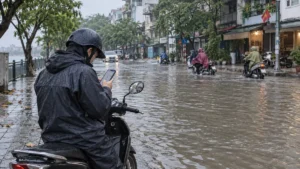
Vietnam is counted among the countries most severely affected by climate change. In rural areas, flooding, and in urban areas, scorching heat, are the main threats. Ho Chi Minh City experiences prolonged heat waves in the dry season (December to April), and years of continued record highs are increasing.
People who work on the street—construction workers, stall vendors, motorbike-taxi drivers, garbage collectors—are exposed to direct sunlight all day. Buying a day's worth of bottled water amounts to an expense equal to a light meal. Moreover, carrying around large numbers of bottles while on the move isn't realistic. Free water spots have become essential infrastructure for these workers.
A culture rooted in southern Vietnamese tradition
This free-water custom isn't a new urban invention. Rural southern Vietnam had a tradition of building leaf-thatched huts along the roadways and placing water jars and coconut ladles to offer water to travelers. This scene, still remaining in the Mekong Delta region, is carried on in a different form on Ho Chi Minh City's sidewalks.
The stainless-steel containers and insulated buckets are the modern version of the coconut ladle and water jar. The tools have changed, but the core of the act—"offering water to passersby"—is the same. Vietnamese people call this culture "tinh nguoi" (human affection).
The distribution and cost of the water spots
| Item | Details |
|---|---|
| Setup locations | Residential-neighborhood sidewalks, the eaves of shopping streets, the entrances of alleys |
| Beverages offered | Purified water, iced tea (tra da, etc.), sometimes snacks |
| Types of containers | Stainless-steel tanks, insulated buckets, plastic bottles |
| Operating body | The goodwill of individual residents (not organized) |
| Usage fee | Completely free |
| Areas with many setups | Densely residential areas of District 1, District 3, Binh Thanh District, and Go Vap District |
| The city's moves | The city government has begun a trial run of public water stations |
| Cost of a day's water (reference) | About 20,000 to 30,000 VND (about 120 to 180 yen) = one light meal |
Local voices—those who set up, users, and tourists
A woman resident who says she's been putting out a water bucket in District 3 for over 20 years says, "I don't think it's anything special. If someone is thirsty on a hot day, putting out water is only natural." A man who drives a motorbike taxi in Go Vap District says, "During the noon delivery rush, I don't have 4 or 5 hours to stop and buy water. Without roadside water, I'd get dehydrated." A Japanese backpacker who visited Ho Chi Minh City recalls, "At first I wondered what it was, but seeing locals just scoop it into a cup and drink normally, I copied them. It was cold and good. I think this kind of culture is Vietnam's warmth."
Practical information for Japanese travelers—is it OK to drink?
What travelers worry about is likely hygiene. To put it plainly, in many cases the water is filtered or commercial bottled water put into the container, and locals drink it daily. That said, Japanese travelers should note the following points.
First, iced tea may contain sugar. If you're not fond of sweetness, choose a container labeled "nuoc loc" (purified water). Next, cups may be shared. If it bothers you, pour it into your own bottle, ororder a Vietnamese coffee for a couple of hundred yen at a nearby caféis also a way to go. If you have concerns about your health, buying a plastic bottle at a convenience store (Circle K, GS25) is the sure bet. The price is 5,000 to 8,000 VND (about 30 to 50 yen) for 500 ml.
A spreading movement—the city government's public water stations
Ho Chi Minh City's government, rather than relying only on individual goodwill, has begun moving on developing public water infrastructure. A pilot program to set up public water stations on a trial basis in the city's major parks and pedestrian streets is underway.
This move also has an environmental effect of reducing plastic bottles. In Vietnam, plastic waste has become a social problem, and expanding free water is drawing attention as an effort that also leads to reducing plastic trash.The shrimp-fishing experience in Ho Chi Minh Citycombined with local experiences like it, it's becoming a place that conveys environmental awareness to tourists too.
How travelers can find free water spots
| Item | Details |
|---|---|
| How to look | Look for stainless-steel containers and insulated buckets on the sidewalk by sight |
| Markers | Handwritten signs reading "Nuoc uong mien phi" or "Nuoc mat" |
| Hours you often see them | Around 8 a.m. to 5 p.m. (the hot hours of the day) |
| Areas with many | Along local roads in densely residential areas |
| Etiquette for use | Scoop it into a cup and drink. Once you've drunk, return it to its place |
| Alternatives | Water 500 ml = about 30 to 50 yen at a convenience store (Circle K/GS25) |
| Related experiences | Vietnamese coffee street cafés (150 to 250 yen a cup) |
| Best time to visit | March to May (the scorching season of the dry season, when water spots are most numerous) |
Summary—Vietnam's "tinh nguoi" dwelling in a cup of water
Ho Chi Minh City's free water spots are hardly listed in tourist guidebooks. There are no pins on Google Maps either. But if you walk the sidewalks attentively, you'll find one every 10 minutes. When you pour cold water from a stainless-steel container into a cup, there's a mutual-aid culture of southern Vietnam spanning decades.
If you're going to experience it as a traveler, in the scorching season of March to May,register the Digital Arrival Card in advanceand visit Ho Chi Minh City—that's best. Walk the residential neighborhoods between tourist attractions and drink a cup of water at a roadside water spot. That alone lets you feel Vietnam's "tinh nguoi"—human affection—firsthand.