In the mountains of Quang Ngai, by the Nuoc Min stream, a new "storyteller of food" at work
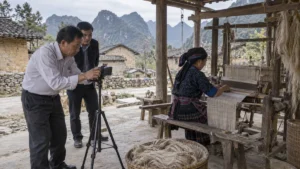
On the banks of the Nuoc Minh Stream in Son Tay Thuong Commune, Quang Ngai Province, Dinh Van Kien, a young man from the Ca Dong ethnic group, opened a stilt-house mountain restaurant and homestay in 2024. He had studied vocal performance at the Hue Conservatory of Music and once stood on stage, but a long recovery from a traffic accident forced him back to his hometown. During his recovery, eating his mother's home cooking awakened a longing for home, and he redirected his skill for voice and storytelling into a restaurant where every dish comes with a story — presenting a new model for ethnic-minority gastronomy in central Vietnam.
A restaurant set among three stilt houses and a stream
The buildings are three stilt-house (nhà sàn) huts framed from bamboo and natural materials. Surrounded by forest and terraced fields, in a setting where the murmur of the Nuoc Min stream reaches right behind the kitchen, he runs it together with his family. It's not a façade built for tourists, but a structure that welcomes outside guests as an extension of daily life.
Who the Ca Dong are — a Xơ Đăng mountain people
The Ca Dong are a sub-group of the Xơ Đăng people, an ethnic minority concentrated in the mountainous areas of Quang Ngai and Kon Tum provinces. They make everyday use of "mountain ingredients" such as upland rice grown from slash-and-burn farming, river fish, forest ferns, young bamboo shoots, and cassava leaves, and have a culture that weaves the ritual music of the gong into life's ceremonies.
Kien has reconstructed this food culture as "something tourists come to eat," adding a story to each dish: "this is the river fish my grandfather caught in the rainy season," "this is the bamboo-tube rice served at weddings." The core of the feature is how his vocal-trained delivery and storytelling bring a musical rhythm to the food.
Table of dishes served
| Dish | Main ingredient | Preparation and serving method |
|---|---|---|
| Grilled river fish | Native river fish from the Nuoc Min stream | Charcoal-grilled, wrapped in leaves |
| Stir-fried forest ferns and stream shrimp | Forest ferns, river shrimp | High-heat stir-fry, with garlic and chili |
| Upland rice | Upland rice grown each year by the Ca Dong's traditional farming methods | Cooked over a wood-fired stove |
| Bamboo-tube rice | Upland rice plus coconut water | Packed into bamboo tubes and cooked over an open flame |
| Cassava leaves and mountain vegetables | A mix from forest and field | Steamed, boiled, and dressed |
※ Prices are not given in the original article. As a rough guide, a typical ethnic-minority experience homestay runs in the range of 150,000–250,000 VND per meal.
A design that serves gong music and food at once
Inside the restaurant, traditional gongs and handmade farm tools are on permanent display, and on request they work with local artisans (craftspeople and musicians) to incorporate gong performances. The setup, which has guests take in food and music in the same space, draws attention as an attempt to experience the gong culture of Vietnam's central highlands (a UNESCO Intangible Cultural Heritage) not as a museum display but "across the dinner table."
Local and industry reaction
Tourism development stakeholders: Quang Ngai is one of the weaker areas for tourist flow even within central Vietnam, and compared with Da Nang, Hoi An, and Hue, it has long suffered a shortage of stay-type content. An effort to turn the food culture of mountain ethnic minorities into tourism as a primary resource is a textbook case of community-based tourism (CBT) and tends to draw the interest of local government.
Local Ca Dong residents: Kien's restaurant employs local residents as cooks, room attendants, and traditional musicians, making it a small employment engine that counters the outflow of young people to the cities. The original article doesn't give specific numbers, but it's a collaborative model at the scale of family plus village.
The social-media crowd: Kien himself shares mountain life and terraced-field scenery on social media, bringing the restaurant's existence to young people in the cities. The picture of a vocally trained communicator broadcasting gongs and rice terraces lands in a different tone from the Mekong Delta video of the "64-year-old French couple's mother-in-law life," received as an intellectual, restrained mountain lifestyle.
Points of interest from a Japanese reader's and editor's perspective
First, "adding a story to a dish" is the same idea as Japan's satoyama gastronomy (the NIPPONIA series, Satoyama Jujo in Niigata, restaurants using local ingredients in Kyotango, and so on), and the people who'd want to visit Vietnam overlap. Second, gong music is scattered around Ya Lу and Kon Tum in the central highlands, and there are few places where tourists can connect with it in an accessible form. If you can experience it alongside a meal in Quang Ngai, it becomes a new candidate for a deep dive into Vietnamese culture.
Third, examples of a vocalist turning to running a restaurant center, in Japan, on the "chef plus sommelier" combination, but in his case the position is designed not as a chef but as "the person who narrates the food." The food is by his family's hands, the story by him, and the music by local gong players — a three-layer structure that balances reliance on one person with room to scale.
Industry ripple effects — a new way to open up mountain gastronomy
The ethnic minorities of central Vietnam (Ca Dong, Kơ Ho, Ê Đê, Ba Na, and others) each have their own food cultures, yet turning them into tourism products has lagged. Kien's case shows that the model of "a young person who studied in the city returns home and bundles natural ingredients, culture, and storytelling into stay-type content" can work on the ground. If similar models spread to places like Buon Ma Thuot in Dak Lak Province and Pleiku in Gia Lai Province, the touring content of the central highlands will grow richer.
Basic information table
| Item | Details |
|---|---|
| Operator | Dinh Van Kien (Ca Dong; graduate of the vocal music department, Hue Academy of Music) |
| Location | Son Tay Thuong Commune, Quang Ngai Province, near the Nuoc Min stream |
| Format | Three stilt-house restaurant buildings plus homestay |
| Opened | 2024 |
| Main experiences | Mountain cuisine × gong music × terraced-field scenery |
| Family and community involvement | Wife and family plus local residents create jobs through cooking, room service, and performance |
Related articles
- In Da Nang, a huge street-food line along the beach with "70 carrying poles"
- A 64-year-old French couple spend two months at the in-laws' home in the Mekong Delta
- The "imagined Vietnam" reflected in soy milk — the truths of the table that a Paris-raised young man discovered in Saigon
Summary
A restaurant that doesn't "serve" dishes but "narrates" them becomes, for travelers, a reason to stay. The three stilt houses by the stream in Quang Ngai are a place worth introducing even to Japanese media, as a site translating Ca Dong food culture through the techniques of vocal performance.