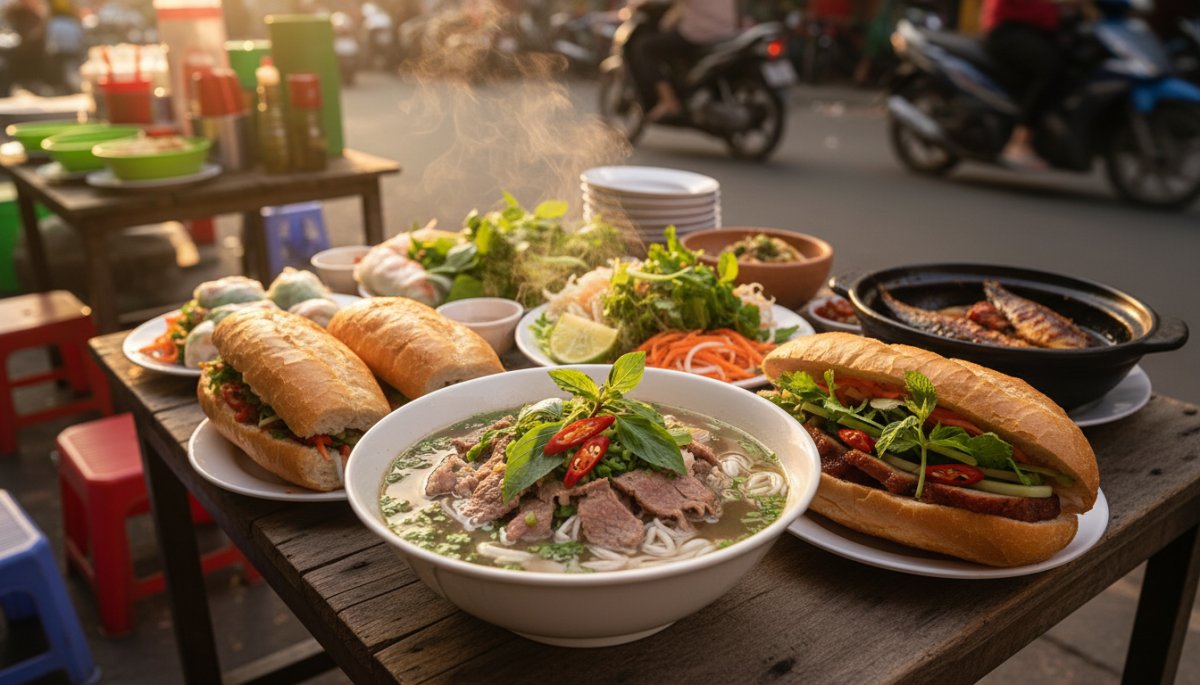
Vietnam's largest tourist city, Ho Chi Minh City, is atreasure trove of food.
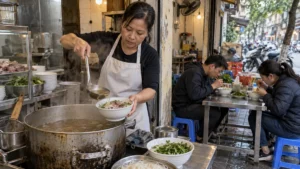
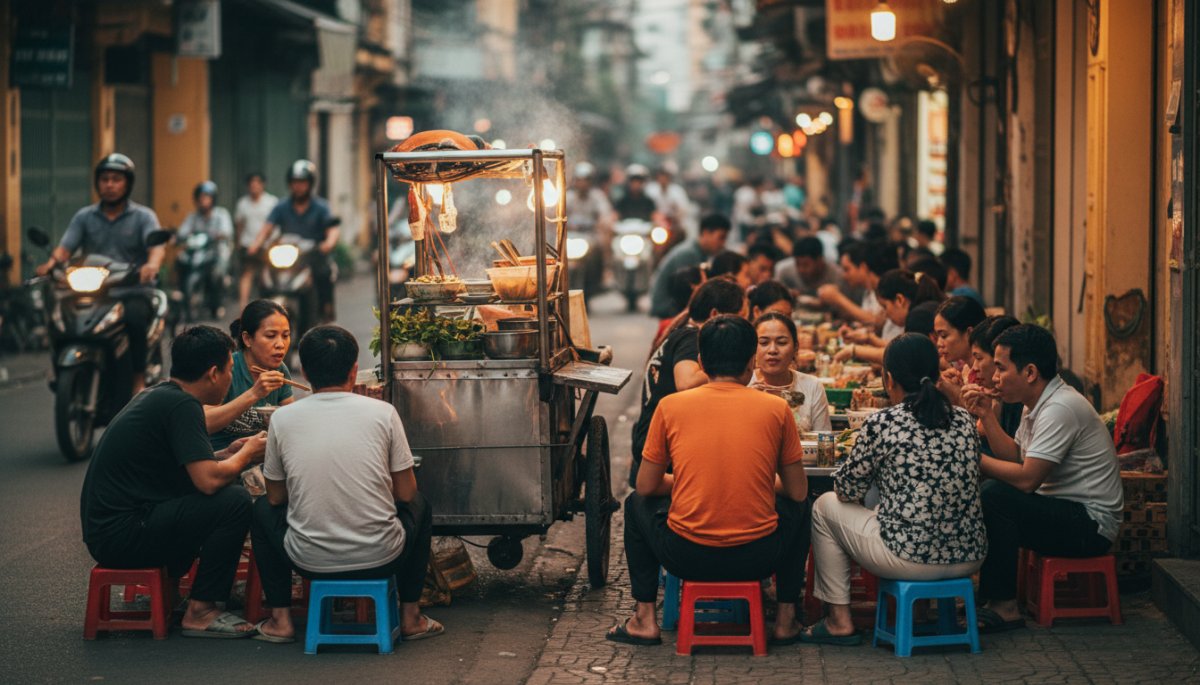
Under the strong sunshine typical of perpetually summery Southeast Asia, streets where motorbikes never stop running are lined with people eating while perched on small plastic stools.
Meanwhile, the towering high-rises house upscale restaurants, and on their rooftops, sophisticated rooftop bars welcome guests. At their feet, old-school eateries do business, and a few meters down a side lane sit food stalls towed by motorbike — a city where old and new mix together, that's Ho Chi Minh City.
・What kinds of places make up Ho Chi Minh City's dining scene
・Never go wrong! Our 4 recommended Vietnamese eateries
・Practical tips and etiquette for eating out in Ho Chi Minh City
・How to spot a good place to eat
Styles of eateries
Dining spots in this city fall broadly intostreet stalls, eateries, and restaurants— three categories.
| Characteristics | Menu | Price range | |
| 1. Street stalls (roadside vendors) | Either takeaway-only, or with simple chairs and tables set out on the street | Snacks, Bánh Mì, simple noodle dishes, and the like | Around 150 to 350 yen |
| 2. Eateries | Often small, open-air, semi-outdoor places | Casual Vietnamese diners, drinking spots, and so on | Around 500 to 2,500 yen |
| 3. Restaurants | Indoors with proper air conditioning | Regional specialties and upscale Vietnamese cuisine, and the like | Around 2,500 to 10,000 yen |
1. Street stalls (roadside vendors)
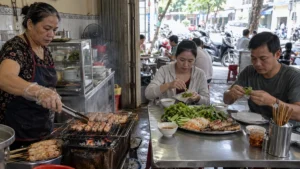
In a style that's simply chairs and tables set out on the street,they appear at each of the morning, midday, and evening mealtimes.
Long-running famous spots do show up on Google Maps, but most aren't listed.
And since they basically operate on a sell-out basis, once they run out of ingredients they close and are gone.
2. Eateries
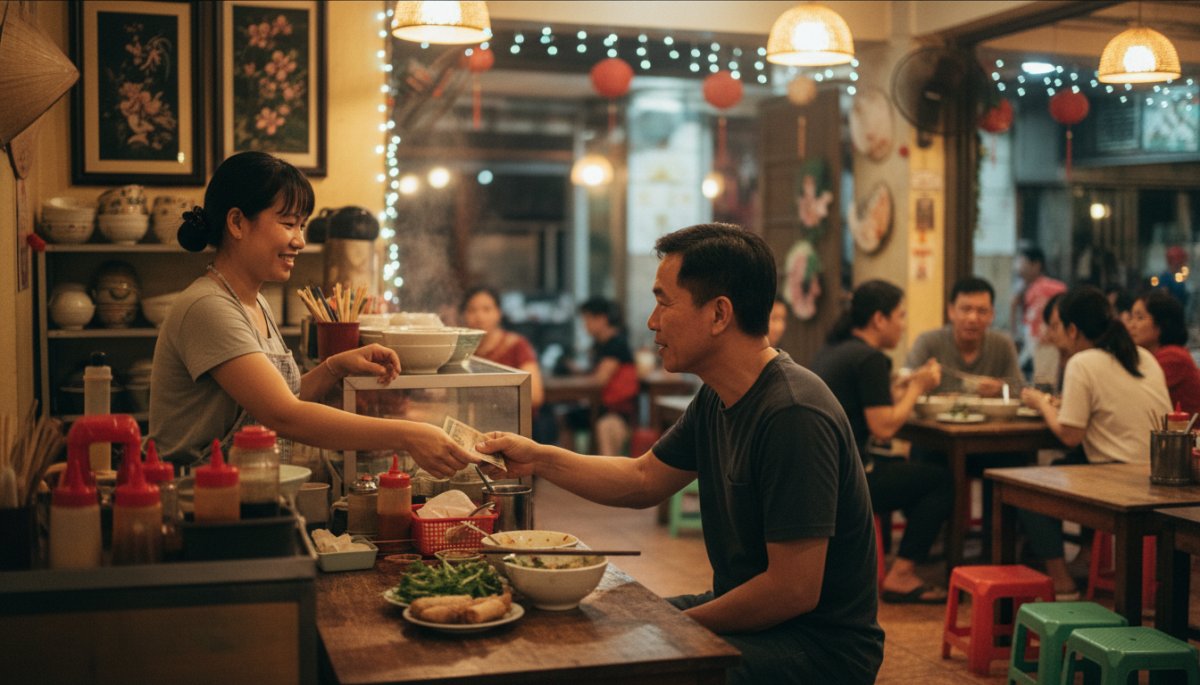
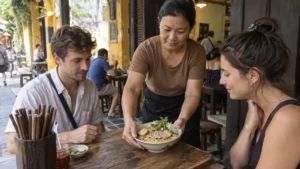
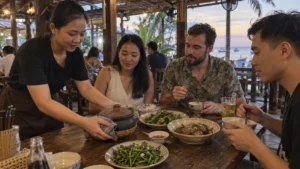
With an atmosphere like a Japanese casual diner,many are single-dish specialists, such as set-meal places or noodle shops.
There are breakfast specialists open from early morning, and at popular places the crowd often won't fit inside, so they frequently spill out and do business on the street.
By night they transform into drinking spots! Places where the cheerful voices of locals ring out.
3. Restaurants
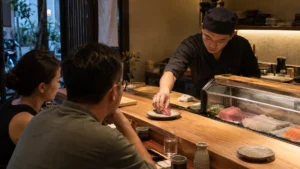
are much the same as in Japan. Inside the air-conditioned space, the menu lines up plenty of dishes.
Being an international city, many of the staff are used to tourists, so they're easy to visit.
For Vietnamese people,a restaurant has the image of an upscale place to use on special occasions, and they're sometimes hosting parties for birthdays and the like.
Many places also have menus in English and Japanese
Compared with Japan, prices are roughlyhalf, or at most two-thirds.
The more local you go, the more you'll be amazed at how cheap it is.
Compared with Japan, Vietnam is a country where people eat out far more often.
There are many dual-income households, and because of housing conditions plenty of people have no kitchen at home, so eating out for every meal rather than cooking has taken root as part of the culture.
As a result, the range of meal prices is well stocked, from the very bottom to the very top.
PHO QUYNH, the pho restaurant that never sleeps
Located on Pham Ngu Lao Street, where backpacker hotels cluster,it's a popular spot open 24 hours.
. Beyond choosing from many kinds of pho at about 500 yen a bowl, you can order a simple breakfast of just a fried egg and bread for 180 yen — an oasis of a place for travelers.
The popular dish isPhở Bò Kho, a beef stew served with pho.
Though it's called a stew, it isn't as thick as the Japanese kind — it's a smooth, light broth.
Fall-apart-tender braised beef and the aroma of herbs that hints at Western cooking make it a distinctly Vietnamese dish evoking the era of French rule.
We recommend ordering bò kho with a bread set instead of pho!
Dip the bread in the broth and you'll find you can eat any number of pieces of the light bread.
You can also order extra bread on its own, so getting some after eating your pho is a nice idea, too.
Bánh Xèo 46A, the Vietnamese savory pancake
Hugely popular with tourists and always busy, this super-famous spot is the place if you want to eat bánh xèo in Ho Chi Minh City.
Lots of pans line the front of the shop, and watching them cook one after another is a sight in itself. Thin batter made by mixing rice flour with turmeric and griddled is packed full of shrimp, pork, and bean sprouts.
Plenty of greens come out, such as lettuce and wasabi greens, so cut the bánh xèo into bite-size pieces and wrap them in the leaves to eat. It's seasoned with salt and pepper as is, but making full use of the table condiments like nước mắm (Vietnam's classic fish sauce) lets you enjoy an even more Asian flavor.
Even if you order the extra-large two-person size, it's a cheap 1,000 yen or so, but it's surprisingly big, so even split between two people it's quite filling. If you want to try other dishes too, or you're thinking of a light lunch, sharing a single regular-size portion might be the better call.
There's a menu with photos and English alongside, so ordering is worry-free!
Fresh spring rolls and fried spring rolls come in sets of 10, but if you ask the staff they'll do a set of 5 at half price
"Bun thit nuong – banh cuon nong," a locally beloved gem
Tucked into a narrow side lane off Nguyen Thi Minh Khai Street — famous for its cluster of great local-food spots — this place isa small but locally beloved gem where the menu it serves is literally the shop's name.
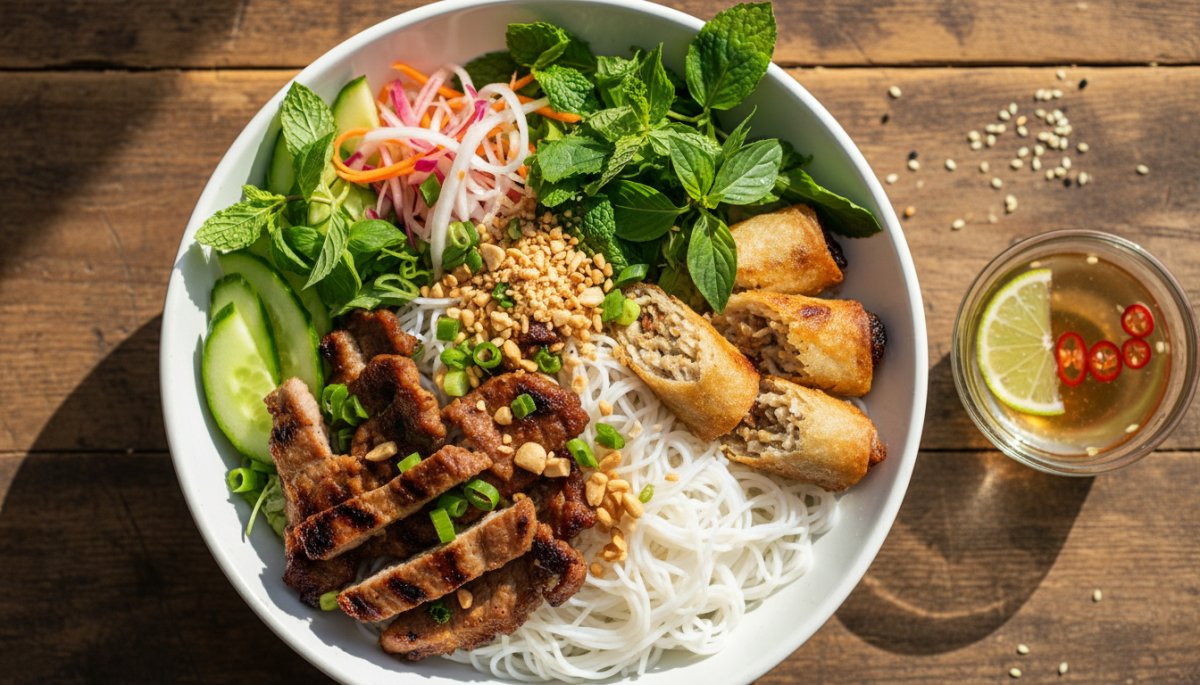
A specialty of southern Vietnam,bún thịt nướngis a brothless mixed-noodle dish topped with grilled pork, fried spring rolls, pickled vegetables, peanuts, and more, over thin rice vermicelli as fine as somen.
There's a sauce in a plastic container on the table, so ladle on a scoopful and dig in.
A satisfying, hearty dish whose intensely Vietnamese, slightly sweet sauce is addictive.
Until 11:00 it serves only the morning-menu item, bánh cuốn — steamed spring rolls. The chewy wrappers are packed with plenty of minced meat, and the carefully rolled craftsmanship is impressive! [

NHA HANG NANG CUA, the crab tapioca noodles
Marked by its cute crab sign, this isa restaurant specializing in crab dishes.。
It relocated and renovated a few years back, so although it's an eatery the interior is restaurant-clean and spacious, with a sense of cleanliness that puts you at ease.
The recommendation isBánh Canh Cua, a Vietnamese-style crab udon.
It looks like udon, but since they're tapioca noodles they have a pleasantly springy bite, packed with plenty of shredded crab meat, and the broth, rich with crab stock, is truly delicious. Loaded with crab andat about 500 yen a bowl,the great value is a joy!
Soak a Chinese fried dough stick thoroughly in the broth and it bursts in your mouth — utterly addictive.
The crab eaten in Vietnam is mainly the freshwater crab known as "cua."
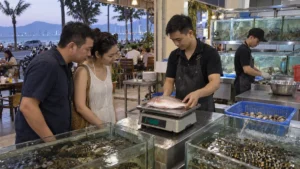
Here they also sell live crab, so you can enjoy a variety of crab dishes!
From entering to being seated
When you find a place that looks good, don't hold back — go on in!
Without waiting to be shown,it's fine to sit at any open seat.
. As you enter, give the staff a quick word (pointing to a table is enough) and take your seat.
With that, you're in.
How to order
If there's a photo menu or an English menu, you can order easily just by pointing.
Even if the menu is only in Vietnamese and you can't read it, pointing and gesturing at what the person next to you is eating works fine.
How to order
If there's a photo menu or an English menu, you can order easily just by pointing.
Even if the menu is only in Vietnamese and you can't read it, pointing and gesturing at what the person next to you is eating works fine.
Showing a photo from a guidebook, or a picture of a dish on your phone, is effective too。
At Bánh Mì stalls and the like, if you point at the fillings to order, they'll put something together for you.
Even if it turns out different from what you intended, chalk it up to experience and enjoy it!
Getting ready to eat
At eateries, if the chopsticks or serving plates concern you, give them a wipe with a wet tissue before using them.
This is something Vietnamese people do normally too, so it's not a breach of etiquette.
The shop's wet tissues are basically not free. They run about 30 yen each, and you're charged for however many you use.
Unlike in Japan, free water isn't served.
On the other hand, bringing in your own plastic bottle and the like is fine.
In Ho Chi Minh City, it's handy to carry wet tissues! You can buy them at convenience stores too.
Tips for eating
Basically, every place has several kinds of condiments, chili, lime, and so on set out on the table.
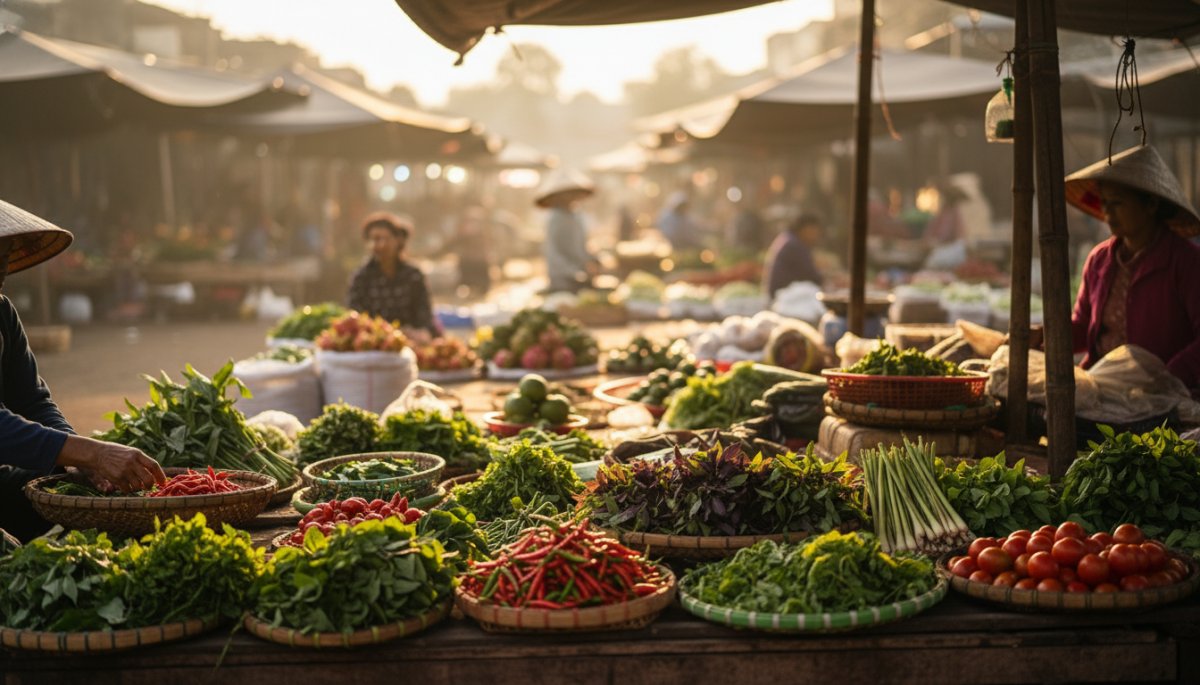
And when you order noodle dishes like pho, a heaping pile of herbs comes out.
Putting all of that to use and building your own preferred flavor is the Vietnamese way. Try this and that.
That said, depending on the shop some of the greens may include ones in poor condition, so it's best to sort through them carefully before tearing them up to use.
Dining etiquette to watch for
In Vietnam, lifting your plate and putting your mouth directly to the bowl is a breach of etiquette.
For soups, use a spoon and the like to bring it to your mouth.
Slurping noodles is also a breach of etiquette, so try to make as little noise as possible while eating.
Spoon in the left hand, chopsticks in the right — that's the Vietnamese style
How to pay
Payment is basically done while seated at your table.
Make a gesture of paying money, or open your palm and, with the index finger of the other hand, draw a wavy "~" shape across it — that gets the message across.
Alternatively, say "tính tiền." Tính tiền means "the bill" in Vietnamese.
Once you're understood, they'll bring a slip or receipt with the cost of your meal written on it.
Basically, once you've settled up at your seat, you can just leave.
Places with a register like in Japan are still few, and local eateries hardly have them at all.
Billing mistakes that happen with no ill intent are common! Always check that it matches the number of items you ordered

How to spot a good eatery
Ho Chi Minh City truly has a huge number of places, so as you walk around town you may well be drawn in by a delicious smell. You want to dive into an unknown shop and try it. At times like that, there are some tricks for telling whether a place is good.
Whether it's lively
First, whether it's crowded with customers. Places where lots of locals gather are reliable in both taste and price. If you want truly delicious Vietnamese food, it's wiser to choose a place locals use day to day over one full of tourists.
A busy shop also has high turnover, so the ingredients are fresh. In Vietnam there are still many places that store ingredients at room temperature, so freshness is an important point for good flavor. The more customers coming and going, the higher the chance the ingredients are kept fresh.
Whether it feels clean
First, you can gauge the cleanliness by looking around the table, such as the state of the condiments stored there.
Shops that pay attention to cleanliness tend to pay attention to their cooking too, so you can have high hopes.
If possible, taking a peek at the kitchen is a good idea as well.
How the ingredients are handled and the cooking process makes for good clues on the hygiene side, too.
At eateries, you might be surprised to find the floor of the shop covered in trash.
Of course, at places with a trash can you put it in the can, but in fact, by custom, in Vietnam it's normal to toss trash under the table.
At a glance it looks unsanitary, but many places hose down and clean it all up after closing, so that's just how it's done.
A lot of trash is actually a sign of a thriving shop
Be mindful of the time of day
Vietnamese eateries each have their strong time slots.
Breakfast specialists, places open only at lunchtime, stalls that open only at night — the operating style differs by time of day.
The flavor is most consistent during the hours when that shop is busiest.
Noodle dishes like pho in particular are often eaten for breakfast, so visiting in the early morning is recommended.
Many shops are closed from the evening onward, so take care.
Go right before closing and many menu items will be sold out

Summary: Enjoy Ho Chi Minh City's food by feel
From restaurants with grand interiors that make you want to snap a photo, to street food grilled over a charcoal brazier at the roadside.
In Ho Chi Minh City you can enjoy a wide variety of food right in the heart of the city.
Among them, eateries put you close to the staff and other customers, letting you feel a stronger sense of Vietnam.
Even if you can't speak Vietnamese, when you're communicating through gestures and enjoying a dish you're eating for the first time, you'll get to savor not just the flavor but the feeling of blending into part of the city.
Now it's your turn to enjoy Ho Chi Minh City's food to your heart's content.
Perched on a small plastic stool, savoring superb Vietnamese food while feeling the rhythm of this city — that time is sure to become an unforgettable memory.