Walking through Hoi An's old town, you'll sometimes come across a building that's neither a temple nor a house — one with a heavy tiled roof and an imposing gate. It's what's called a “đình” in Vietnamese, a communal meeting house. One of these, a đình more than 200 years old at 27 Le Loi Street, transformed into an exhibition space for bamboo craft and coconut-paper artisan works on August 15-16, 2026. During this two-day event titled “Hoi An through Old Eyes,” an old building that most people usually walk right past became, for a moment, a destination worth building into an itinerary. For Japanese travelers revisiting Hoi An, it's a clue to another face of the old town beyond lanterns and tailor shops.
27 Le Loi Street — An 18th-Century Đình Became the Venue
The venue was the đình at 27 Le Loi Street in the Hoi An district. Built in the 18th century, it's well over 200 years old by that measure. Following administrative changes, Hoi An is now treated as part of Da Nang, the major city of central Vietnam. It's one of the town's leading cultural heritage buildings and has served as the stage for milestone events before. This time, photo panels and handmade works were brought inside, combining a craft exhibition titled “Art from the Hands of Hoi An” with a roundtable discussion on heritage. The organizers framed the event's aim not as putting heritage on a display shelf, but as keeping it alive through continued use by residents.
A Đình Is Not a Temple — A Village Guardian Spirit and a Community House
It's an easy point for Japanese travelers to misunderstand, but a đình is not a Buddhist temple. It's a shared facility enshrining the village's guardian spirit (thành hoàng) or the founders of the village, where villagers gather for festivals and meetings. Think of it as something between a Shinto shrine and a community hall — traditionally placed at the heart of the village as its most prestigious building. The curve of the roof, the woodwork, and the character of the enshrined spirit all vary by region, so each one has its own distinct character. In a port town like Hoi An, such communal facilities also became a meeting point for people drawn together by trade.
The move to open up đình as tourist destinations is now spreading in various places. In Tay Ninh, 90km from Ho Chi Minh City,A 140-Year-Old Communal Shrine Has Been Developed Into a Third Tourist Destinationis one such example. A đình that was once a place of prayer and gathering is being kept in use by residents while also opened to travelers. Placed within that trend, the purpose of Hoi An's two-day event becomes clearer. Rather than simply showing off an old box of a building, the point was to show the people working with their hands inside it.
Bamboo, Coconut Paper, Painting — Why Three Artisans Shared the Space
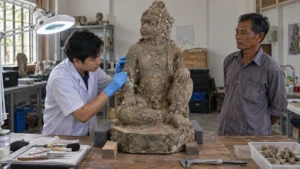
The exhibition's core was the work of three local artisans: bamboo craftsman Vo Thanh Thanh, Truong Thanh To, who makes paper from coconut fiber, and painter Van Tri. Making paper from coconut is an idea unfamiliar in Japan, but it's a craft unique to this area, born from local materials and handiwork around Hoi An. Both the technique of splitting and weaving bamboo and the work of painting the town's scenery came alive by being shown inside a historic building, forging a connection between the works and the place. True to the title “Hoi An through Old Eyes,” the photo panels lined up scenes of the town before it became today's tourist destination, letting visitors overlay them onto the present-day streets. The organizers put forward the line “heritage truly lives only when a community cares for it, practices it, and passes it on,” placing the emphasis less on admiring finished pieces and more on showing the hands that make them. The roundtable discussion, too, was organized as a conversation aimed at keeping heritage from being confined to museum displays. For Japanese travelers, whether they get to witness an artisan working with their hands in person is what decides whether an event like this is worth building into an itinerary.
Practical Notes for Fitting Hoi An's Historic Buildings Into Your Itinerary
This particular event ran for just two days, but the đình on Le Loi Street itself is within walking distance of the old town. If you're touring Hoi An's historic streets, it's efficient to combine it with a banh mi tour, the town's signature food. Here's what to keep in mind for planning your trip.
- Location: 27 Le Loi Street, Hoi An district. In the heart of the old town, within walking distance of the Japanese Covered Bridge and the tailor shop district.
- How to explore: Old buildings are easiest to see in the morning, when daylight streams in. For lunch,Top Banh Mi Shops in Hoi An, With Pricesmakes it easy to build in a lunch break along the way.
- Admission: Much of Hoi An's old town operates on a common preservation ticket system for certain zones. Entry into a đình or assembly hall interior may be included, so check the latest details at a local ticket booth.
- Heritage worth seeing alongside this: uncovered by the sea,An Old Shipwreck Off the Coast of Hoi Anand other traces of the town's era as a trading port are scattered throughout.
Another Side to the Town of Lanterns
When people picture Hoi An, it's usually the classic image of night lanterns and floating lights on the river. But just as the đình at 27 Le Loi Street opened its doors to an artisan showcase for only two days, it's in these small events held inside old buildings that what this town has preserved really shows through. Next time you visit Hoi An, it's worth pausing at the notices posted at assembly halls and đình in the old town. If you happen to catch a limited-run exhibition or festival, you'll come away with a photo very different from the usual lantern shot.