When you hear Vietnam's Mekong Delta, most people picture canals and orchards of a water country. But in the same delta, inland in An Giang Province near the Cambodian border, another world spreads out where rocky mountains jut straight up from the plain—the “Bay Nui” (Seven Mountains). Six irrigation reservoirs built in those mountains have drawn attention as photo spots after coverage by the local paper Dan Viet. Originally dam lakes to store agricultural water, their jade-colored surfaces and mirror-like stillness have caught young travelers' eyes and are turning them into so-called “check-in meccas.” The stay-and-explore way of combining mountains and villagesBay Nui village tourism, staying in a palmyra-palm forestIt's continuous with that as well, an area worth the trip out from Ho Chi Minh City or Chau Doc.
The six lakes of the Seven Mountains region, each with its own face
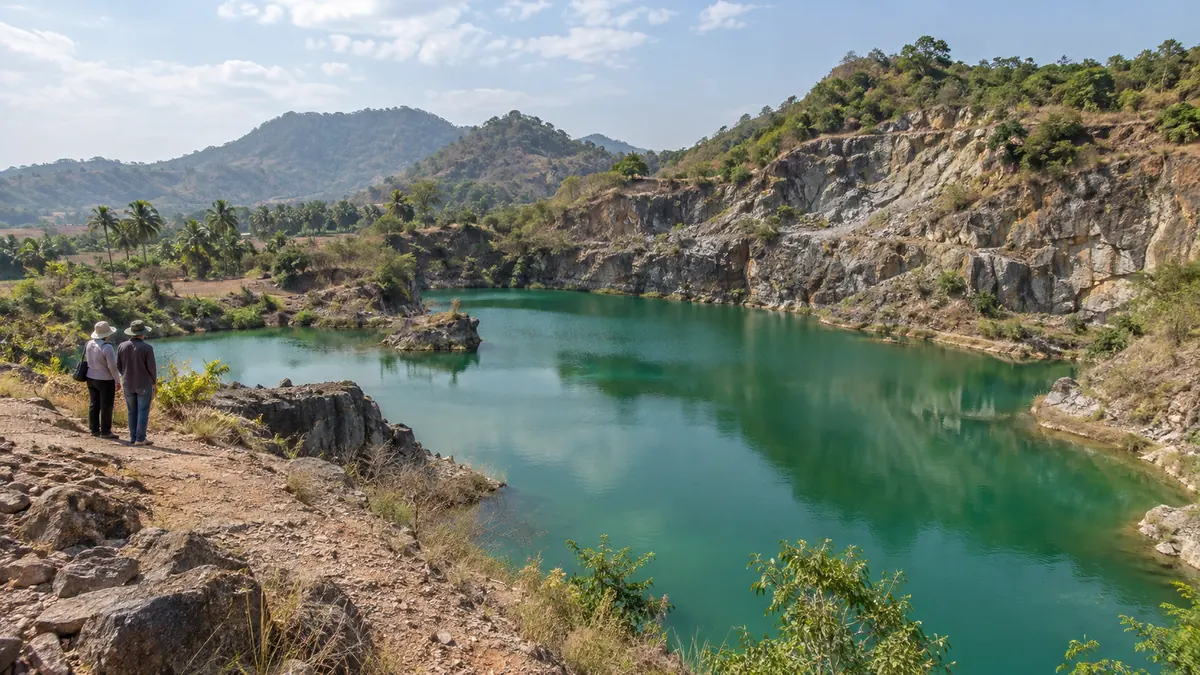
The six lakes cited in the reports are all scattered at the foot or summit of mountains around Tri Tôn and Tịnh Biên. The first to be named is Tà Pạ Lake (Hồ Tà Pạ). A lake formed by chance when water pooled in a quarry pit, it earns the nickname “Tuyet Tinh Coc (Valley of Severed Emotion)” for the sheer rock walls that surround it. Its surface—reflecting the color of the sky and the rock layers on the lakebed, shifting from blue-green to mystical hues—is the main draw.
Soai So Lake (Hồ Soài So) sits at the foot of Phung Hoang Son mountain and is among the oldest reservoirs in the Seven Mountains, built in the 1990s. Because it gathers clear water welling from the mountain, it stays clear year-round, and its still surface reflecting the mountain's shadow is described as mirror-like. Co To Lake (Hồ Cô Tô) spreads at the base of Co To mountain, with an open surface reflecting the sacred mountain in a pastoral scene, making it a popular spot for camping and watching the sunset.
The remaining three lakes draw you in with more untouched nature. Ho Ta Lot lies in a valley wedged between Cam Mountain and Dai Mountain, a rugged, quiet expanse ringed by forest and hills. Ho Nui Dai 2 (in Le Tri commune) is a practical lake that irrigates highland orchards, its scenery like a watercolor where sheer rock melts into blue woodland. And Ho Thuy Liem sits near the summit of the 705-meter Cam Mountain (Núi Cấm), known for a dreamlike view where clouds and sky seem to descend onto the water.
Originally a Dam to Support Farming, Now a Tourism Resource
None of these six lakes was built for tourism. In mountain areas prone to running dry in the dry season, they were developed as social infrastructure out of urgent needs — irrigation and household water, and preventing wildfires.
The effect is changing farmers’ lives. With a stable water source, harvests that were once once a year became possible up to three times a year, and on higher fields a shift toward high-value fruit trees such as durian, avocado, and mango has advanced. Just how deep the Mekong Delta’s fruit culture runs isAll-you-can-eat durian in Can Thoas events like this show, the highland orchards of the Seven Mountains are starting to play their part too. The irrigation dams keep the farm economy turning while their waterscapes pull in eco-tourism—serving a double role.
A Quick Guide to the Six Lakes, by Numbers and Location
To plan an itinerary, it helps to lay out where each lake is and what you go to see. Note that in the 2025 reorganization, districts were abolished and Tri Ton and Tinh Bien have been reorganized into commune units.
| Lake | Location (foot of the mountain / area) | Highlights |
|---|---|---|
| Ta Pa Lake | Tri Ton (formerly Nui To) | Jade-green water in a former quarry, rock walls, about 17 m deep |
| Soai So Lake | At the foot of Phung Hoang Son Mountain | Among the oldest in the Seven Mountains; a mirror-like surface |
| Ho Co To | The foot of Mount Co To | Sunset, camping, and mountain reflections |
| Ta Lot Lake | The valley between Cam Mountain and Dai Mountain | A primeval quiet ringed by forest |
| Nui Giai Lake 2 | Tinh Bien (An Cu) | An orchard-irrigation lake; watercolor-like rock and greenery |
| Thuy Liem Lake | Near the summit of Cam Mountain | A sea of clouds, temple clusters, and a mercy-release pond |
Thuy Liem Lake atop the mountain, paired with temple visits
Among the six lakes, the easiest for a first-timer to work in is Thuy Liem Lake. It sits at the summit of Cam Mountain, the highest of the Seven Mountains, with attractions packed around the lake.
- A 33.6-meter seated Maitreya Buddha statue said to be among the largest in Asia. Enthroned at the summit, its white form is visible even from afar.
- Chua Phat Lon (Great Buddha Temple) and Chua Van Linh (Ten Thousand Souls Temple), with its nine-story, 35-meter tower. These are pilgrimage sites steeped in the serene air of southern Buddhism.
- Thuy Liem Lake itself covers about 60,000 square meters and holds 300,000 cubic meters of water. It's also cherished as a place for "mercy release," where releasing fish earns merit.
A cable car runs up Cam Mountain, so you can reach the summit even without confidence in your stamina. You can cover the lake, the great Buddha, and the temple in half a day, so first-time visitors to the Seven Mountains grasp the overall picture more easily by starting here.
The value for travelers, and points to note
What makes these six lakes interesting as a destination is three reasons beyond being mere photo spots.
First,You can meet the Mekong Delta's 'other face'In a delta strongly associated with canals and boats, you can experience the opposite scenery—rocky peaks and highland lakes—within the same day-trip range. The more a traveler has grown tired of waterway cruises, the fresher this should feel.
Second,A land steeped in Khmer culture and faithNear Tà Pạ Lake, the Khmer temple Chưng Năm (Tà Pạ Pagoda) stands on a hill, and Cam Mountain has a string of southern Buddhist pilgrimage sites. Being able to savor the lakes’ scenery together with the multiethnic life and worship rooted in this land is the depth of the Seven Mountains.
Third,Not yet touristy. There aren't many built-up viewpoints or paid attractions, and a simplicity remains where you arrive by asking locals for directions. The flip side is that signage and public transport are scarce, so it's safest to charter a motorbike or car in Chau Doc or Long Xuyen and move in the morning during the dry season (roughly November to April). In the rainy season the roads turn to mud and mountain travel gets hard to predict.
Basic access information
The base is Châu Đốc, the gateway to Mekong Delta tourism. Tà Pạ Lake is roughly 45 km away, a little over an hour by car or motorbike. The clearest route is to take National Highway 91 to the market in Nha Ban, then turn onto Provincial Road 948 (DT948) toward Tri Ton.
| Item | Details |
|---|---|
| Area | Seven Mountains (Bay Nui / Thất Sơn) region, An Giang Province |
| Main base city | Chau Doc (within the province) / about 6 hours from Ho Chi Minh City |
| Distance to Ta Pa Lake | About 45 km from Chau Doc, a little over an hour by car |
| The pinnacle | Cam Mountain (705 m elevation, cable car available) |
| Best season | Mornings in the dry season (November–April) |
| Mode of transport | Chartered car or rented motorbike (little public transport) |
Summary: add a day of 'mountains and lakes' to a Delta trip
An Giang's Seven Mountains and Six Lakes are a rare case of reservoirs growing into a tourism resource. Tour lakes of different character in a day—jade-green Tà Pạ Lake, mirror-like Soai So Lake, and hilltop Thuy Liem Lake attended by temple clusters—and the flat image of the Mekong Delta is repainted in three dimensions. To get moving, it's realistic to set Chau Doc as your overnight base and, first thing on a dry-season morning, arrange a car or motorbike and tour around Tà Pạ Lake and Mount Cam. To savor the delta even more deeply, traveling the waterways themselvesLuxury river cruiser on the MekongCombining it with ___ for an itinerary that experiences “two Mekongs”—mountain lakes and a river boat—is also appealing.