“Getting hit by a typhoon on your trip” is a classic travel-mishap story. Yet on the night of July 4, 2026, when Typhoon No. 1 “Maysak” made landfall in Quang Ninh Province in northern Vietnam, the opposite scene unfolded on the offshore island of Cô Tô. With all ferries canceled and about 50 guests stranded on the island, a hotel owner slaughtered a wild boar he had raised for more than a year and threw a free feast. This event, reported one after another by VietnamNet and other local papers, is not someone else’s story for Japanese travelers venturing to islands within reach of Hanoi. Along with the substance of the news, we dig into how to get to Cô Tô Island and how to deal with typhoon risk during the rainy season.
The night every boat was canceled, the hotel owner butchered a wild boar
Co To Island is a remote island in Quang Ninh Province, out beyond Bai Tu Long Bay, which spreads east of the World Heritage site Ha Long Bay. On July 3, with Typhoon No. 1 approaching, authorities ordered a full halt to passenger ferries. According to VietnamNet, the island's Đông Á Hotel was housing about 50 guests who could not return to the mainland, spread across 20 rooms.
The owner, Pham Dinh Tam (Phạm Đình Tâm, born 1959), acted on the very night the typhoon made landfall, the evening of July 4. He butchered a wild boar he had sourced from the highlands of Moc Chau in Son La Province and raised for more than a year, and treated all of his guests toA free dinner partyinvited them. Twenty employees, joined by some of the guests, did the cooking, and in about three hours around ten dishes were laid out on the table. At one point a guest from Phu Tho Province served up a dish recreating the taste of home.
Speaking to a local paper, Tam said, 'I bought this boar in Moc Chau and raised it for over a year,' and 'Whatever the situation, I want travelers to feel warmth.' Beyond the feast, the lodging rates and service charges during the time guests were strandedNo price increases at allhe also stated plainly.
About 2,800 people were left on the island - Typhoon No. 1 and Co To Island by the numbers
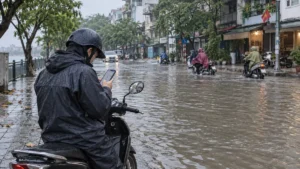
Typhoon No. 1 Maysak made landfall near Mong Cai in Quang Ninh Province on the night of July 4. According to local reports, Mong Cai saw more than 850 fallen trees and damage to house roofs, while Cô Tô Island suffered a power outage that crews rushed to restore.
The island's evacuation response, on the other hand, was swift. According to Dan Tri, passenger ferry service stopped at 5 p.m. on July 3 (the last departure was at 4 p.m. the same day). By then, 18 extra sailings had been added, returning 3,147 tourists to the mainland. About 6,000 tourists were reportedly staying on the island before the shutdown was decided, which leaves roughly 2,800 who stayed on the island to ride out the typhoon.
| Item | Details |
|---|---|
| Typhoon | 2026 Typhoon No. 1 "Maysak" |
| Landfall | Night of July 4, near Mong Cai in Quang Ninh Province |
| Suspension of boat services | 17:00 on July 3 (last ferry departs at 16:00) |
| Tourists who returned to the mainland | 18 extra sailings in all, carrying 3,147 people |
| Tourists who stayed on the island | About 2,800 people |
| Guests stranded at the Dong A Hotel | about 50 people (20 rooms) |
| What the banquet included | One wild boar, about 10 dishes, free |
* Figures are based on reporting by VietnamNet, Dân Trí and Thanh Niên.
“It wasn’t the typhoon but people’s kindness that stayed with me” — local reactions
Thanh Nien newspaper carried comments from guests invited to the feast. Le Ngoc Muong, visiting from Hoa Binh Province (now part of Phu Tho Province following the July 2025 provincial restructuring), said, “Almost all my worries disappeared. I was truly moved.” Vu Manh Hong, from Hanoi, recalled, “What stayed with me wasn't the typhoon itself, but the warmth of the local people. Strangers ended up as close as relatives.”
The authorities' actions matter too. Quang Ninh Province ordered the island's lodgings to secure meals and living conditions for stranded guests and to share weather updates frequently, so the Đông Á Hotel's response was also where personal goodwill met an official request.
And this one night's feast became "news," picked up in turn by national papers—VietnamNet, Dân Trí, Thanh Niên, and Tiền Phong. A single wild boar and ten dishes made the names of the island and the hotel known across Vietnam overnight.
Why it was "lavish generosity" rather than "price gouging"
Think about it coldly, and stranded tourists are “captive customers” with nowhere else to go. Opportunistic price gouging, where lodging rates spike during disasters, happens all over the world, and the rooms fill even after a hike. That Mr. Tam did the opposite reveals a logic particular to an island tourist destination.
First, Co To Island is an up-and-coming beach resort that has built out its power grid and tourism infrastructure since the 2010s, and repeat visitors and word of mouth are its lifeline. Rather than squeezing one-time guests, the reputation that 'that island looked after its guests even on the night of a typhoon' is far more valuable in the long run. Second, as social media and news coverage ultimately proved,Goodwill is the strongest advertisingIt can become that. Convert the exposure across several national papers into advertising cost, and it's no comparison to the cost of one wild boar. Third, there's the norm Vietnamese call "tình người" (human compassion), of not leaving someone in trouble to fend for themselves. It was telling that Hong's comment made human warmth, not the typhoon, the subject.
In the service industry there's an idea that a brilliant recovery from trouble stays in a customer's memory more strongly than if there had been no trouble at all. This episode is a textbook case: the worst-case travel scenario of "stranded by a typhoon" was rewritten into the once-in-a-lifetime memory of "the night the owner butchered a wild boar for us." Flexible cancellation policies and extended-stay discounts during typhoons are spreading at inns in Japan too, but examples that go as far as a free banquet hosted by the inn are rare. From a traveler's standpoint, you can't choose the weather but you can choose the inn. On remote islands, an inn "where you can see the owner's face" is better insurance in a pinch than a lavish building - that, I think, is the practical lesson of this news.
How to get to Cô Tô Island, and tips for not getting stuck in the rainy season
The gateway to Co To Island is Ao Tien port in Van Don, about a three-to-four-hour drive east of Hanoi. From there it's 60–90 minutes by speedboat, with fares running about 230,000–300,000 dong one way (about 1,400–1,800 yen, at roughly 60 yen per 10,000 dong). Summer high season fills up easily, so booking boat tickets one to two days ahead is safer. If you pair it with a stay in Hanoi before or after, the area that began going car-free on weekend nightsA new way to walk the Old Quarteras well.
| Practical information | Details |
|---|---|
| How to get there | Hanoi → Van Don / Ao Tien Port (about 3–4 hours by car) → high-speed ferry 60–90 minutes |
| Rough fare guide | 230,000-300,000 dong one way (about 1,400-1,800 yen) |
| Typhoon risk | In summer (roughly June–September), all sailings are canceled immediately when a storm approaches |
| Where to get information when ferries are cancelled | Direct confirmation with your accommodation and ferry company (hotels have official instructions to share weather information) |
On top of that, here are some tips for not getting stuck on a rainy-season island trip.
- Don’t book an international flight for the day after you leave the island. Leave a buffer of one or two days after the island
- Before departure, check whether your travel insurance covers lodging costs for weather-related cancellations and extra nights, as well as itinerary-change expenses
- Carry plenty of small bills in case a power outage stops ATMs and card terminals
- As for a power bank to guard against outages,From July, carry-on limited to two unitsprepare within the scope of the rules that have been set
- If it's a time when getting on a boat at all makes you uneasy, there's also the option of a northern beach reachable entirely by land. Thanh Hoa'sSam Son Beach and the striking Hon Co Giai rocksthen you're free of cancellation risk
Summary - an itinerary that's "fine even if you get stranded" brings the best memories
What happened on Cô Tô Island on the night of Typhoon No. 1 was, at the same time as being disaster news, a record of the moment a travel mishap turned into a lifelong memory through an island’s hospitality. If you next add a northern Vietnamese island to your itinerary, there are three things to do. Leave a spare day after the island. Choose insurance that covers bad weather. And when picking a place to stay, read reviews not only for how beautiful the photos are but for “how they responded when things went wrong.” Get those right, and even if the ferries stop, that night might just become the highlight of your trip.
Sources
- VietnamNet: Chủ khách sạn ở Cô Tô mổ lợn rừng đãi gần 50 khách lưu trú khi bão số 1 đổ bộ
- Dân Trí: Khách ở lại do bão số 1, chủ khách sạn Quảng Ninh mổ lợn mời 50 người
- Thanh Niên: Giữa bão số 1, chủ khách sạn mổ lợn đãi khách ‘mắc kẹt’
- Tiền Phong: Chủ khách sạn ở Cô Tô mổ lợn rừng đãi gần 50 du khách mắc kẹt vì bão
- Dân Trí: Quảng Ninh: Bão số 1 làm hơn 850 cây xanh đổ, nhiều nhà tốc mái ở Móng Cái
- Beka Travel: Speedboat To Co To Island – Schedule & Ticket Prices