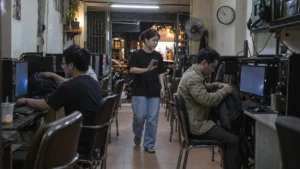
If you step into a Vietnamese cafe and hear a calm reading voice or something like an anime theme song instead of the usual pop, that may be background music the owner chose 'on purpose.' From July 1, 2026, restaurants and cafes that play music in-store incur an obligation to pay copyright fees, and some Hanoi cafes are moving to swap the music itself for other audio. For travelers, it's a story that reveals the identity of 'that odd feeling' the next time you enter a Vietnamese cafe, and at the same time a case that reflects what Vietnam's shops don't want to spend on right now.
The "café music costs money" scheme that began in July
The trigger is Decree 134 (Nghị định 134/2026), which sets copyright fees for publicly playing music at commercial facilities such as restaurants. Effective July 1, 2026, shops that routinely play background music at cafés and restaurants are structured to pay an annual usage fee to rights holders. The amount is calculated in line with the shop's floor area and the base wage, which was also raised from the same July.
One owner (37) who runs three shops in Hanoi swapped out the background music all at once to coincide with the enforcement date. At the roughly 300-square-meter Hao Nam shop, he switched to audiobook narration; at the roughly 150-square-meter Pham Ngoc Thach shop, to audio from anime films and game-play commentary streamed on YouTube; and at the roughly 50-square-meter Duong Que shop, likewise - each to sound sources other than music, he says.
Why “drop the music” — the cost the owner wanted to avoid
What this owner most wanted to avoid was raising drink prices. He left a comment to the effect that 'taxes, employees' social insurance, parking fees, ingredient costs — every expense is going up. At a time when customers are so price-sensitive, I don't want to raise the price of coffee.' Changing the background music from songs to another genre was chosen as one way to avoid that.
Let's look at the burden of actually keeping music on, using a 150-square-meter shop on Pham Ngoc Thach as an example. This shop is said to face roughly 9.5 million dong in royalties a year. Converted at about 165 dong to the yen (a guide as of July 2026), that's around 58,000 yen. Looking at the amount alone you might feel "is that all," but for an owner with multiple shops, it's taken as one more fixed cost that could feed straight into a price increase.
How the fee is decided—a formula based on area
The thinking behind Decree 134 is simple: a formula of "annual royalty = base wage x adjustment coefficient." The base wage applied from July 1 is 2,530,000 dong a month, multiplied by an adjustment coefficient based on floor area.
| Classification by floor area | How the coefficient increases |
|---|---|
| Up to 15 square meters | Base coefficient 0.35 |
| The 15-to-50-square-meter portion | +0.04 per square meter |
| The portion exceeding 50 square meters | +0.02 per square meter |
Applying the aforementioned 150 square meters to this formula, the coefficient is 0.35 + (50−15)×0.04 + (150−50)×0.02 = 3.75. Multiplying by the base wage of 2,530,000 dong gives about 9,487,500 dong, nearly matching the "about 9.5 million dong" cited in reports. There are also discounts by urban classification, and the rate drops the more rural you go. A cap is set as well, however: the annual cap is 8 times the base wage—that is, it won't exceed 20,240,000 dong (about 120,000 yen).
"Turn off the music and you're safe" isn't true - the risk experts point out
On the move to drop music and switch to readings or anime audio, legal experts have also voiced caution. A Ho Chi Minh City lawyer points out that audiobooks involve, on top of the copyright in the literary work itself, the rights of the reader and the production company, while anime films layer the rights of the script, footage, music, voice actors, recording, and production company.
In other words, it's not as simple as 'avoid music and no rights processing is needed'; as long as you play something in-store for commercial purposes, rights issues separate from watching YouTube privately can arise. Because the system has room to reach beyond music, the current switch to spoken-word or anime audio may remain only a stopgap.
How do customers feel
The all-important customer reaction was, if anything, a tailwind for shop owners. In interviews with several patrons, voices prioritizing "the taste of the coffee and a space to spend time quietly" over whether the background is music stood out. For those who want to focus on conversation or work, low-key spoken-word audio or a near-silent environment seems, if anything, to be received as more comfortable.
In a café culture where music has shaped a shop's character, this reaction is symbolic. Vietnamese cafés were long inseparable from music, but the change in cost structure is now nudging along shops that sell quiet as their draw.
A perspective you can “use next time” on a Vietnam trip
As a traveler, knowing about this sharpens how you choose a cafe a little. If you're looking for a cafe to work or read in, 'shops with subdued music, playing readings or ambient audio' have become, from July on, more of a target. Conversely, cafes that sell themselves on live performance or a well-curated playlist are likely bearing the corresponding background-music costs, which may be reflected in prices or a cover charge.
To get a feel for the cost of getting around and staying, it helps to also look at examples of Vietnamese rule changes that ripple into travelers' costs. For the July changes on the transport side,About Ho Chi Minh City's 134 bus routes going free from Julywe've summarized it there, and pre-entry procedures areThe health declaration on entry to Vietnam, revived from Julyyou can check it there. Since this is a period when system changes are concentrated, checking them all together before your trip is reassuring.
The impact spreading across food-service and retail
This move isn't limited to cafés. Restaurants, general goods stores, coworking spaces—any commercial space that plays background music can be subject to the same formula. To pay the royalties properly, you need to contact a management body such as the Vietnam Center for Protection of Music Copyright (VCPMC), representing composers and authors, or the Recording Industry Association of Vietnam (RIAV), representing record producers and performers.
The shop's options broadly split into three: pay the proper license fee and keep playing music, switch to copyright-free sources or royalty-free streaming, or - as in this case - drop music itself and substitute other audio. In Japan too, in-store background music presupposes payments to a management body, but in Vietnam the system has only just entered full operation, and you could say the field is still feeling out how to respond.
Summary
If a Hanoi café is playing readings or anime audio, it’s a trace of the shop’s own workaround for the regulatory change. Next time you step into a café in Vietnam, try listening closely to the background sound. If you want a quiet setting, pick a shop light on music; if instead you want to enjoy live performances or a curated playlist, keeping in a corner of your mind that the shop bears that cost brings a sense of conviction to choosing a place. July is a time when travel and entry rules switch over at once, so it’s a good idea to check the related information together before your trip.