
ベトナムの電源は220Vが基本です。コンセントの形より先に、充電器や家電の「INPUT」を見てください。「100–240V」とあれば多くの場合は変圧器不要ですが、「100V」のみなら、そのまま挿すと故障や発熱の危険があります。
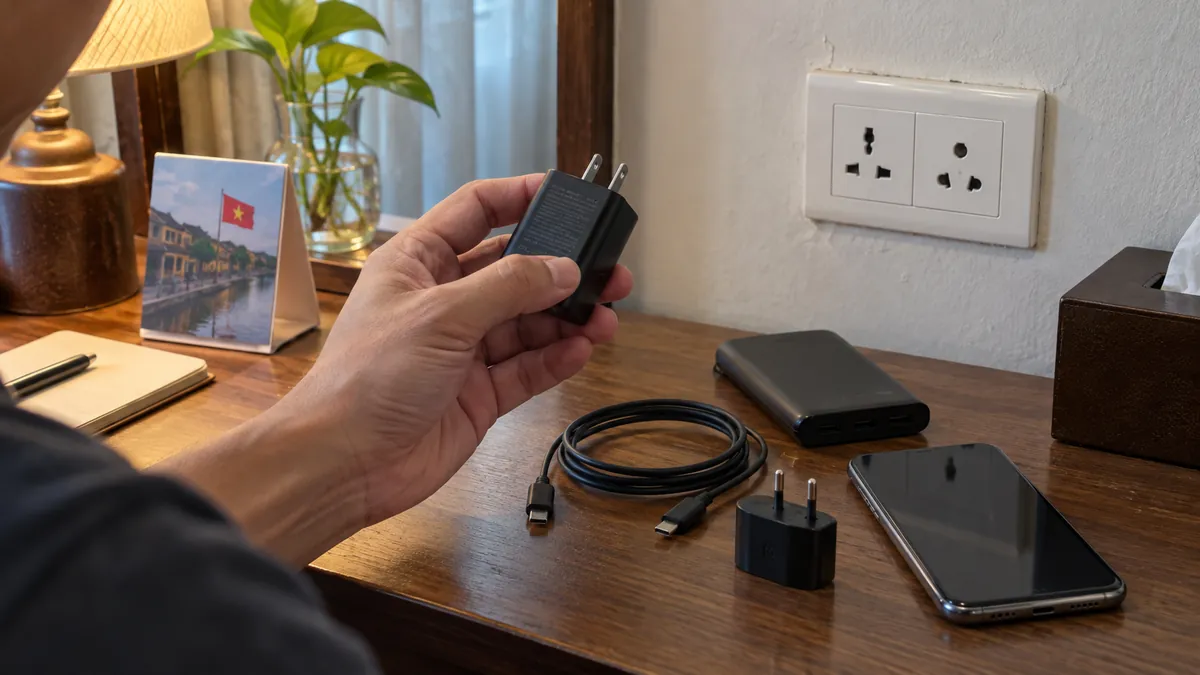
スマホ充電器は海外対応でも、ドライヤーや美容家電は100V専用が残っています。また、モバイルバッテリーの個数・容量・機内での使用ルールは航空会社ごとに違います。この記事では、電圧・プラグ・航空ルールを分けて確認します。
先に結論:持参前の確認順
- 機器本体または充電器のINPUTが100–240Vか確認
- 100V専用の高出力家電は、旅行用の海外対応品へ替えることも検討
- A/C対応の小型変換プラグを一つ用意
- モバイルバッテリーはWh表示と搭乗航空会社の個数制限を確認し、手荷物へ
Vietnam's voltage and plugs
| Voltage | 220V (Japan is 100V) |
|---|---|
| Frequency | 50Hz |
| Plug shape | Mainly A and C types (A/C dual-compatible outlets are common too) |
How to tell the plug shape
The outlets you'll see in Vietnam are mainly two kinds. Knowing the shapes saves you from panicking "it won't fit" on the ground.
- Type A— The same two flat prongs as Japan. At newer hotels' A/C dual-compatible outlets, it often plugs in as is
- Type C— Two round prongs. Common in Europe and the standard in Vietnam. In rural areas and older buildings it may be C-only
- Rarely, Type D or F— Very occasionally seen in old buildings and the like. Have a multi-type plug adapter and you'll almost never have trouble with the shape
Can Japanese appliances be used as is?
Since Japanese plugs are Type A, they often plug into A/C dual-compatible outlets as is. The issue, however, is voltage. Plugging a Japanese 100V-only product in as is risks failure, so checking the compatible voltage is essential.
- Products compatible with "100–240V"— Many chargers for phones and laptops fall here, and no converter is needed
- 100V-only products— Some hair dryers and beauty appliances. A voltage converter is needed to use them
- If the plug won't fit— For C-only outlets in old rural buildings, an A/C adapter gives peace of mind
A quick-reference chart by device
| Chargers for phones, tablets, and laptops | Most are 100–240V compatible. No converter needed |
|---|---|
| Chargers for digital cameras and mobile batteries | Many are overseas-compatible. Check the INPUT label |
| Hair dryers and hair irons | Many Japanese ones are 100V-only. An overseas-compatible product or a converter is needed |
| Electric shavers and electric toothbrushes | Depends on the model. Check in advance whether it's overseas-compatible |
Things to have for peace of mind
- An A/C-compatible plug adapter (a multi-type is handy)
- A charger labeled "100–240V" compatible
- A charger or mobile battery with many USB ports (to charge several devices at once)
How to choose a plug adapter and charger
- A multi-type plug adapter— If it covers A/C plus countries worldwide, you can reuse it on other trips
- Consolidate into a charger with USB ports— Charge a phone, earbuds, and camera at once from one unit, saving outlet slots
- USB-C PD compatible— If you can cover a laptop or tablet with a single charger too, luggage shrinks
- A GaN (gallium nitride) charger is handy— Small and light at the same output, and a model with several USB-C ports lets you consolidate into one charger. Fewer outlet slots and less luggage
- A small power strip— Hotels may have few outlets, and being able to multiply one slot is convenient
The hotel power situation
A common gripe at hotels is "there's no outlet where I want to charge." Knowing in advance makes it easier to cope.
- Few outlets— Older hotels may have only a few in the room. A charger with many USB ports or a small strip lets you charge several devices at once
- None by the bedside— You may want to charge at your pillow but there's no slot nearby. Having one longish charging cable gives peace of mind
- Power cuts off when the card key is removed— Some hotels cut room power when you pull the key from the in-room card-key holder. To charge while out, find another always-on outlet or ask the front desk
How to choose when you need a voltage converter
A voltage converter (transformer) is needed only when using devices not compatible with "100–240V." When choosing, always check that it handles the device's power consumption (W).
- Check the power consumption (W)— Choose a converter with a rated capacity larger than the wattage shown on the device. High-output devices like hair dryers need a converter with a larger capacity too
- The option of going overseas-compatible in the first place— Using a travel "100–240V" hair dryer or hair iron means no converter is needed and lighter luggage
- A plug adapter and a voltage converter are different things— A plug adapter only matches the "shape" and doesn't change voltage. When you want to lower the voltage, a converter is needed
Handling mobile batteries
モバイルバッテリーやリチウム電池は、飛行機では預け入れができず機内持ち込みが原則です。容量はWh(ワットアワー)で見るのが基本で、おおまかに10,000mAhで約37Wh、27,000mAh前後で約100Whが目安です。100Wh以下でも個数制限は航空会社ごとに異なります。たとえばVietjetは100Wh以下を最大2個と案内しています。100〜160Whは事前承認の対象になることがあり、160Wh超は通常持ち込めません。必ず利用会社の規定を確認してください。
Vietnamese airlines restrict in-flight use of mobile batteries
Vietnam Airlines and VietJet Air restrict in-flight use of mobile batteries for safety. Not being able to check them is common to all carriers, but Vietnamese airlines require extra care with in-flight handling.
- Charging in flight is not allowed— Using a mobile battery to charge a device during flight is prohibited. Turn it off and store it
- Don't put it in the overhead bin— You're asked not to put it in the overhead bin but to keep it in a visible place around your seat
- Charging via the in-seat USB port is also not allowed— Using the seat's USB port to charge the mobile battery body itself is also prohibited
- Check the latest rules with each carrier— Since capacity and quantity limits and operations can change, check the official guidance of the airline you're flying before departure
Points to note
- Always check the compatible voltage on the "INPUT" label of chargers and adapters
- Don't use 100V-only high-output devices (hair dryers, etc.) without a voltage converter
- At some hotels you can borrow a plug adapter at the front desk
Frequently asked questions
- What are Vietnam's voltage and plugs?
-
The voltage is 220V and the frequency is 50Hz. Plugs are mainly A and C types, and A/C dual-compatible outlets are common too. Since Japan is 100V, you need to check your devices' compatible voltage.
- Can I use my Japanese phone charger as is?
-
Many phone and PC chargers are "100–240V" compatible, so they work without a converter. The Japanese Type A plug often plugs in as is too, but having a plug adapter gives peace of mind for C-only outlets.
- Do I need a voltage converter?
-
Not for a "100–240V" compatible device. A converter is only needed when using a Japanese 100V-only product (some hair dryers and beauty appliances, etc.).
- Are there enough outlets at hotels?
-
Mid-range and up hotels have several in the room, and USB-port ones are increasing. However, some rooms have few, or no slot by the bedside, so a charger with USB ports, a small power strip, and a longish charging cable let you charge several devices at once, which is handy.
- Can I bring a mobile battery on the plane?
-
機内持ち込みが原則で、預け入れはできません。容量はWhで見て、100Wh以下でも個数制限は航空会社ごとに異なります(10,000mAhで約37Whが目安)。Vietjetは最大2個と案内しています。機内での使用や座席USBでの充電にも制限があるため、搭乗する航空会社の最新の案内を確認してください。
Please also check the overall packing list and the season together.

まとめ:変換プラグより先にINPUTとWhを見る
スマホやPCは100–240V対応が多い一方、100V専用家電は別です。ラベルを読まずに判断しないことが最重要です。モバイルバッテリーは預けず、端子を保護して機内手荷物へ入れ、個数・使用・保管場所は搭乗航空会社の最新規定に従ってください。