In Vietnam, the Duanwu festival of the 5th day of the 5th lunar month, "Tet Doan Ngo," came around on June 19 in 2026. What always lines the offering tables of households on this day is the amber-colored small dumpling "banh u tro," boiled with lye. Triangular and about the size of a child's fist, opening the leaf reveals a translucent, springy rice cake. In fact, this way of making it is astonishingly similar to Kagoshima's local sweet "akumaki." For travelers, it's a seasonal taste that lines the markets only for the few days of the festival, and it also lets you touch the wisdom of Duanwu food common to Vietnam and Japan.
What are Tet Doan Ngo and the "lye dumpling"
Tet Doan Ngo is a festival celebrated on the 5th day of the 5th lunar month, sharing an origin with China's Duanwu (Duanwu). In Vietnam it's also called "Tet diet sau bo = the pest-killing festival," an agriculture-derived event that, at the height of summer, drives out bodily ailments and pests, honors ancestors, and prays for a good harvest. By custom, offerings are made at noon (the hour of the horse in the lunar calendar, 11 a.m. to 1 p.m.).
The star of those offerings is banh u tro. By soaking glutinous rice for a full day inlye (alkaline water) taken from plant ash,part of the starch breaks down, and the finished product becomes semi-transparent with a distinctive jelly-like chew. The ash's raw material differs by region, using ash from burning pomelo peel, chinaberry, sesame stalks, rice straw, and the like, with lime added. The soaked glutinous rice is wrapped in bamboo, dong leaves, banana leaves, and such, boiled for about 4 to 6 hours, then hung on bamboo poles to dry.
The starting topic: renewed attention to a near-lost handcraft
Saigon's English-language media Saigoneer introduces this banh u tro as "a sweet wrapping the childhood joy of Duanwu in green leaves." What the article emphasizes is the rusticity — the rice cake itself has almost no sweetness, with only a faint scent of ash remaining. That's exactly why children enjoy the chewy outer texture with nothing on it, or dipped in black syrup or coarse sugar. As the makers who take on the labor-intensive lye prep decrease year by year, this sweet, which lines the markets each festival, is spotlighted as a living handcraft that still remains.
Three faces differing in north, central, and south
Even the same lye dumpling has large regional differences, Vietnam being a long, vertical country. Depending on where you travel, the form of the "Duanwu dumpling" you meet changes entirely.
| Region | Name | Shape and features | How to eat |
|---|---|---|---|
| North (Hanoi, etc.) | Banh gio / banh nan (banh gio) | A rustic, filling-less type | With molasses (banh gio mat) poured over |
| Central (Hue, Hoi An, etc.) | Banh u tro | Pyramid-shaped, sold in bundles of ten. Some with mung bean paste | As is, or with molasses or sugar |
| South (Ho Chi Minh City, etc.) | Banh u la che (wrapped in bamboo-grass leaves) | Varied fillings: durian, coconut, sugared coconut, sugared winter melon | As is, without a dipping sauce |
The further north you go the plainer it is, savored with molasses, while the further south you go the more it takes on the face of a sweet with bean paste or fruit fillings. In the central region it's sold in "bundles" of ten tied with a single string, easy to make into a souvenir.
A relationship strikingly like Kagoshima's "akumaki"
Japan too has regions where lye-boiled dumplings are eaten at the Duanwu festival. That's the Kagoshima and Miyazaki local sweet "akumaki (lye roll)." Soaking glutinous rice in lye from burning wood or bamboo, wrapping it in moso-bamboo sheath, and boiling it in lye water for several hours — the method is nearly the same idea as banh u tro, with the alkali softening the glutinous rice and improving its keeping. Akumaki too has almost no taste itself, and even the point of eating it with kinako, black syrup, or sugar poured over is common.
The difference lies in the story each carries. There's a theory that akumaki began when Shimazu Yoshihiro brought it as long-keeping provisions at the Battle of Sekigahara, and its aspect as preserved food and camp food is strong. Banh u tro, meanwhile, is positioned as a festival good-luck item that drives out the summer heat and pests. The same combination of "lye + glutinous rice + leaves + Duanwu" has been handed down in two lands across the sea, each cloaked in a different meaning. Travelers familiar with Japanese food culture will surely notice, on meeting this sweet in Vietnam, that "it's like akumaki."
How locals received it
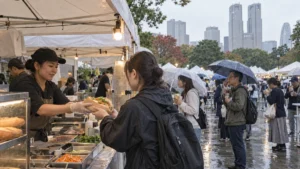
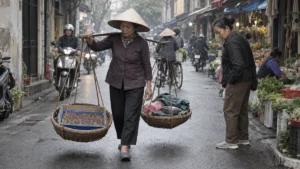
In Ho Chi Minh City, as the festival nears, leaf-wrapped dumplings line the markets all at once, centered on the Cholon district, where there are many ethnic Chinese residents (Hoa people). But the dumplings sold at the market aren't uniform. Alongside the translucent lye dumpling banh u tro, Chinese-style savory dumplings (banh ba trang) stuffed with pork, salted egg, lotus seed, mushroom, and mung bean are also sold. According to local media, Phung Hung Market (Cholon) has Cantonese makers handling the latter, and some shops stuff over a dozen kinds of fillings including abalone and roast meat, making luxury items nearly one kilogram each for three generations running. Even at the same Duanwu festival, it's easier to understand thinking of the sweet, rustic lye dumpling and the filled dumpling closer to a side dish as separate lineages.
How households make offerings is also changing. For the 2026 festival, Vietnamese media reported that "simple offerings" of just fruit and a few banh u tro are spreading. It's a form where households that value feeling over labor have increased.
Implications for travelers and Japanese consumers
Banh u tro is a "seasonal message" that overflows the streets only when your itinerary overlaps around the 5th day of the 5th lunar month. If you want to enjoy food on a Vietnam trip, whether you can meet such calendar-linked sweets — not just standards like pho and banh mi — changes the depth of the experience. The moment the leaf opens and the amber rice cake appears, and the faint scent of ash, are local sensations hard to convey in photos or words.
From the viewpoint of Japanese consumers and food businesses, it's interesting that the technique of changing glutinous rice's texture and keeping quality with lye (alkali) is rooted in both Vietnam and Japan. Rustic ways of enjoying it — wrapping in leaves and boiling, eating with molasses or kinako — are contiguous with the Japanese sensibility too. If you take it home as a souvenir, the rustic type that plainly brings out the lye flavor, rather than one with bean paste or fruit, is easier to talk about "the difference from Japan's akumaki" over, and livens up the conversation with the person you gave it to.
Practical information: where and for how much can you buy it?
Lye dumplings once prepped in each household are now increasingly lined up as seasonal products at markets, butcher shops, and food stores. There's a range from sold-by-weight bundles of ten to luxury lines boxed for gifting. The peak is the few days around the 5th day of the 5th lunar month (June 19 in 2026), with the price changing by region and size. Exchange was converted at 10,000 VND ≒ 60 yen (a guide to the market rate around the festival; actual prices vary by shop and year).
| Item | Guide | Note |
|---|---|---|
| Price (bundle of ten) | About 50,000 to 100,000 VND (about 300 to 600 yen) | Around 60,000 VND (about 360 yen) is common |
| Ho Chi Minh City going rate | About 60,000 to 80,000 VND (about 360 to 480 yen) per bundle | Said to be cheaper than other regions |
| Markets where you can buy (Ho Chi Minh City) | Cholon (District 5), Ba Chieu Market, Nguyen Tri Phuong Market (District 10), and others | Concentrated in districts with many ethnic Chinese residents |
| When you can buy | Only the few days around the festival | Hard to obtain once it passes |
| How to eat | As is / with molasses, coarse sugar, or kinako | The filled southern type is fine without a dipping sauce |
At shops where you can choose whether it has filling, those who want to savor the lye flavor should choose "filling-less (chay)," and those who want to enjoy it as a sweet should choose ones with mung bean paste or coconut. Since it keeps several days at room temperature wrapped in the leaf, it's easy to carry even on an itinerary where you don't return home that day.
Frequently asked questions
When can I buy banh u tro?
The peak is the few days around the Duanwu festival of the 5th day of the 5th lunar month, "Tet Doan Ngo." In 2026 it fell on June 19. Once this period passes it nearly vanishes from the markets, so the target is when your Vietnam trip schedule overlaps these few days.
What does it taste like? Is it a sweet dessert?
The rice cake itself has almost no sweetness, a rustic taste with only a faint scent of ash. In the north and central regions it's eaten with molasses, coarse sugar, or sugar. The south also has filled versions stuffed with durian, coconut, or mung bean paste, and those taste closer to a sweet.
How does it differ from Japanese chimaki or akumaki?
The method of soaking glutinous rice in lye (alkaline water), cooking it, wrapping it in leaves, and boiling is much like Kagoshima and Miyazaki's "akumaki." Eating it with kinako or black syrup is common too. The difference is the background: akumaki has a story of preserved food and provisions, while banh u tro is cherished as a Duanwu good-luck item that drives out the summer heat and pests.
Summary: try walking the streets in step with the calendar
Banh u tro is a seasonal sweet that overflows the town only for the once-a-year Duanwu festival. If your Vietnam trip overlaps around the 5th day of the 5th lunar month, try heading to a market with many ethnic Chinese residents, buying a bundle of ten, and opening the leaf. Drop a little coarse sugar or molasses on the amber rice cake and you meet a Duanwu taste contiguous with Kagoshima's akumaki, yet a little different. If you make it a souvenir, choosing the rustic type that plainly brings out the lye flavor makes it a conversation starter at the Japanese table over "how is it different from akumaki?"
Related reading
Source: