In Quang Ngai in central Vietnam, the younger generation is reviving traditional livelihoods that had once declined. A 35-year-old man took over silkworm farming and a 33-year-old woman took over sugarcane molasses making, each improving the work and reviving their areas as production regions. Floor-rearing cut the labor by about half, and the molasses earned a 3-star rating under the local specialty certification "OCOP." An expansion into tourism experiences is also in view.
Silkworm farming revived by a 35-year-old, with floor-rearing halving the labor
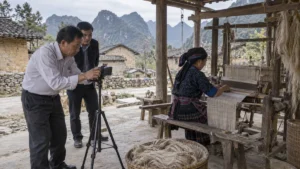
Ton Long Quy (35), from Buon hamlet in Nghia Giang commune, once tried silkworm farming in 2002 but failed for lack of capital and technique. He tried again in 2022. By abandoning the labor-intensive bamboo racks and switching to floor-rearing using wooden trays, he reduced labor by up to 50%. The silkworm rearing cycle is about 15 days and can be run up to 10 times a year. The finished cocoons are uniform and meet export standards.
About 57,000 yen net profit per cycle, in a cooperative of 12 households
On the revenue side, a net profit of 10 million dong (about 57,000 yen) per cycle is expected. Over a year, it could reach 100 million dong (about 570,000 yen). Quy has organized a cooperative of 12 households, five of which are led by the younger generation. The table below organizes the improvements in silkworm farming.
| Item | Before / now |
|---|---|
| Rearing method | Bamboo racks → floor-rearing with wooden trays |
| Labor | Reduced by up to 50% |
| Rearing cycle | About 15 days / up to 10 times a year |
| Net profit per cycle | About 10 million dong (about 57,000 yen) |
| Estimated annual income | About 100 million dong (about 570,000 yen) |
| Cooperative | 12 households (5 led by young farmers) |
Sugarcane molasses taken over by a 33-year-old, earning OCOP 3 stars
Trinh Thi Kim Oanh (33), from Tien Do hamlet in Binh Son commune, studied business administration in Ho Chi Minh City, then took over the last remaining family sugar-making workshop in the hamlet. Its heyday was the 1980s and 90s, when 300 kg of sugar was said to be worth three taels of gold.
Oanh extends the boiling of the sugarcane juice to 3 or 4 hours and filters it many times to make a clear, amber syrup. She has developed products such as unrefined sugar that can replace refined sugar in cooking, as well as molasses and raw sugar, and earned a 3-star certification under OCOP (One Commune One Product). She sells them online nationwide as local-specialty gifts.
"A single drop of molasses carries the toil of the farmers"
Oanh says, "In a single drop of molasses lives the toil of the farmers and a plain beauty." On silkworm farming, Quy says, "I want visitors, especially children, to be able to touch mulberry leaves, feed the silkworms, and watch the process of cocoons forming," looking ahead to develop not just production but a place for hands-on experiences.
The Youth Union boosts sales channels and outreach
The Quang Ngai provincial Youth Union supports these efforts as a bridge to the market. Under Ho Thi Thu Thanh, deputy secretary of the provincial Youth Union, programs are in place for connecting sales channels, skills training for online sales, and access to support from provincial authorities and the science and technology department.
Summary
The Quang Ngai case stands out for making traditional livelihoods sustainable not by "preserving them as they are" but through improving the work, turning it into products, and obtaining certifications. Labor savings through floor-rearing, OCOP 3 stars, online sales, and a vision for experiential tourism — combining the ideas of young people with the Youth Union's support, it is becoming a model for reviving declining production regions.
Related articles:
・The revived Thanh Ha pottery village
・A lantern maker’s story
・Hue’s lotus-seed snacks
Source:Viet Nam News / Young people revive fading traditional trades in Quang Ngai / Viet Nam News / Society