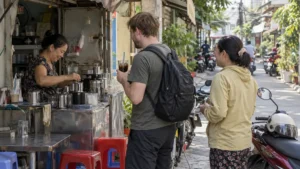
Coffee Concept, a Vietnamese café-industry consulting firm, has announced the five major café trends to watch in 2026. From “wellness coffee” blended with reishi and cordyceps to hybrid-type stores that shift from takeout in the morning to coworking at midday to a socializing venue at night, the new currents following egg coffee are all in place.
The five major trends chosen by Coffee Concept
Coffee Concept, which is based in Ho Chi Minh City and handles café-opening support and menu development, has laid out five directions gaining presence in Vietnam’s café market in 2026.
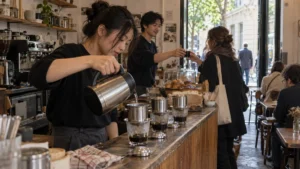
The first trend is the “multidimensional experiential café.”It refers to evolution into a “third place” that combines coworking spaces, galleries, and workshops rather than just serving coffee. Stores with three faces in a day are increasing—morning takeout demand, midday remote-work customers, and nighttime community mingling. Since dwell time gets longer, it’s a structure where non-beverage sales such as food and goods also grow.
The second trend is “sustainable & traceable.”Transparency that discloses to consumers the bean’s origin, processing method, and logistics route is in demand. The adoption of eco-packaging is also accelerating, and stores that eliminate disposable plastic cups win support.
The third trend is “technology integration and personalization.”Custom ordering via app (bean type, roast level, milk choice), self-order terminals, and QR-code payment are becoming standard equipment. Data-based loyalty programs reliably lock in repeat customers.
The fourth trend is the main subject, “wellness coffee.”“Adaptogen blends” that mix medicinal mushrooms and herbs such as reishi, cordyceps, lion’s mane, and ashwagandha into coffee have appeared on menus. They’re functional beverages that health-conscious segments choose even at an extra charge—collagen lattes and focus coffee touting concentration, and more. The expansion of choices in cold brew, nitro coffee, and plant-based milks such as oat milk and almond milk is also part of this trend.
The fifth trend is the “compact model.”A model that holds down initial investment with small-format stores—micro cafés, kiosks, and drive-through types—while raising turnover by specializing in takeout is spreading even to regional cities.
The background of wellness coffee—the global market tops US$2.2 billion
Wellness coffee (mushroom coffee) is growing rapidly on a global scale, with the 2026 market size projected to exceed US$2.2 billion (about 330 billion yen). Over the past five years, search volume has increased by more than 250%.
The main medicinal mushrooms blended in and their touted effects are as follows.
| Mushroom/herb | English name | Main claim | How it’s used in cafés |
|---|---|---|---|
| Reishi | Reishi | Relaxation, immune support | Nighttime decaf blends |
| Cordyceps | Cordyceps | Energy, endurance | Morning boost |
| Lion’s mane | Lion’s Mane | Concentration, cognitive function | Focus coffee |
| Chaga | Chaga | Antioxidant, immunity | Smoothie blends |
| Ashwagandha | Ashwagandha | Stress reduction | Adaptogen latte |
What resonates with health-conscious consumers is that the mushroom components are said to ease the caffeine spike and crash (jitters and crash) that ordinary coffee causes, producing a smooth energy curve.
The local response—baristas, consumers, investors
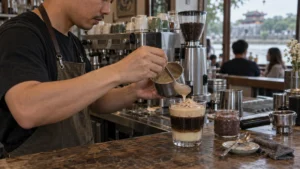
Baristas: At specialty cafés in Ho Chi Minh City, research into mushroom-powder blend ratios and compatibility with espresso is advancing. Experiments adding mushrooms to the existing Vietnamese “ca phe sua da” have also begun.
Consumers: Among Vietnam’s health-conscious young people (in their 20s–30s), the segment willing to accept a premium of an extra 50,000–80,000 VND (about 300–480 yen) is increasing. Sharing on social media is also active.
Investment and industry: Cases where consulting firms including Coffee Concept propose introducing wellness menus are increasing, and a supplier list for mushroom ingredients has come to be attached as standard to café-opening packages.
Impact on Japanese travelers
A new pleasure is added to café-hopping on a trip to Vietnam. For repeat customers who’ve had a run through egg coffee and coconut coffee, a reishi latte or cordyceps boost could become the next “cup you can only drink in Vietnam.” The price range is only about 50,000 VND higher than ordinary specialty coffee—a difference of about 300 yen in Japanese money. It’s efficient to look in Ho Chi Minh City’s dense specialty-café areas (around District 3 and Thao Dien).
Ripple effects on the industry—changes in OEM and ingredient sourcing
The rise of wellness coffee brings new sales channels to Vietnam’s mushroom-growing farmers and herb processors. In the highland areas around Da Lat, reishi cultivation is thriving, and demand for powder processing for cafés is growing directly. Awareness of adaptogen-type beverages is spreading in the Japanese market too, and expanded imports of Vietnamese ingredients are expected.
| Item | Details |
|---|---|
| Information source | Coffee Concept (based in Ho Chi Minh City, café-opening consulting) |
| Contact | +84 965 867 586 / hello@coffeeconcept.vn |
| Average price of wellness coffee | 80,000–120,000 VND (about 480–720 yen) |
| Price difference from ordinary coffee | Around +50,000 VND (about 300 yen) |
| Global market for mushroom coffee | Over US$2.2 billion (2026 estimate) |
| Recommended areas to explore | Ho Chi Minh City District 3, Thao Dien in District 2, around My Khe Beach in Da Nang |
Summary
Vietnam’s café culture, which drew the world’s attention with egg coffee, is evolving in 2026 along three axes: wellness, hybrid spaces, and technology. For travelers, reishi lattes and cordyceps coffee become a new experience, and for the industry, a business opportunity has opened in the expansion of sourcing routes for mushroom ingredients and functional foods. Café-hopping in Ho Chi Minh City is entering an age that is no longer about “which shop to drink at” but “which function to choose.”
Related reading
- ArchDaily's picks: 10 spots that revived French colonial apartments and old merchant houses as cafés
- Eight distinctive cafés open in Ho Chi Minh City’s back alleys
- The Dark Soul Latte at Hoi An’s “The Espresso Station”
- Trung Nguyen Legend’s first store in Taiwan
Source