If you ride the bus every morning in Hanoi, you may have noticed the sound on board changing bit by bit. The heavy diesel vibration and engine noise are gone, and electric buses that glide off quietly are replacing service on the city’s main routes one after another. On July 9, 2026, Transerco (Hanoi Transport Corporation) announced that in the first half of the year it had converted 17 routes and 281 buses to EVs. It plans to make more than 51% of its fleet green vehicles within the year, and for residents who rely on buses to commute or get to school, both the ride and the lineup of routes are starting to shift.
17 routes, 281 buses: a first half that put 165 into service in six months
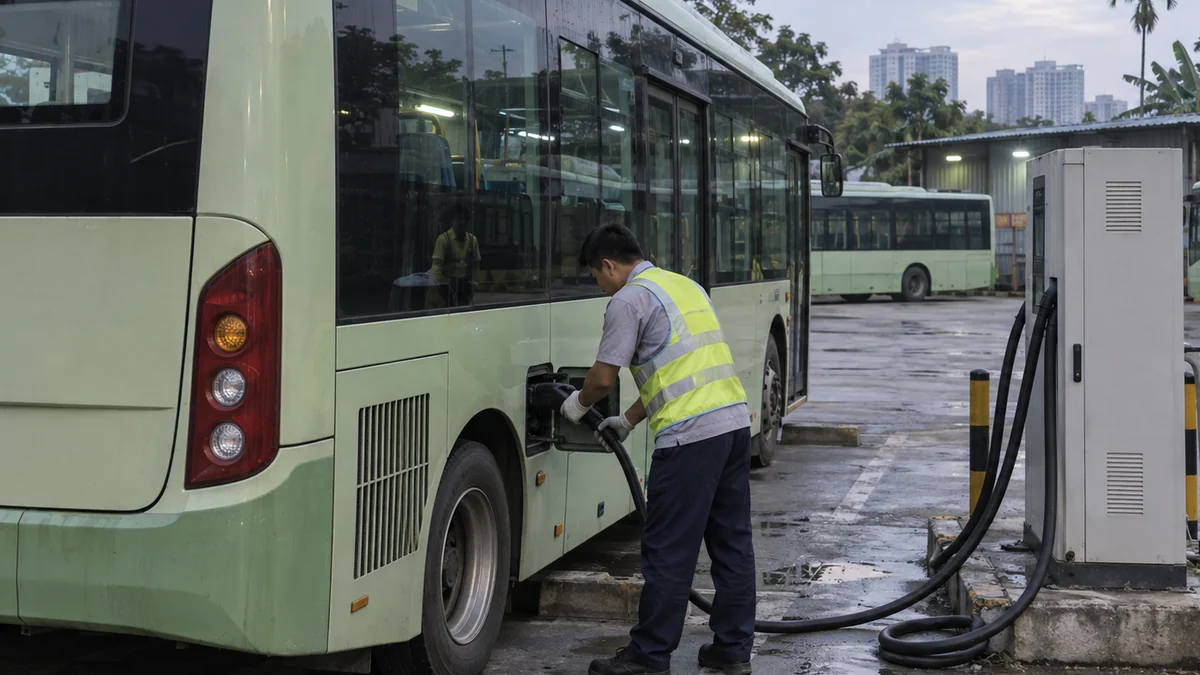
According to Transerco, as of the end of June 2026 the company's EV buses had reached 17 routes and 281 vehicles. Of these, 165 were put into service in the first half of 2026 alone, so the pace of conversion is clearly accelerating. Transerco is the largest public operator underpinning Hanoi's bus network and runs the core of the city's routes. That this core operator electrified 165 buses in six months shows it has moved past the pilot stage into a phase of building EVs into everyday service.
The numbers aren't only about vehicles. In first-half ridership figures, passenger numbers rose 3.3% year on year, while violations related to service quality fell about 40% and passenger complaints fell 38%. Over the same period, e-ticketing (cashless payment) has spread across the public transport network, and a system that shortens boarding times and lets you transfer across multiple modes with a single account or card is taking shape. What characterizes this shift is that the overhaul of vehicles and the overhaul of payment are running at the same time.
A phased design: "2025–2026 is the groundwork"
Hanoi has drawn up a phased roadmap for switching its buses to green energy. From 2025 to 2026 is a “groundwork” period to firm up support schemes and policies, expand the EV bus network, and build charging infrastructure including fast charging. The following 2027–2030 is designed to push the full-scale replacement of fossil-fuel buses all at once. Behind Transerco’s ability to deploy 165 buses in half a year is the fact that charging sites and operational know-how have built up in this first phase.
Citywide, the final bus fleet is expected to settle at around 2,000 to 2,400 vehicles depending on how electrification proceeds, with a path drawn to start by using electricity together with LNG/CNG and raise the EV share as conditions allow. Transerco's “over 51% within the year” amounts to reaching the first turning point on that long road.
The numbers that moved in the first half
| Indicator | First-half 2026 results |
|---|---|
| EV buses (cumulative) | 17 routes, 281 buses |
| Of which, put into service in the first half | 165 buses |
| Passenger numbers | +3.3% year on year |
| Service quality violations | About 40% reduction |
| Passenger complaints | Down 38% |
| Green-fleet share within the year (target) | Over 51% |
What changes in residents' daily lives
Where electrification first pays off is the ride itself. On city routes that stop and start over and over, engine noise, vibration, and exhaust heat all weigh on passengers. EV buses ease all three at once. Through Hanoi's summers of near-40-degree days and the long waits at lights in traffic, the comfort of a quiet, low-vibration cabin makes a big felt difference. For residents who ride the same route every day, renewing a line means more than just 'a new vehicle showed up.'
Another change is the usability of the bus as a mode of transport itself. In Hanoi,IC card applications for free busesand fare-free service on central routes is advancing, and as it overlaps with this rollout of e-ticketing, the chore of “having coins ready before boarding” is disappearing. Vehicles are new, payment is cashless, and on some routes there’s no fare at all—when these three advance at once, buses become a realistic option even for those who have always gotten around by motorbike. The city is simultaneously advancingA low-emission zone trial in the Old Quartershare the same aim, and EV buses are positioned as one move toward a 'zero-emission way to get around downtown.'
There are real benefits for travelers and business visitors, too. Once e-ticketing bundles your transfers onto a single card, then as long as you have the route map you can cut down on relying on taxis or ride-hailing apps for short trips. Which routes qualify as EV or free changes over time, so checking the latest eligible routes before your stay makes getting around easier.
Two cities' design philosophies, seen through a comparison with Ho Chi Minh City
On boosting public transit, Ho Chi Minh City is moving in the same period. Ho Chi Minh City has rolled out a measure to build ridership quickly by making buses free,raised ridership by 30% in just five days of going freedelivered results. Hanoi's Transerco, by contrast, puts its weight on 'replacing the vehicles themselves with electric ones' alongside fare-free service. Ho Chi Minh City draws demand with fares while Hanoi shores up its footing through fleet renewal and infrastructure—the difference in approach reads as a gap in the two cities' transport-policy thinking.
This shift isn't irrelevant to Japanese companies. There's room for supply and collaboration in mass-producing EV buses, charging equipment, onboard components, and operations-management systems, and once the replacement gets going in earnest between 2027 and 2030, the market will grow considerably larger. The moment Vietnam's urban transport enters a renewal phase under the banner of "greening" is, from the parts and infrastructure side, a point where the door opens.
Summary
The momentum of Hanoi's EV buses shows less in the milestone of 17 routes and 281 vehicles than in the pace — 165 added in half a year — and the near-term goal of over 51% within the year. Residents should first check whether the routes they use are covered by the EV, free-fare, and cashless programs. Travelers who line up which routes support e-tickets before their stay gain one more option for getting around the city. This shift toward quieter vehicles and lighter payments will reshape everyday travel in Hanoi over the next several years.
Sources
- Báo Quân Đội Nhân Dân「Hà Nội: Chuyển đổi 281 xe buýt điện cho 17 tuyến buýt」
- Nhân Dân「Tổng Công ty vận tải Hà Nội phấn đấu năm 2026 chuyển đổi phương tiện xanh đạt hơn 51%」
- Tiền Phong「Transerco phấn đấu chuyển đổi xanh đạt hơn 51% đội xe buýt trong năm 2026」
- VietnamPlus, “Hanoi accelerates shift to green buses” (background on the city’s roadmap)