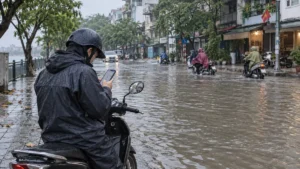
Gasoline prices in Vietnam fell from 3pm on August 6. The ceiling price for E10 gasoline (RON95-type), now the nationwide standard, is 22,324 dong per liter — about 134 yen. That's down 1,035 dong from the previous week, or roughly 6 yen. For business travelers who take taxis or ride-hailing apps multiple times a day, it's a change that adds up gradually. Rather than stop at a simple price update, this piece looks at why the change came now, how the pricing mechanism works, and what it means for residents' and business travelers' transport costs and the cost of living.
(Yen conversions are based on the exchange rate as of August 2026, at roughly 6.0 yen per 1,000 dong. Same below.)
E10 fell to 134 yen a liter, E5 to 130 yen
Gasoline wasn't the only thing to fall in this revision. Industrial heavy fuel oil also dropped, while diesel actually rose. Here are the four main products side by side.
| Item | New ceiling price | Yen equivalent (approx.) | Change from previous week |
|---|---|---|---|
| E10 RON95-III (main fuel for passenger cars) | 22,324 dong/L | About 134 yen/L | Down 1,035 dong (about 6 yen) |
| E5 RON92 (for older motorbikes) | 21,728 dong/L | About 130 yen/L | Down 1,160 dong (about 7 yen) |
| 0.05S diesel | 27,544 dong/L | About 165 yen/L | Up 1,080 dong (about 6.5 yen) |
| 180CST heavy fuel oil | 16,391 dong/kg | About 98 yen/kg | Down 587 dong (about 3.5 yen) |
Filling a 40L tank, E10 works out to roughly 240 yen cheaper per fill-up. The savings add up for anyone touring the countryside by rental motorbike or car. Compared with regular gasoline in Japan (around 170 yen/L), E10 at 134 yen still looks considerably cheaper.
Gasoline falls while diesel rises to 165 yen a liter — a "reversal"
One surprising thing in the table is that diesel now costs more than gasoline. E10 is 134 yen, while diesel is 165 yen. In Japan, the assumption is that diesel is cheaper, but in Vietnam right now it's the other way around. Even this time, diesel rose by 1,080 dong while gasoline and heavy fuel oil both fell.
Behind this is the fact that diesel (a middle distillate) tends to run tighter on global supply and demand than gasoline, along with the fact that Vietnamese gasoline contains ethanol. E10 is 10% domestically produced ethanol, so its price moves differently from diesel, which is 100% crude-oil-derived. Trucking and logistics run on diesel, so this increase will eventually work its way into the price of food and daily goods. Even with gasoline falling,local priceswon't necessarily get lighter across the board any time soon — that's worth keeping in mind.
Prices move every Thursday. The next revision is August 13
Gasoline prices in Vietnam aren't set once a month in a lump. Under Decree 80/2023, the Ministry of Industry and Trade and the Ministry of Finance review ceiling prices every seven days in principle, on Thursdays, taking effect from 3pm the same day. This latest revision on August 6 was also a Thursday, part of that regular cycle. In other words, the next change comes a week later, on August 13.
There's also an exception: when the reference price swings sharply, the change isn't held for Thursday. A drop of 10% or more takes effect immediately, and a rise of 15% or more takes effect the following day. If you're staying long-term and use a car or motorbike regularly, it's worth glancing at Thursday's announcement — that habit helps you avoid missing a good moment to fill up when prices are falling. In a week when crude is dropping, filling the tank after Thursday tends to work in your favor.
RON95 disappeared nationwide in June — a guide to filling up in the E10 era
Some people are probably wondering, "What is E10?" Starting June 1, 2026, Vietnam switched nationwide from the previous RON95 to E10. E10 is a biofuel blended with 10% ethanol, and what's now on offer at the pump is essentially a choice between E10 RON95-type and E5 RON92. Most current cars and motorbikes are certified by their manufacturers as E10-compatible, and problems are unlikely under normal use.
That said, E5 RON92 will remain available through the end of 2030 for older motorbikes. Business travelers renting a motorbike should just follow the color-coded pump labels or staff guidance, and if in doubt, check whether the vehicle itself lists which fuel it takes. By price, E5 runs about 4 yen a liter cheaper than E10, but matching the fuel to the vehicle should come first.
The impact on business travelers' transport — reading Grab, taxis, and Xanh SM
So how much does this price cut actually ease travel costs? Honestly, not enough to notice on a single Grab ride. Out of a typical Grab fare of 50,000–60,000 dong (about 300–360 yen) for a 5km trip in the city, fuel is only part of the cost, so a 6-yen-per-liter drop doesn't translate directly into the fare. What it does affect is driving yourself in a rental car or rental motorbike, or the total spent over multiple days onride-hailing appsusage.
Another factor not to overlook is the shift toward electric vehicles. VinFast-affiliated electric ride-hailing service Xanh SM has overtaken Grab to become the top provider (about 40–44.7% share), andEV taxis have taken center stage. EVs are unaffected by gasoline and diesel price revisions in the first place, so the higher fuel prices climb, the more competitive they become. The current picture, with diesel up to 165 yen, quietly reinforces this shift toward EVs. Rather than reacting to every swing in gasoline prices, it's more practical for business travelers to see this as an era when EV ride-hailing is also an option.
Fill up after Thursday in weeks when crude is cheap — an era when EVs are also an option
In the August 6 revision, E10 gasoline fell to 22,324 dong/L (about 134 yen), down roughly 6 yen, while E5 dropped to about 130 yen. Diesel, however, moved the other way, rising to 165 yen, leaving room for it to feed through into prices via logistics. Prices change every Thursday, with the next revision on August 13. In weeks when crude is falling, simply pushing a fill-up or a countryside drive to after Thursday tends to pay off. With EV ride-hailing now available as an option unaffected by fuel prices, it pays not to lock yourself into a single way of getting around in Vietnam today.
Sources
- Vietnam Plus, "Vietnam cuts retail fuel prices on August 6" (August 6, 2026)https://en.vietnamplus.vn/vietnam-cuts-retail-fuel-prices-on-august-6-post349607.vnp
- Vietstock「Việt Nam cuts retail fuel prices on August 6」https://en.vietstock.vn/2026/08/viet-nam-cuts-retail-fuel-prices-on-august-6-970-640563.htm
- Reporting on Decree 80/2023 (the weekly Thursday price-revision cycle and its exception rules)
- Reporting on the nationwide E10 switch (June 1, 2026, Circular 50/2025/TT-BCT)