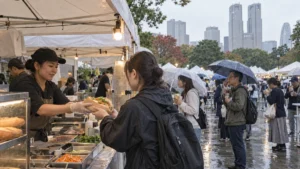
In Can Tho, the hub city of the Mekong Delta, a 13-year-old boy stands in front of a charcoal fire, flipping out banh xeo one after another. The boy's name is Nguyen Hoang De. Together with his mother, Le Thi Thuy Hang, 37, he runs a small shop in Thoi Long Ward. For travelers visiting Can Tho, it's a dish you can stop for between the floating market and the night market — one that serves up the local way of life just as it is.
One piece costs 13,000 dong (roughly ¥76, using an approximate rate of ¥1 = 170 dong). The simple flavor, topped with shrimp, pork, and freshly picked greens, fuels local customers' mornings.
A skill picked up by watching his mother, never formally taught
De didn't start making banh xeo because anyone told him to. According to his mother Hang, he somehow learned to cook it without ever being taught. "I was surprised he'd picked up how to make it without any instruction," she recalls. Seeing his mother work nonstop, he couldn't just stand by, so he took his place at the pan.
His technique belies his age. The boy describes the timing like this: "To cook it well, you have to pour the batter in the moment the oil gets hot. If the pan isn't hot enough, it won't turn out crispy." He says he can tell which pan a piece was cooked in just by looking at the finished result. Even the sense that charcoal-grilled banh xeo looks different is something he picked up on his own through daily repetition.
From day labor earning 100,000 dong to a shop that supports the family
The mother and son opened the shop in 2019. Before that, the Hang couple, who owned no farmland, worked day labor in other people's fields year-round. From morning until dusk they were covered in mud and exposed to rain and wind, yet still earned only about 100,000 dong (roughly ¥590) a day. The banh xeo shop became a literal lifeline that changed that way of living.
These days they go through 2–4 kg of flour a day, with a profit of 300,000–500,000 dong (roughly ¥1,800–2,900). They light the fire at 9am and are usually sold out by midday or early afternoon. The numbers may look modest, but compared to their days of day labor in the fields, it's a living the family has built with their own hands.
Cheap and packed with vegetables — high marks from local customers
The shop's reputation rests on regulars from the neighborhood. Tran Kim Son, 74, says, "The banh xeo here really suits my taste. It's cheap, comes with plenty of vegetables, and the shop is clean too. That boy is friendly, and skilled." Dinh Van Vuong, 43, gave it a score of 9.5 without hesitation.
A 13,000-dong piece comes with shrimp, pork, and a mountain of fresh raw vegetables. The greens are local leaves like rau cach and bang lang, picked fresh. Whatever's available locally goes out that day. It isn't flashy, but this single dish holds exactly what travelers look for in Vietnam's back alleys: what local people actually eat every day.
| Item | Details |
|---|---|
| Shop location | Thoi Long Ward, Can Tho City |
| One banh xeo | 13,000 dong (roughly ¥76) |
| Daily flour used | 2–4 kg |
| Daily profit | 300,000–500,000 dong (roughly ¥1,800–2,900) |
| opening hours | From 9am until sold out (late morning to early afternoon) |
| Opened | 2019 |
The exchange rate is approximated at ¥1 = roughly 170 dong. The actual yen amount will vary with exchange rate fluctuations.
So what exactly is banh xeo?
Banh xeo is a Southern Vietnamese specialty made by thinly frying a batter of rice flour, turmeric, water, and sometimes coconut milk, then filling it with shrimp, pork, and bean sprouts. "Xeo" mimics the sizzling sound the batter makes when it hits the hot pan. Eaten fresh off the pan, it's torn into bite-size pieces, wrapped in herbs and greens, and dipped in nuoc cham (a sweet-and-sour fish sauce dip). The Southern version is large, prized for the contrast between its crisp-fried edges and the freshness of the wrapped vegetables.
Even the same dish takes on a different character depending on who's cooking it and where. At a seaside food stall village in Da Nang, in central Vietnam, foreign visitors line up for banh xeo and nem lui (grilled skewered meat) (see our article on Da Nang's food stall village). What the Can Tho mother-and-son shop serves is a different kind of banh xeo from that tourist-facing style — one closer to an everyday meal.
Pairing Can Tho with its floating market
Can Tho is the gateway to Mekong Delta tourism, and most travelers come for the early-morning Cai Rang floating market. Small boats gather before dawn, and buying and selling fruit, noodles, and coffee right on the water is a morning scene unique to this region. The city also hosts food festivals, and it's become common to combine the night market with the morning floating market in a single overnight visit (see our article on Can Tho's food festival)。
. After seeing the floating market, get off the boat and grab breakfast at an alley food stall. A place like De's shop sits right along that route. Mekong mornings can get so busy that island-hopping boats have a two-hour wait on some days (see our article on Mekong boat trips). Once you've taken in the classic waterway scenery, venturing to a small shop where locals line up brings the shape of this place much closer.
A single street stall becomes a travel destination
In Vietnam, a single food stall or a single maker is increasingly becoming a reason to travel somewhere. Word spreads on social media, and people gather around who's making it and how, more than around the dish itself. The Can Tho mother-and-son shop has no fancy interior or tourist-oriented menu. All there is, is the fact that a 13-year-old stands at the charcoal fire, helping his mother, cooking one piece at a time. That, separate from price or taste, is reason enough to visit.
If you're putting Can Tho on your itinerary, build your visit around the floating market and night market, but also try to eat a piece of banh xeo in a local alley in the morning. A breakfast that costs about ¥76 a piece will teach you the texture of this city's daily life faster than anything else. Since the shop sells out, morning is your best bet.