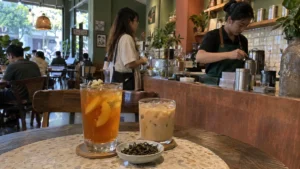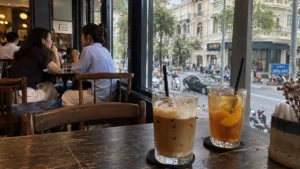
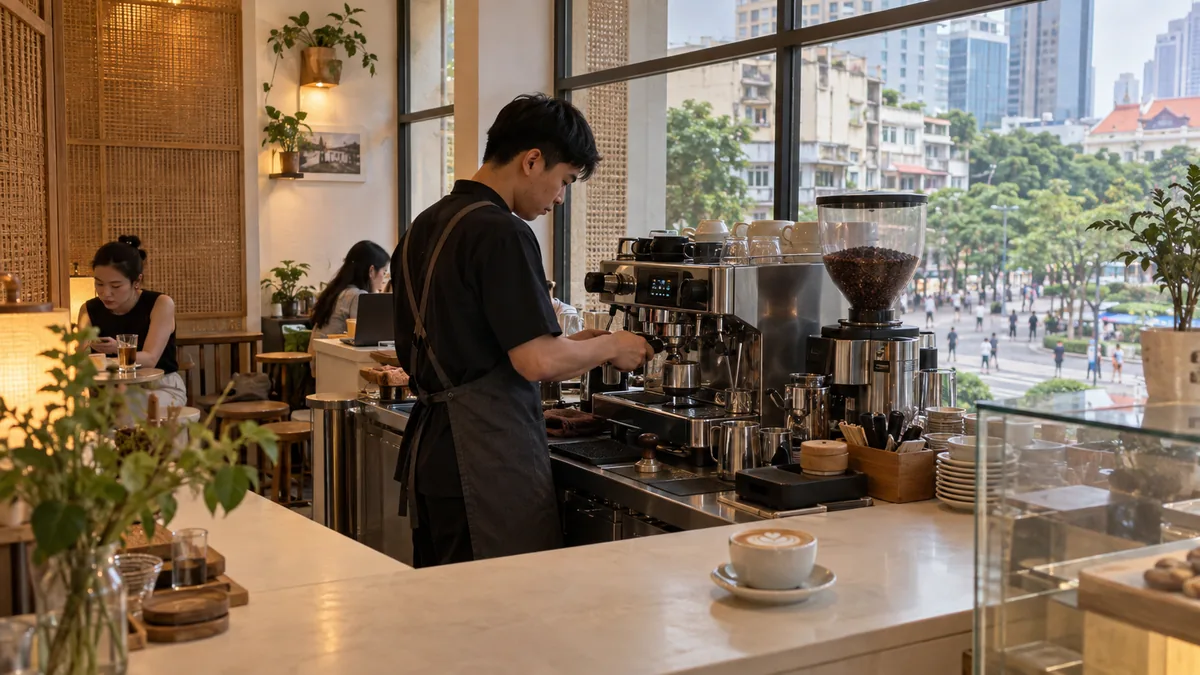
ホーチミンの%Arabicaは、白いミニマルな意匠と都市の景観を組み合わせた店舗です。ただし「京都らしさ」を感じるかは見る人次第で、空間の物語とコーヒーの味は分けて評価する必要があります。%Arabica(アラビカ)は、京都に拠点を置きながら20を超える国と地域へ広がったコーヒーブランドだ。基本情報やメニュー、地図は店舗ガイドにまとめているので、ここではブランドそのものの来歴と、ベトナム店がどんな考え方で京都の世界観を現地に置き換えたのかを掘り下げる。
A brand born in Hong Kong that headed to the world from Kyoto
%Arabica's journey does not begin and end in Kyoto. Founder Kenneth Shoji opened his first store in Hong Kong in 2013, and the following year, in 2014, opened the world flagship store at the foot of the Yasaka Pagoda in Higashiyama, Kyoto. The appearance of a small, white glass-walled store on a corner of the tourist-thronged Sannenzaka was, at the time, an unusual event in the coffee industry.
その後、ブランドは京都を本拠地に据えながら各地へ店舗を広げていく。店舗数と進出国は増減が早いため、2025年の「230店超」を現在値として扱いません。営業中店舗は%Arabicaの公式店舗一覧で確認してください。なかでも中国本土の店舗数が突出して多く、アジアを軸に成長してきた経緯がうかがえる。京都発のブランドが、派手な広告ではなく店の佇まいとカップのデザインで認知を広げてきた点は、コーヒーの世界では独特の道のりといえる。
The minimal design philosophy conveyed by the "%" mark
Something you can't leave out when talking about %Arabica is the "%" logo that gives the store its name. Combining the coffee bean variety "Arabica" with the percent sign, which evokes the ratio or blend of extraction, this mark is placed simply, just once, on both the sign and the paper cup. It strips away text and leaves a lasting impression with a single symbol. At its root is the subtractive thinking akin to Japanese minimalism.
The store spaces are built on the same philosophy. Materials such as white walls, solid wood, glass, and stainless steel are pulled together in a restrained number of colors, and the counter is opened up so that the very act of brewing coffee is visible. It is a design that leaves negative space rather than adding decoration. At the same time, the brand does not simply paste a globally shared template onto each location. Design studios at home and abroad, such as ciguë and nendo, are involved, incorporating the architecture and materials of the land where a store opens while keeping the shared language of white, wood, and glass. The sense that "every store looks the same, yet somehow different" comes from this design stance.
The phrase the brand champions is "See the World Through Coffee." The idea of moving between countries and cultures through a single cup of coffee is consistent in both its store-opening strategy and its space-making. The quiet you feel at the Kyoto store, and the local expression you meet at stores in various places: making both coexist within the same brand is at the core of %Arabica's worldview.
2024, arrival in Vietnam: the reason for choosing the café apartment
%Arabica first opened in Vietnam in 2024. The location is the upper floor of the "café apartment" facing Nguyen Hue Street in the center of Ho Chi Minh City. It is a building where an apartment complex built in the 1960s was revived, with each unit transformed into a café or goods shop, and it has become a landmark known to locals and travelers alike. Choosing an old building layered with the city's memories rather than a new commercial building reflects the brand's stance of trying to blend into the land.
Behind the choice of Ho Chi Minh City are its lively food culture and the speed of the city's growth. Nguyen Hue Street, bustling as a pedestrian zone, is a location that echoes the brand's store-opening sensibility of "setting up small in a place where people come and go," just like the flagship store in Higashiyama, Kyoto. Placing a store on a tourist route while making the space itself the destination. The Kyoto main store and the Vietnam store have completely different streetscapes and climates, yet you can see a shared way of thinking in how they choose their locations.
Bamboo craft and low seats: transposing Kyoto's white into Vietnamese texture
The Vietnam store was designed by ciguë, the French design studio that has also handled the Kyoto flagship and others. What is interesting here is that, while keeping the minimal framework typical of %Arabica, the interior incorporates bamboo craft made by artisans from northern Vietnam. The north around Hanoi is known as a producing region for bamboo craft, home to many artisans skilled in weaving. By working that handiwork into the space, a local texture was added to a store based on white and wood.
The low-seated chairs are another element that takes in the culture seen at street-corner cafés in Vietnam. The sight of sitting on small plastic stools to drink coffee is rooted in this country's everyday life. %Arabica translated that sense of sitting into the interior, tilting the lighting slightly warm to bring out the texture of the materials. Green plantings are placed too, bringing the warmth of the land into a minimal space that can otherwise feel cold.
If the Kyoto main store is designed to gently insert a white box into the Higashiyama scenery of rows of wooden machiya townhouses, then the Vietnam store leans toward local life with northern bamboo craft and low chairs while respecting the frame of an old apartment. The same brand changes its expression by location: it can be called an example of the phrase "See the World Through Coffee" made concrete at the level of space.
| Perspective | Kyoto Higashiyama flagship | Ho Chi Minh City store |
|---|---|---|
| Location | At the foot of the Yasaka Pagoda, on the tourist route of Sannenzaka | Upper floor of the café apartment on Nguyen Hue Street |
| A few minutes' walk from the square in front of St. Joseph's Cathedral | A corner of the historic scenery of rows of machiya townhouses | A building revived from a 1960s apartment complex |
| Local adaptation | A small white box blending into the streetscape of Kyoto | Bamboo craft by northern artisans, low seats, warm lighting |
| Shared materials | A minimal space based on white, solid wood, and glass | |
The philosophy of the space carries into the flavor of the cup
The talk has centered on design, but %Arabica is ultimately a specialty coffee brand. It handles everything from bean sourcing to roasting in-house and serves an espresso-based menu at near-identical quality across countries. Showing the act of brewing coffee in a space stripped of decoration also overlaps with the intent of drawing the eye to the flavor itself. The store design with plenty of negative space and the cup that makes the most of the ingredients are connected by the same subtractive thinking.
At the Vietnam store too, you can taste a cup that symbolizes the brand, such as the "Kyoto Latte" that bears Kyoto's name. Specific menus and prices are gathered in the store guide, so please use it as a reference for ordering. What to remember here is that the coffee in the glass and the bamboo-craft walls and low chairs surrounding it are designed not as separate things but as one experience.
訪問前に決めること
- 景観を楽しむのか、豆を比べるのか
- エスプレッソ、ラテ、ドリップのどれを選ぶか
- 混雑時に長居せず利用できるか
- 入口・階段・エレベーターなど建物の動線
ラテは飲みやすい一方、豆の産地差は分かりにくくなります。豆を知りたいならブラック、空間と一緒に気軽に楽しむならラテというように目的を分けるとよいでしょう。価格や限定豆は当日のメニューを優先してください。
Summary: Kyoto and Vietnam overlap beyond the cup
%Arabica is a coffee brand that began in Hong Kong in 2013 and Higashiyama, Kyoto in 2014, and has spread from its Kyoto base to more than 20 countries and regions. While keeping the shared language of the "%" logo and a minimal space of white, wood, and glass, it takes in the materials and life of each place. The Ho Chi Minh City store that arrived in 2024 is one example of transposing Kyoto's quiet into Vietnamese texture, combining bamboo craft by northern artisans and low seats with the frame of an old café apartment. When you hold a cup with the "%" mark on Nguyen Hue Street, spend just a cup's worth of thought on how that white cup connects to Higashiyama, Kyoto.
🗺️ For %Arabica's basic information, signature menu, map, and reviews, seeShop guide (card)where we've put it all together.
🗺️ If you also want to compare it with other cafés,Vietnam's 30 Popular Cafés: A Thorough Comparison Guidelets you browse from a single list.