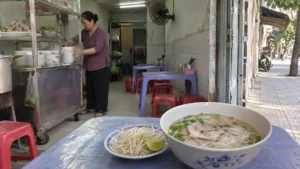
Over two days — September 26 and 27, 2026 — a "Vietnam Bánh Mì Festival" was held at Shinjuku Central Park in Nishi-Shinjuku, Tokyo. The Embassy of the Socialist Republic of Vietnam in Japan was listed as a co-organizer, and this marked the first time an event in Japan had placed bánh mì front and center. Organizers planned for around 30 food booths, and admission was free. The first day was unfortunately rainy, but Vietnam News Agency (VNA) reported that several thousand people attended. This is not simply a story about the growing number of Vietnamese restaurants in Japan. Vietnam has been systematically taking its food abroad as a national brand, and it is now Japan's turn in that sequence. For those who travel regularly to Vietnam or have lived there, it is also a signal that scenes familiar from the country itself are beginning to be reproduced in Tokyo.
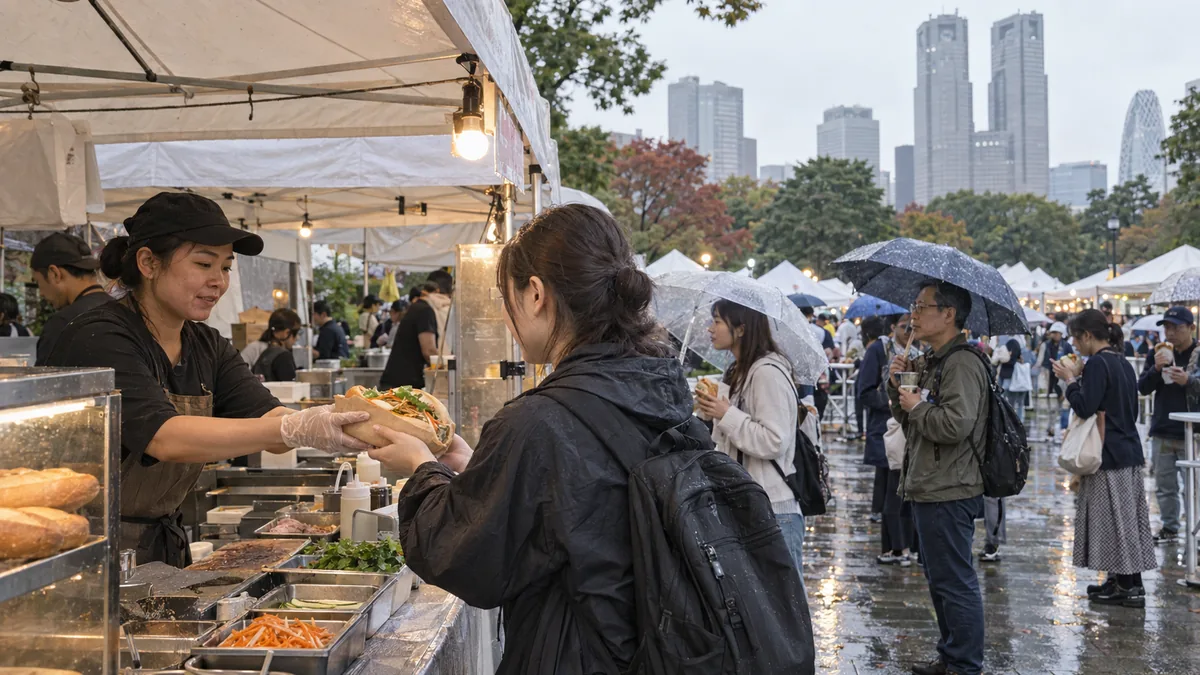
Held over two days at Shinjuku Central Park, with around 30 booths planned
The event ran from 11:00 to 20:00 on Saturday, September 26, and from 10:00 to 18:00 on Sunday, September 27. The venue was the Fun More Time Hiroba at Shinjuku Central Park (2-11 Nishi-Shinjuku, Shinjuku-ku, Tokyo). According to the park's directions, it is a 1-minute walk from Exit A5 of Tochomae Station on the Toei Oedo Line, and a 10-minute walk from the West Exit of JR Shinjuku Station. The event was co-organized by four parties: the Embassy of the Socialist Republic of Vietnam in Japan, Rhino Connect Co., Ltd., the Association of Vietnamese Traditional Arts and Culture in Japan (Betoraku), and iiMedia. It was supported by the Ministry of Foreign Affairs, the Ministry of Justice Immigration Services Agency, Shinjuku City, and the ASEAN-Japan Centre. Special sponsors were SMS Group and Vietnam Airlines, with Ohana Co., Ltd. and SENKYU Co., Ltd. listed as cooperating organizations. Organizers anticipated approximately 30 vendor booths and an attendance of 20,000 to 30,000 visitors.
The program included bánh mì and Vietnamese food booths alongside a live stage featuring traditional dance and folk music, star-shaped lantern making, painting nón lá (Vietnamese conical hats), áo dài try-on experiences, a craft market, and a stamp rally. Because the event coincided with the Mid-Autumn Festival, a lantern parade, lion dance, and mooncake tasting were also scheduled. The Mid-Autumn lion dance is a seasonal highlight across Vietnam, andin Hanoi, an underwater lion dance performance at an aquarium was plannedand ran through the same weekend. Nguyen Sau, Minister-Counselor at the Embassy of Vietnam in Japan, spoke at the opening ceremony and described bánh mì and coffee as two iconic Vietnamese foods gaining popularity in Japan and around the world, expressing hope that visitors would experience not only the food and drink but also Vietnamese culture and its people. The organizers indicated their intention to make the event an annual occasion.
What kind of square is the "Fun More Time Hiroba" venue?
Vietnamese media reports all referred to the venue in English as "Fun More Time Square," with no information given about its Japanese name. On investigation, this turns out to be the current name of the "Water Plaza" (Mizu no Hiroba) within Shinjuku Central Park. Shinjuku City operates a naming rights program for the plaza, covering the period from April 1, 2024 to March 31, 2029. The naming rights were acquired by the Shinjuku Subcenter Area Environmental Improvement Committee, made up of 19 private companies in the Nishi-Shinjuku area, and the nameFun More Time Hirobawas chosen based on the concept of "enjoying more time in the city." The committee also co-hosts an event with the Tokyo Metropolitan Government called "FUN MORE TIME SHINJUKU," which opens the Nishi-Shinjuku area to pedestrians, and the plaza's name comes from the same banner.
The choice of venue carries meaning. Among large Vietnam-related events in Japan, Yoyogi Park is the name most familiar to Japanese audiences, but this time the foot of the Tokyo Metropolitan Government Building was chosen instead. Nishi-Shinjuku has a large weekday working population, and on weekends the park's regular visitors mix with foot traffic from Shinjuku Station. It is also close to Shin-Okubo and Takadanobaba, where Vietnamese restaurants are concentrated. The organizers have not publicly stated their reasons for selecting the venue. Looking purely at the location's characteristics, it is a spot where an event can simultaneously serve the Vietnamese community in Japan and reach Japanese people with no prior exposure to Vietnam.
What goes inside a bánh mì?
Bánh mì is a Vietnamese word that refers to bread itself, and the sandwich made with it goes by the same name. Bread eating was introduced during the French colonial period; according to an explanation by the Nisshin Seifun Group, it was brought by the French during roughly 100 years of colonial rule. Vietnamese baguettes have a different texture from their French counterparts — the company describes them as having a thin crust with a clean bite, and a crumb so light it melts in the mouth.
As an explanation for this lightness, Japanese bread-making recipes and bánh mì specialty shop descriptions often mention blending rice flour into the wheat flour. However, explanations from flour manufacturers attribute the lightness to a high-hydration dough and steam during baking, without assuming the use of rice flour. While it is certainly true that some recipes do incorporate rice flour, no evidence was found to support the claim that all Vietnamese bánh mì contain it. For the buyer, it is more accurate to assume that the bread varies from shop to shop.
As for the fillings, a widely shared base consists of a spread of liver pâté, layers of ham and chả lụa (Vietnamese-style pork roll), pickled daikon and carrot (đồ chua), cucumber, fresh herbs such as cilantro, and chili. Beyond that, the contents vary by region. Reading through explanations from multiple Vietnamese bakeries and food businesses, the tendencies can be summarized as follows. Differences between individual shops are significant, and the table below represents typical examples only.
| type | Filling composition | Seasoning style |
|---|---|---|
| Hanoi style | A restrained selection: pâté, ruốc (pork floss), fried egg, chả lụa, and similar | Flavor built on the saltiness of the pâté and heat from chili |
| Saigon style | Multiple types of ham, roast pork, xíu mại (minced meat balls), and other ingredients layered generously | Combined with butter sauce, mayonnaise, and house-made sauces |
On the question of crust thickness, some sources say Hanoi's is thinner while others say Saigon's is thinner, and since no conclusion could be reached, it is not included here. Another regional variation that cannot be overlooked is Bánh Mì Phượng in Hội An in central Vietnam — a shop that started as a market stall and became internationally known after being featured on Anthony Bourdain's program No Reservations in 2009. The pattern of a single outsider's word transforming a single shop isvery similar to the story of Bill Clinton stopping in at Phở 2000 in Saigon.
What did the vendors, the embassy, and the organizers say?
Nguyen Khanh Ly of the organizing committee said she wants to bring Vietnamese food — and bánh mì in particular — into the everyday lives of Japanese people. This is a different aim from a product fair targeting tourists; it means going after food habits rather than memories.
Vendors also had their say. As reported by a media outlet affiliated with Vietnam's Ministry of Foreign Affairs, Tonozuka Rikako, owner of Ba Ba Banh Mi, noted that the shop has been open for about five years and that its bánh mì are priced in the 750–850 yen range. In Japan's dining-out market, this price point is acceptable for a specialty sandwich shop, but placed alongside convenience store bread or a bowl of gyūdon, it reads as expensive. How to bridge that gap remains a challenge for permanent shops.
A notable feature of the embassy's remarks was the pairing of bánh mì with coffee. Minister-Counselor Nguyen Sau positioned the two as Vietnam's representative foods gaining popularity in Japan and worldwide. Presenting a drink and a food together as a set is a recurring pattern in Vietnamese food promotion — it treats coffee not as a standalone export commodity but as an entry point into food culture.
One more point worth recording, regarding how the numbers should be read: organizers had projected 20,000 to 30,000 visitors over the two days, but what VNA reported about the first day was "several thousand people." The first day was rainy, and the event ran for two days. However, the 20,000–30,000 figure was the pre-event estimate for the full two-day run, while "several thousand" was what VNA reported partway through the first day. Total attendance for both days was not announced, so the two figures cannot be placed side by side to judge success or failure. The only fact that can be stated is that the first day was rainy.
Events have been rolling out one by one: phở, coffee, bánh mì
Events that put a single Vietnamese dish front and center have been held in succession over the past several years. The organizing bodies are different in each case, however, and no documents have emerged showing that the government planned and sequenced them. Laid out in chronological order, the timeline looks like this.
Phở came first. December 12 is "Phở Day" (Ngày của Phở), and on December 12, 2018, Tuổi Trẻ newspaper received an intellectual property decision recognizing that date's designation. The first overseas edition was held in Japan: Vietnam Phở Festival 2023 took place on October 7 and 8, 2023, at Yoyogi Park. It was organized by Tuổi Trẻ and Saigontourist Group, with the Embassy of Vietnam in Japan as a supporting body, and was positioned as a commemorative event for the 50th anniversary of diplomatic relations between Japan and Vietnam. Coffee came next, advancing on two fronts simultaneously — as an export commodity and through the expansion of café outlets.
And now bánh mì. "Bánh mì" has an entry in the Oxford English Dictionary; the entry was first published in March 2011, and the earliest recorded usage cited is from the San Francisco Chronicle in 1985. The Vietnamese side treats the OED inclusion date as March 24, 2011, counting 2026 as the 15th anniversary. In Ho Chi Minh City, the 4th Vietnam Bánh Mì Festival was held from April 23 to 26, 2026, at Lê Văn Tám Park, with 150 booths and an expected attendance of over 200,000. It was organized by the Ho Chi Minh City Tourism Association, the Vietnam Culinary Culture Research, Preservation and Development Center, and the Ho Chi Minh City Journalists Association, under the theme "Vietnamese Bánh Mì — World Culinary Value, to the Five Continents." The Tokyo debut came five months after Ho Chi Minh City's fourth edition. That is how the timeline lines up, but no documents have been found indicating a plan to develop the event domestically before taking it abroad.
For readers who travel regularly to Vietnam, there are two practical takeaways. First, the schedules of single-dish festivals held in Vietnam can serve as a guide when looking for related events in Japan. Second, these events offer a rare chance to compare shops run by Vietnamese residents in Japan with Japanese specialty shops billing themselves as serving authentic flavors — all in one place. The list of vendors published by the organizers included names such as BANH MI XIN CHAO in Kaminarimon, Taitō-ku; nico bánh mì in Nihonbashi Kobunacho, Chūō-ku; TOKYO BANH MI STAND in Hirakawachō, Chiyoda-ku; SAIGON – BÁNH MÌ VIỆT in Izumi-ku, Yokohama; and CHAN BAKERY in Kawagoe. Shops that would normally require trips across Tokyo, Saitama, Chiba, and Kanagawa gathered in the same plaza for just two days.
How far has bánh mì come in the Japanese market?
The potential audience can be pinned down with statistics. According to the resident foreign nationals figures published by the Immigration Services Agency on March 27, 2026, covering the end of December 2025, the total number of foreign residents exceeded 4 million for the first time, reaching 4,125,395. By nationality, Vietnam ranked second at 681,100 (up 46,739 from the end of the previous year), behind China in first place at 930,428, and ahead of South Korea in third at 407,341. Vietnam also ranks among the top countries by net increase.
No official statistics exist for the number of shops, so industry association estimates must be relied upon. According to the Japan Bánh Mì Association's 2026 survey, as of the end of 2025 there were 215 brick-and-mortar specialty shops, 144 food truck specialty operations, and 240 shops handling bánh mì, for a total of 599 locations. The same association's figures from a year earlier put the end-of-2024 total at approximately 540 locations, suggesting an increase of around 60 in one year. The association also cites roughly fourfold growth over 10 years and 36-fold growth over 15 years. The pattern of new openings, it notes, splits between locally oriented specialty shops appearing in industrial areas and student neighborhoods with large Vietnamese resident populations, and Japanese-adapted shops opening in city centers and tourist areas. It should be noted that the association's materials describe the Vietnamese resident population as "exceeding 600,000," which does not align with the 681,100 figure above due to a difference in reference dates. The location count is also an industry association tally rather than an official statistic, so it should be read with some margin. The association announced the results of its "Best Bánh Mì 2026" ranking in August 2026, noting that nearly 200 shops nationwide were considered as candidates.
Events are also gaining depth. The Vietnam Festival at Yoyogi Park began in 2008 and reached its 18th edition on May 30 and 31, 2026. Organized by an executive committee and the Embassy of Vietnam in Japan, it drew 140,000 visitors in 2025 and set a target of 180,000 for 2026. In Kanagawa, Vietnam Festa in Kanagawa 2026 was held on September 12 and 13 along Nihon-odori, at the Kanagawa Prefectural Government Main Building, and at Zou-no-Hana Park. Vietnam Airlines appeared as top sponsor at the Kanagawa event and as a special sponsor at the Shinjuku bánh mì festival two weeks later. The airline attached its name to two consecutive autumn events, suggesting that food events are being treated as a channel for generating passenger demand.
Where and for how much can you eat bánh mì — in Japan and in Vietnam?
First, on upcoming opportunities: this event has already ended, and while the organizers have indicated their intention to make it annual, no date for 2027 has been announced. Among major Vietnam-related events with predictable schedules, there is the Vietnam Festival at Yoyogi Park (May 30–31 in 2026) and Vietnam Festa in Kanagawa in September. For those aiming to attend events in Vietnam itself, the Ho Chi Minh City Bánh Mì Festival is held in late April (April 23–26 in 2026).
For a permanent dining option, Vietnamese restaurants are concentrated around Shin-Okubo and Takadanobaba in Tokyo — areas with large student and resident Vietnamese populations where locally oriented shops tend to survive. As a price reference, Ba Ba Banh Mi, which participated in this event, charges 750–850 yen.
The following is a summary of price ranges for eating bánh mì in Vietnam. The exchange rate used is1 yen = approximately 164.7 dong (as of September 28, 2026), making 10,000 dong approximately 61 yen.
| Where to buy | Local price | Approximate yen conversion |
|---|---|---|
| Street stalls and hawkers (lowest-price examples) | 5,000 dong | About 30 yen |
| Well-known high-end shops with queues (Huỳnh Hoa in Saigon / "Special" on the official menu board) | 61,000–78,000 dong | Approximately 370–474 yen |
The 5,000-dong figure refers to an elderly woman hawker cited by Thanh Niên newspaper as selling "the cheapest in the country" — it should not be taken as a standard. A bánh mì from the high-end shop is a different kind of purchase from one bought at a street stall, and is closer in feel to eating out in Japan.Compared with a shop in a Hanoi alley serving bánh cuốn for 89 yen a plate, bánh mì sits somewhere in the middle to slightly above average among Vietnamese light meals. If you are unsure what to order, the quickest approach is to start with one basic bánh mì containing pâté and chả lụa and assess the bread. If the bread comes out light and crisp, it is worth ordering the more expensive version with extra fillings. In Hong Kong, the bánh mì specialty shop Bánh Mì Nếm has earned a Michelin Selected listing — one example of how this dish is no longer confined to the street food category.
Summary: Where to eat next, and what to keep an eye on
The Tokyo Bánh Mì Festival wrapped up after two days, but there are points worth holding onto. For those looking for the next opportunity, Vietnam's own calendar moves faster. The Ho Chi Minh City Bánh Mì Festival is in late April, Phở Day falls on December 12, and the Vietnam Festival at Yoyogi Park comes at the end of May.
For eating in Tokyo, it is worth separating locally oriented shops from adapted ones and visiting both. Shops in Shin-Okubo and Takadanobaba and specialty shops near major terminal stations may share the same name on the menu but serve quite different things. And the next time you go to Vietnam, try comparing the bread before the fillings. The filling combinations differ between Hanoi and Saigon, and Hội An has the shop made famous by a television program. Eating bánh mì in all three cities makes what was described as a single dish appear as three distinct ones.
Finally, it is worth watching whether this event becomes annual. A lineup in which the embassy sits on the organizing committee, the Ministry of Foreign Affairs and the Immigration Services Agency appear as supporting bodies, and an airline signs on as sponsor has a different character from a private trade fair. If a second edition is held in 2027, it will provide a measure of whether there is enough demand in Japan to sustain a dedicated bánh mì event on its own.
Sources
- VnExpress International・Vietnam banh mi festival held for first time in Japan
- VietnamPlus・Vietnamese banh mi takes centre stage at first festival in Japan
- The World and Vietnam Report・First Vietnamese Banh Mi Festival in Japan
- Planning Office SMS Co., Ltd. · 'Vietnam Bánh Mì Festival' to Be Held on September 26–27, 2026
- Vietnam Airlines Japan Branch · Sponsoring and Exhibiting at Two Major Events Celebrating Autumn Vietnamese Culture
- Nishi-Shinjuku LOVE WALKER · Shinjuku Chuo Park's Water Plaza Renamed 'Fun More Time Hiroba'
- Immigration Services Agency · Number of Foreign Residents in Japan as of End of 2025
- Japan Bánh Mì Association · Market Size Research Report on Bánh Mì (2025 Edition)
- VIETJO Vietnam News · Japan Bánh Mì Association Announces Three 'Best Bánh Mì 2026' Award-Winning Shops
- Ho Chi Minh City Electronic Information Portal · Lễ hội Bánh mì Việt Nam lần thứ 4
- Thanh Niên・Bánh mì Việt Nam: Từ ổ bánh giá 5.000 đồng đến tiệm được Michelin vinh danh
- Tuổi Trẻ・Vietnam Phở Festival 2023 ở công viên Yoyogi
- Vietnam Festival 2026 Executive Committee · Event Overview
- Nisshin Seifun Group · A Journey Through Bread, Recipe vol.1: Bread and Meat — Vietnamese Bánh Mì
- Planning Office SMS Co., Ltd. · Two Days of Vietnamese Culture: Full Details of the 'Vietnam Bánh Mì Festival' Revealed! (September 16 Edition)
- Oxford English Dictionary・banh mi, n.
- Vietnam Bánh Mì Festival Official Website
- Shinjuku Chuo Park Official Website · Access
- Bánh Mì Huynh Hoa Official Website · Menu
- Japan Bánh Mì Association · Market Size Research Report on Bánh Mì (2026 Edition)